Guides
OpenMeter vs Stigg (2026): One Platform or a Runtime Layer?
OpenMeter vs Stigg, compared on metering, entitlements, credits, and billing connection. See how each is hosted and when each one fits your AI product.

Compare 7 OpenMeter alternatives for usage metering, AI credits, and billing. Explore features, pricing, deployment options, and limitations.

Kong's acquisition of OpenMeter in September 2025 changed how companies access its managed service, now called Konnect Metering & Billing. The open-source project remains available, but the new setup gives teams a reason to explore other options.
Stigg fits AI products that need credits and limits enforced on every request, while Lago and Flexprice suit teams that want open-source billing.
We compare seven OpenMeter alternatives by features, pricing, deployment, and limitations to help you find the right fit.
OpenMeter became part of Kong in September, 2025. The acquisition brought its usage metering, billing, and entitlement technology into Kong's API management portfolio.
OpenMeter Cloud is now called Konnect Metering & Billing. The open-source project remains available under Apache 2.0, so teams can continue operating the software themselves.
OpenMeter already handles CloudEvents ingestion, usage aggregation, billing, and real-time entitlement checks. Its entitlement system supports boolean, static, and metered access rules, including credit grants, balances, and spending limits.
The acquisition gives companies four practical reasons to review their options:
OpenMeter remains a reasonable choice for existing users. Its permissive license and real-time entitlement system are valuable, particularly if you’re comfortable running its infrastructure or already invested in Kong products.
The right OpenMeter alternative depends on what your team needs to manage. Some tools give you more control over metering infrastructure, others handle complex billing, and a few focus on AI credits and usage limits.
Here's how to narrow down your options:
Stick with OpenMeter if your current meters, entitlements, and integrations already cover your needs. If you're comfortable with its infrastructure and the move to Konnect doesn't affect your setup, migrating may add work without solving a pressing problem.
The table compares deployment, licensing, and published pricing across the seven options.
| Platform | Best for | Deployment and license | Published price |
|---|---|---|---|
 Stigg |
AI credits and usage enforcement | Cloud, BYOC, or BYODB; commercial | Free Build; Pro $399/mo annually or $499 monthly; Scale custom; BYOC from $40K/yr |
 Lago |
Open-source usage billing | Self-hosted AGPLv3 or Cloud | Free self-hosted; Cloud Launch 0.7% of billings + $20 per 1M events after allowances |
 Flexprice |
Open-source metering and credits | Self-hosted AGPLv3 or Cloud | Free open source; Launch $99/mo; Growth from $500/mo + 0.40% of billing; Scale custom |
 Metronome |
Complex usage contracts | Hosted; commercial | 0.8% of billing volume + $0.04 per 1K events |
 Amberflo |
AI cost and margin tracking | Hosted; commercial | Essential and Custom; current quote required |
 Stripe Billing |
Stripe-native metered billing | Hosted; commercial | 0.7% of Billing volume |
 Kill Bill |
Self-hosted subscription billing | Apache 2.0 self-hosted; paid Aviate | Free open source; Aviate $9,999/mo annually |
Disclaimer: Prices are subject to change without notice. Always visit the official company websites for the most up-to-date pricing information. Figures may exclude infrastructure, payment processing, and implementation fees.
Stigg provides a usage runtime for AI products, combining metering, entitlements, credit management, and spending controls within an application.
OpenMeter also supports real-time entitlements. Stigg takes a different architectural approach with cache-backed checks, configurable credit operations, and components that can be adopted independently.
Consider an AI task that consumes a variable number of tokens or GPU seconds. The final cost may be unknown when execution begins. Stigg can reserve credits before the task and settle the balance once consumption is measured.
The application can also apply budgets to users, departments, or agents sharing the same credit allowance.

Stigg offers three deployment options: Cloud, Bring Your Own Cloud (BYOC), which runs the usage runtime inside your own VPC, and BYODB, where Stigg writes to your own database and event queue.
How your application checks entitlements depends on your stack. Node.js apps can use Stigg's SDK to run checks in-process. Other languages connect to the Sidecar, a Docker container that communicates with your app over gRPC.
The Sidecar caches entitlement data locally for fast checks, with Redis available as an option. On a cache miss, it calls Stigg's Edge API using a configurable timeout. If the API is unreachable, it checks cached data before applying your fallback defaults.
Stigg's pricing starts with a free Build plan covering 10,000 managed entities and 5 million monthly usage events. Pro is listed at $399 per month with annual billing or $499 on monthly billing. It includes 25 million monthly events and 10,000 managed entities before graduated charges.
Scale uses custom pricing. BYOC is priced as a fixed license starting from $40,000 per year, with no per-event billing because events run on your own infrastructure.
Stigg suits AI products selling tokens, API calls, inference usage, or agent actions, especially when multiple users or agents consume from shared balances.
It's also useful for companies that want to add usage controls without changing their existing payment and billing systems.
Lago is an open-source usage billing engine that connects event metering, pricing calculations, subscriptions, and invoicing. Its API-first design gives engineers control over billing workflows and how they connect to payment providers, CRMs, and accounting software.
Lago offers both self-hosting and managed Cloud deployment. Teams can choose the operating model that fits their infrastructure and support requirements.

Lago's open-source edition uses AGPLv3 and supports self-hosting. Lago Cloud runs the managed service. Enterprise agreements can include customer VPC or on-premises deployment options.
Lago's pricing includes a free self-hosted edition. Cloud Launch has no minimum commitment and provides one-time allowances for $100,000 in processed billings and 5 million accepted production events.
After the respective allowances, pricing is 0.7% of processed billings plus $20 per million accepted production events. The next Cloud tier has a $12,000 annual minimum commitment, and enterprise terms are custom.
Lago suits engineering teams that want metering and invoicing through an open-source billing engine. Its strongest fit is a company that needs control over billing integrations and has the technical resources to operate a self-hosted deployment.
Flexprice combines metering, credit wallets, and billing in an open-source product aimed at AI and API companies. It can collect consumption events, apply pricing rules, and turn the resulting usage into invoices. Credit-based products can also track prepaid balances and top-ups.
Flexprice is a close alternative for teams looking to replace OpenMeter's metering infrastructure with an engine that includes billing and credit workflows.
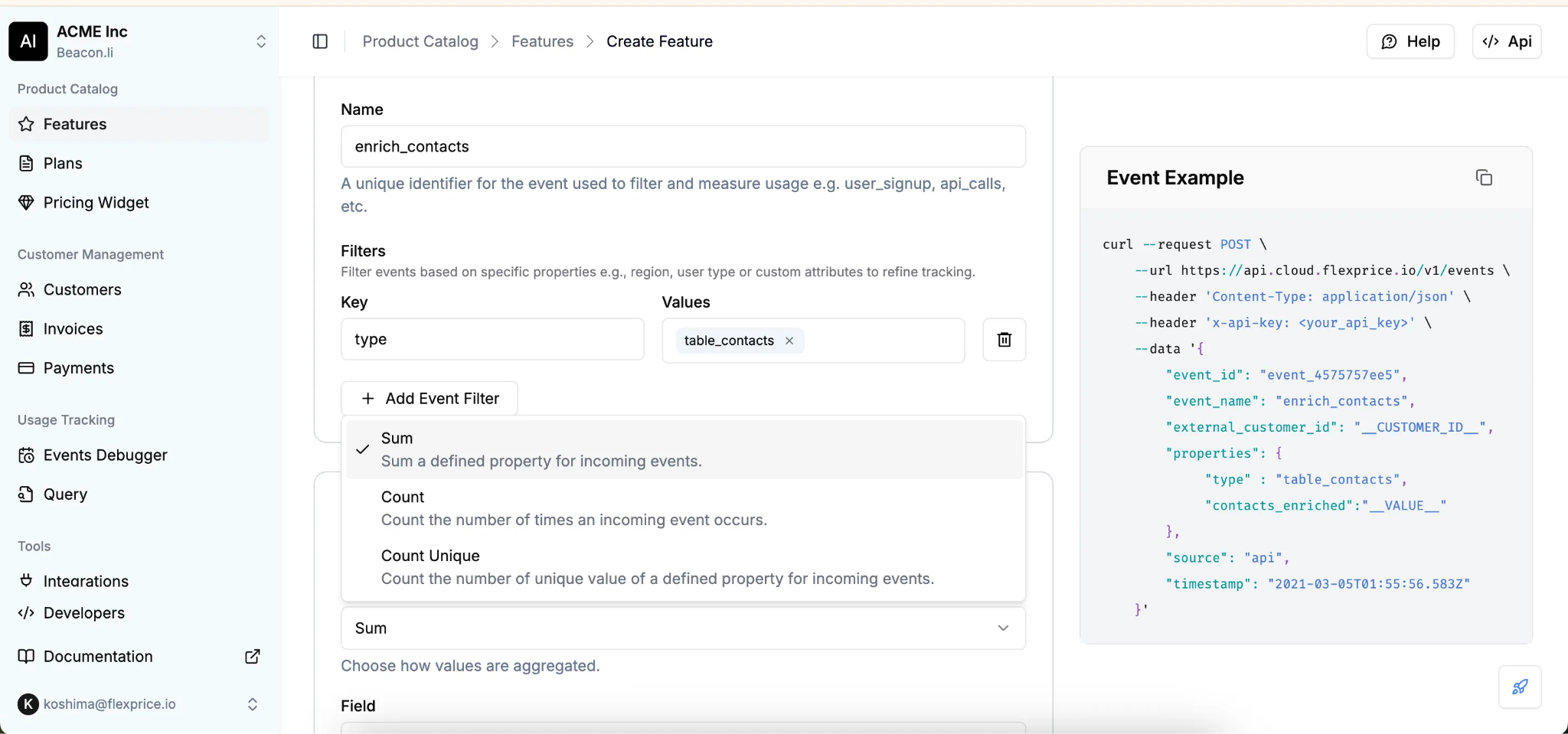
Flexprice offers Cloud and self-hosted deployment, and its core repository uses AGPLv3. The self-hosted architecture includes PostgreSQL, ClickHouse, Kafka, Temporal, Redis, and object storage.
Running the product internally requires engineers to operate those dependencies. Commercial plans also provide managed infrastructure and additional enterprise features.
Flexprice's pricing starts with Launch at $99 per month, covering up to $300,000 in billing volume. Growth starts at $500 per month plus 0.40% of billing and includes up to 50 million usage events per month. Scale uses custom pricing.
The open-source engine is free to self-host, excluding infrastructure and operational costs.
Flexprice fits AI and API products that want open-source metering alongside prepaid credits and billing. It's particularly relevant to teams comfortable operating the supporting infrastructure or using Flexprice Cloud.
Metronome handles usage billing where contract terms vary between customers. It supports rate cards, minimum commitments, credits, and negotiated pricing amendments.
A customer might agree to a prepaid commitment with discounted overages. Another might have an amendment taking effect halfway through a billing period.
Metronome handles these arrangements through configurable usage metrics and contract rules. It's part of Stripe and connects with Stripe's payment services.

Metronome is a hosted commercial service and does not advertise an open-source self-hosted edition.
Metronome's pricing lists Starter at 0.8% of billing volume plus $0.04 per 1,000 ingested events. Custom plans require a quote and include additional integrations, data exports, and enterprise support options.
Metronome fits AI and infrastructure companies with customer-specific contracts, especially when commitments, pricing amendments, and invoicing need to remain consistent.
Companies considering other contract billing platforms can also compare the options in our Metronome alternatives guide.
Amberflo connects usage metering with AI cost tracking and billing. It helps teams understand how much each customer, agent, or workload costs to operate and how those expenses compare with revenue.
For AI products using several models or infrastructure providers, cost attribution is important as two customers consuming similar amounts of usage may have different underlying costs. Amberflo brings those figures into the same system used for pricing, credits, and billing.

Amberflo is a hosted commercial platform. Its Custom plan advertises advanced security and deployment options. Specific private-network arrangements require confirmation with Amberflo.
Amberflo's pricing page currently presents Essential and Custom plans without standard monthly amounts.
The page also contains older fixed-price plan listings. Since both structures appear on the website, buyers should confirm the current plan and price directly with Amberflo.
Amberflo suits AI companies that need customer-level profitability information alongside metering and billing. Its cost attribution capabilities are particularly useful when model selection, workloads, or provider charges affect product margins.
Stigg's Amberflo alternatives comparison covers other metering and billing options.
Stripe Billing lets companies add usage-based charges to existing Stripe subscriptions. Its native meters collect consumption events, calculate billable usage, and feed the results into subscription invoices.
If Stripe already handles customer payments, the billing team can work within the same product ecosystem. Stripe also offers Metronome for advanced usage contracts requiring negotiated rates and more detailed pricing rules.

Stripe Billing is a hosted commercial service operating within Stripe's payment and billing ecosystem.
Stripe Billing's pricing starts at 0.7% of Billing volume on pay-as-you-go. Stripe also offers annual subscriptions paid monthly, starting at $620 per month for up to $100,000 in monthly Billing volume. Payment processing and additional Stripe products have separate charges.
Stripe Billing suits products already collecting payments through Stripe that need subscription and consumption charges on the same invoices.
Its native meters work well for common usage-pricing requirements, with Metronome available for more involved commercial contracts.
Kill Bill is an Apache 2.0 billing and payments engine that companies deploy and operate themselves. The open-source product handles subscriptions, invoicing, payment workflows, and usage records. Engineers can connect payment gateways or add custom billing logic through its plugin system.
For raw-event metering and prepaid credit wallets, Kill Bill offers the commercial Aviate edition.

Kill Bill's open-source engine uses Apache 2.0 and runs in the customer's cloud or data center. Aviate is commercially licensed and operates on top of the self-hosted Kill Bill engine.
Kill Bill's pricing lists the open-source engine as free under Apache 2.0. Aviate costs $9,999 per month, paid annually, with a 12-month minimum contract. Infrastructure, payment gateway fees, and internal operations remain separate costs.
Kill Bill suits companies that want control over subscription billing and payment integrations, supported by an engineering team comfortable running production billing infrastructure.
Migrating off OpenMeter starts with preserving your usage data and billing rules. You'll need to carry over events, meters, entitlements, and credit balances, then check that the new platform produces consistent results.
Here's how to approach the migration in 4 steps:
Watch for late events and billing corrections. Differences in event timing or aggregation can affect totals, even when the pricing rules match.
Stigg's usage metering guide explains how event ingestion and aggregation affect billing accuracy.
Choose an OpenMeter alternative by testing how it handles your actual usage and billing requirements. Start with a representative customer account and follow its consumption data through metering, credit calculations, and invoicing.
The table highlights the most useful checks for different needs:
| Requirement | What to test | Tools to compare |
|---|---|---|
| Request-time enforcement | Access checks, shared credit budgets per user, team, or agent, depleted balances, latency, and fallback behavior | Stigg, OpenMeter, Flexprice |
| Open-source deployment | License terms, infrastructure dependencies, upgrades, and support | Lago, Flexprice, Kill Bill |
| Complex usage contracts | Commitments, negotiated prices, effective dates, and invoice corrections | Metronome, Lago, Flexprice |
| AI cost visibility | Cost attribution, customer margins, budgets, and model-level spending | Amberflo |
| Existing payment integrations | Subscription synchronization, payment collection, and invoicing | Stripe Billing, Lago, Kill Bill |
| Operating costs | Monthly fees, event allowances, billing-volume charges, and infrastructure | All seven platforms |
Before choosing a platform, put its metering and billing rules to the test. Send the same event twice, report usage after a billing period closes, and simulate two AI agents drawing from one credit balance. Check whether the resulting charges and balances stay accurate.
Also, calculate what a typical month would cost using your event volume, billing amount, and hosting requirements. A free license or low starting fee can still come with infrastructure costs or usage-based charges.
For more options, compare Stigg's usage-based billing software guide and metered billing software roundup.
Switching from OpenMeter should solve a specific problem. You might want to spend less time operating your metering infrastructure, support more complex billing contracts, or manage AI credit consumption without building the logic yourself.
Each of the seven OpenMeter alternatives approaches those needs differently.
The biggest consideration is how much engineering work your team can take on. A self-hosted engine gives you control over deployment, while a managed platform handles more of the infrastructure. Existing OpenMeter users may find their current setup already does the job.
If agents can drain a shared credit balance faster than your limits catch up, that's a sign enforcement belongs in the request path. Stigg's documentation shows how the runtime sits alongside your billing provider, or you can talk to the team about your stack.
Yes, Kong announced its acquisition of OpenMeter on September 3, 2025. OpenMeter's managed offering is now Konnect Metering & Billing, part of the Kong Konnect platform.
Yes, OpenMeter remains open source under Apache 2.0 following Kong's acquisition. Companies can self-host the project, with their own infrastructure and operational responsibilities.
The best OpenMeter alternatives for AI usage metering include Stigg, Lago, Flexprice, Metronome, Amberflo, Stripe Billing, and Kill Bill. Stigg focuses on AI credit management, Lago and Flexprice provide open-source options, and Amberflo offers customer-level cost tracking.
Yes, Lago, Flexprice, and Kill Bill offer free open-source editions. Stigg's Build plan includes 10,000 managed entities and 5 million monthly usage events. Self-hosted options still carry infrastructure costs.
Stigg can cover OpenMeter's metering and entitlement functions for supported use cases, with migration work required for existing rules and balances. Stigg can operate alongside a billing provider and also offers native invoicing. Payment processing and tax calculation remain with external services.