%20(1).png)
Guides
Best Metered Billing Software: 9 Tools Ranked (2026)
I tested 9 metered billing software platforms for metering accuracy, pricing, and real-time enforcement, with honest pros, cons, and prices for 2026.

Compare 9 Amberflo alternatives built for engineers. Learn more about which tools make billing simpler and which ones just push logic into your codebase.


A usage spike hits on a Friday. The customer is on a 10,000 credit plan. The system processes 40,000 requests before anyone notices because the enforcement check runs after the fact instead of in the request path. The overage lands on the next invoice and the customer disputes it.
Most billing tools stop at metering and leave enforcement to you. I compared 9 Amberflo alternatives to find out which ones handle both, and what the gap costs when they don't. If you need Amberflo alternatives for enterprise metering specifically, start with m3ter and Metronome, the two options here built around high-volume usage.
| Tool | Strengths | Best for | Limitation | Starting price |
|---|---|---|---|---|
| 1. Togai | Strong data transformation and pricing logic inside the billing layer | Teams with complex, non-standard billing models | No entitlements or real-time enforcement layer | Usage-based, no upfront fees |
| 2. Metronome | Precise metering with rate cards and commitment contracts | Engineering-led teams managing billing in pipelines | Pricing changes require engineering, no runtime enforcement | Free starter plan, custom pricing |
| 3. Orb | Fast setup with simple usage metering and a clean data model | Startups getting started with usage-based billing | Limited support for complex pricing, may require migration later | Custom pricing across multiple tiers |
| 4. Chargebee | Full subscription lifecycle and payment infrastructure | Subscription businesses with global payment needs | Weak for usage-based logic and real-time control | Free tier, paid plans from ~$599/month |
| 5. Maxio | Strong contract billing and finance-aligned workflows | Finance-heavy SaaS with complex revenue recognition | Complex setup, slower iteration for engineering teams | Starts at $599/month |
| 6. m3ter | High-scale ingestion, rating, and billing accuracy | High-volume usage-based billing at scale | Learning curve and higher cost | Custom pricing based on usage |
| 7. Lago | Open-source control and self-hosted flexibility | Teams wanting full infrastructure ownership | Requires setup, maintenance, and engineering ownership | Custom pricing across different plans |
| 8. Stripe | Clean APIs, strong integrations, reliable billing foundation | API-first teams building on payments | No entitlements or feature-level enforcement | 0.7% usage |
| 9. Zuora | Enterprise-grade billing with multi-entity and compliance support | Large orgs with complex billing and finance requirements | Heavy implementation and operational complexity | Custom pricing based on billing volume |
I looked at these Amberflo alternatives the same way I would evaluate them for a real system.
Where does the logic live, how fast can you change pricing, and how much of it ends up in application code?
I focused on the parts that tend to break first once usage-based pricing moves beyond a single metric.
Here’s what I looked at:
The biggest difference came down to boundaries. Some tools stop at metering, others stop at billing, and the remaining logic ends up in the codebase. These boundaries drive long-term engineering cost.
Billing records what has already happened. The usage runtime decides whether a request is allowed to happen at all, in real time, while the request is still executing.
Most tools in this guide handle billing well. They record usage and generate invoices reliably. The friction shows up during usage itself, when your system needs to decide whether a customer can access a feature or keep consuming resources. That decision has to happen synchronously, on every request, at low latency. Billing infrastructure was not designed for this.
Most teams build that enforcement logic in-house early on. For a single product with a handful of plans, that's the right call. A few checks in middleware will hold for a while. The problem starts when the model grows:
Every change routes through engineering. The logic spreads across services until no single place owns it.
A usage runtime sits between your product and billing stack and resolves access state, current usage, and usage limits in one place. It runs synchronously before your application responds. Billing continues to track usage and generate invoices, while the usage runtime handles what is allowed.
| | Billing | Usage runtime |
|---|---|---|
| What it tracks | Usage events | Access state |
| When it runs | After usage | During usage |
| What it produces | Invoices and payments | Runtime decisions |
| Who it serves | Finance | Engineering |
These layers solve different problems and work best when they stay separate. Trying to push runtime decisions into billing usually ends up with that logic scattered across services anyway.
You likely have a usage runtime problem if:
Stigg is one example of this layer: entitlement checks at P95 under 100ms, a credit ledger with financial-grade correctness, and budget allocation across users, agents, and org hierarchies without custom code paths.
At scale, with AI agents running autonomously across customer accounts, deferred enforcement becomes a liability. The check has to happen in the request path, or the overage has already happened.
With that in mind, here are the top Amberflo alternatives and how each one handles metering, billing, and the boundaries around them.
What it does: Togai is a usage-based metering and billing platform that ingests raw events, transforms them into billable metrics, and handles pricing and invoicing.
Best for: Engineering teams dealing with non-standard billing scenarios like complex data transformations, multi-timeline pricing plans, or conditional billing logic.
Togai stands out in how it handles data transformation by letting raw events come in as they are and converting them into billable units like minutes or SMS segments using formulas you define, so that logic stays in the billing layer instead of spreading into your application code.
| Pros | Cons |
|---|---|
| Data enrichment keeps transformation logic out of application code | No entitlements enforcement layer; feature access control requires a separate tool |
| Pricing rules add conditional billing logic that most metering platforms lack | Complex features may be overkill for simple billing models |
| High-throughput ingestion with idempotency and reprocessing built in | Custom workflows can increase maintenance overhead |
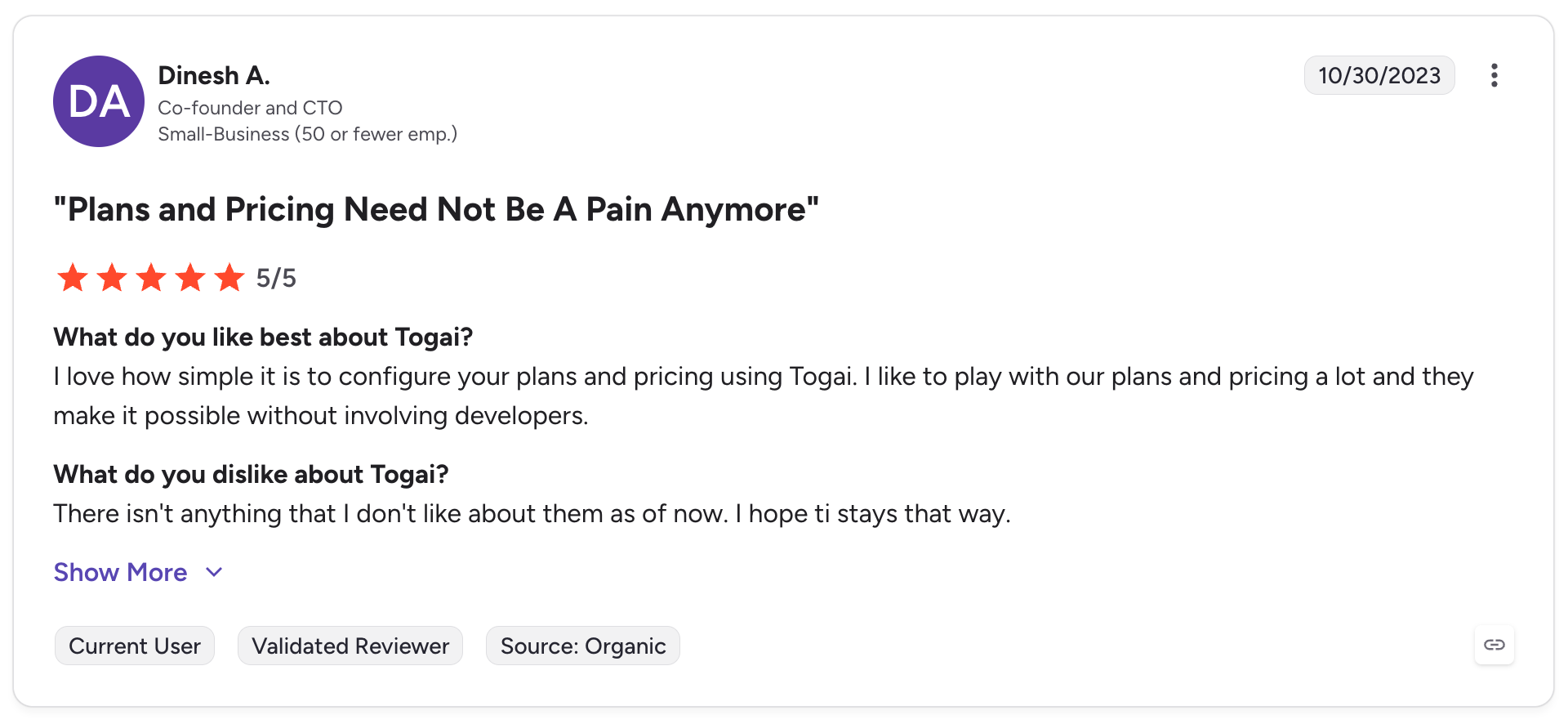
Pro: “I love how simple it is to configure your plans and pricing using Togai. I like to play with our plans and pricing a lot, and they make it possible without involving developers. (Dinesh A., Co-founder and CTO, G2; October 30, 2023)
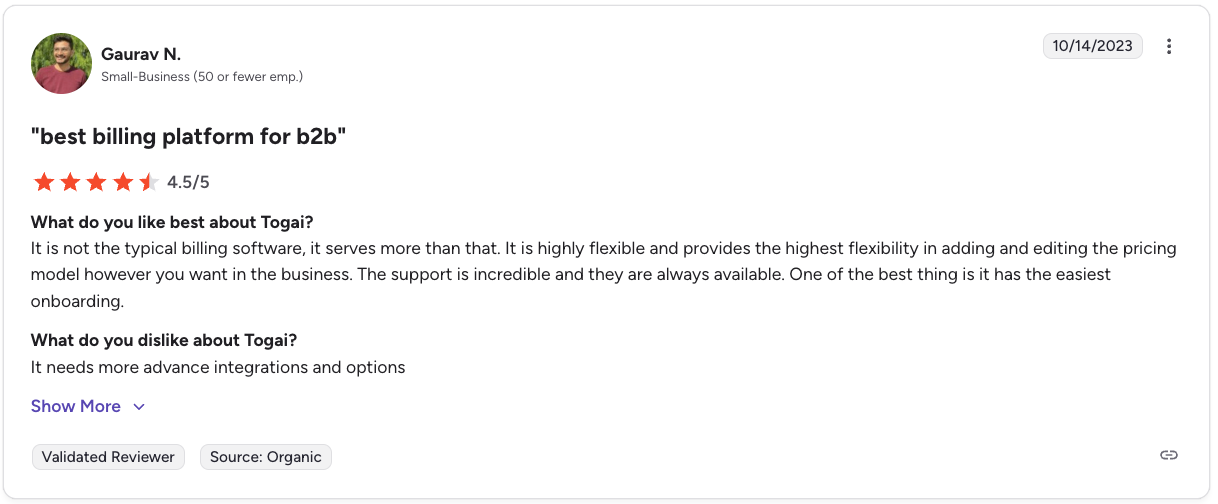
Con: “It needs more advanced integrations and options to fully meet business needs.” (Verified User in Small Business, G2; October 14, 2023)
Togai uses usage-based pricing that scales with event volume and invoice value, with no upfront fees and full feature access from the start. Enterprise plans remove limits and include dedicated support.
Togai works well when your billing depends on transforming raw usage data and applying custom pricing logic inside the billing layer. It works well for non-standard models where pipelines or code would otherwise handle that complexity.
It is less ideal when you need real-time enforcement in your product, since access and usage limits still need a separate layer.
What it does: Metronome is a usage-based billing platform built for engineering teams that need to instrument billing directly into their data pipelines.
Best for: Engineering-led teams billing on one or two usage metrics who need accurate event-level tracking and commit contract management for enterprise deals.
Metronome stands out for how it handles metering with a strong focus on accuracy and control. It keeps pricing centralized through rate cards, so changes can be made in one place and applied across all customers without duplicating plans or rewriting logic in multiple systems.
| Pros | Cons |
|---|---|
| Rate cards and dimensional pricing cover most enterprise usage billing scenarios | Pricing updates depend on engineering due to code and SQL workflows |
| Commit contracts handle prepaid structures without custom logic | Streaming aggregation limits raw event access and historical backfills |
| Native marketplace integrations reduce custom billing workflows | No entitlements or real-time enforcement, so teams typically add a separate entitlements layer alongside Metronome |

Pro: “Metronome is very expensive and is the only rating and metering solution … listed that works for enterprise level usage volumes.” (Reddit User; July 09, 2024)
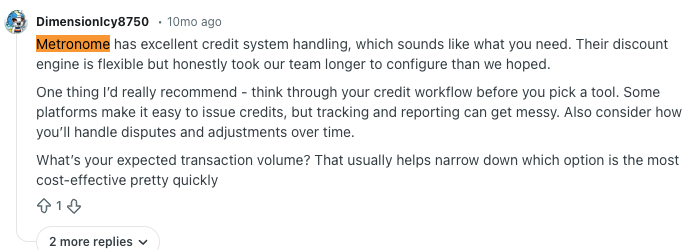
Con: “Their discount engine is flexible, but honestly took our team longer to configure than we hoped.” (Reddit User; July 03, 2025)
Metronome offers a free Starter plan with core metering and pricing features, while Custom plans add integrations, data exports, and support for high-volume, enterprise-scale billing needs.
Metronome is right for your architecture if your team owns billing end-to-end and manages usage logic in data pipelines. Our hands-on Metronome review covers what that ownership looks like after setup.
It works well for a small set of metrics with tight engineering control, but it becomes limiting when pricing changes depend on non-engineering teams or when you need real-time enforcement inside the product.
Teams that hit that ceiling typically don't replace Metronome; they add an entitlements layer on top of it.

What it does: Orb is a usage metering and billing platform built for quick implementation and minimal setup overhead.
Best for: Early-stage startups that need basic usage tracking and billing without complex customization requirements.
Orb stands out for how quickly you can get from zero to a working billing setup. It keeps the surface area small, so teams can start tracking usage, define billing cycles, and generate invoices without spending time designing complex systems or pipelines.
| Pros | Cons |
|---|---|
| Minimal setup for basic metering without heavy infrastructure | Limited support for complex pricing logic and advanced billing models |
| Event store enables auditing, backfills, and pricing changes without data loss | No entitlements or feature-level enforcement inside the product |
| Centralized data model keeps billing and usage logic in one place | Simpler architecture may require migration as billing complexity grows |

Pro: “Great for complex usage calculations with a clean API … implementation was smoother than we expected.” (Reddit User; July 03, 2025)

Con: “If you want accountants and finance to oversee invoicing, then avoid Orb.” (Reddit User; July 09, 2024)
Orb offers custom pricing across Core, Advanced, and Enterprise tiers, with features expanding from real-time metering and billing to integrations, data sync, and dedicated support.
Orb is right for your architecture if you need a simple starting point for usage-based billing and want to get set up quickly without heavy engineering work. Expect a sales conversation before you see a number, though. Our Orb pricing guide explains what drives the quote.
It works well for straightforward metering, but teams with complex pricing models, AI credit systems, or entitlements will likely outgrow it and need to plan for migration later.

What it does: Chargebee is a subscription management platform covering recurring billing, invoicing, dunning, trial management, and payment gateway integrations.
Best for: Subscription-based businesses expanding internationally that need dunning automation and support for multiple payment gateways.
Chargebee stands out for how much of the subscription lifecycle it covers in one place, from billing and invoicing to trials, upgrades, and payment recovery.
Chargebee gives teams a full system for managing recurring revenue, and the API and webhooks are solid enough to plug into existing systems without too much friction.
| Pros | Cons |
|---|---|
| Well-documented APIs and a reliable webhook system | Proration is complex and hard to predict, with a setup that requires heavy customization |
| Broad payment integrations reduce custom gateway work | Data sync delay of up to 24 hours limits real-time analysis |
| Built-in retry logic for failed payments reduces custom recovery flows | Pricing configuration can require custom logic even for simpler use cases |
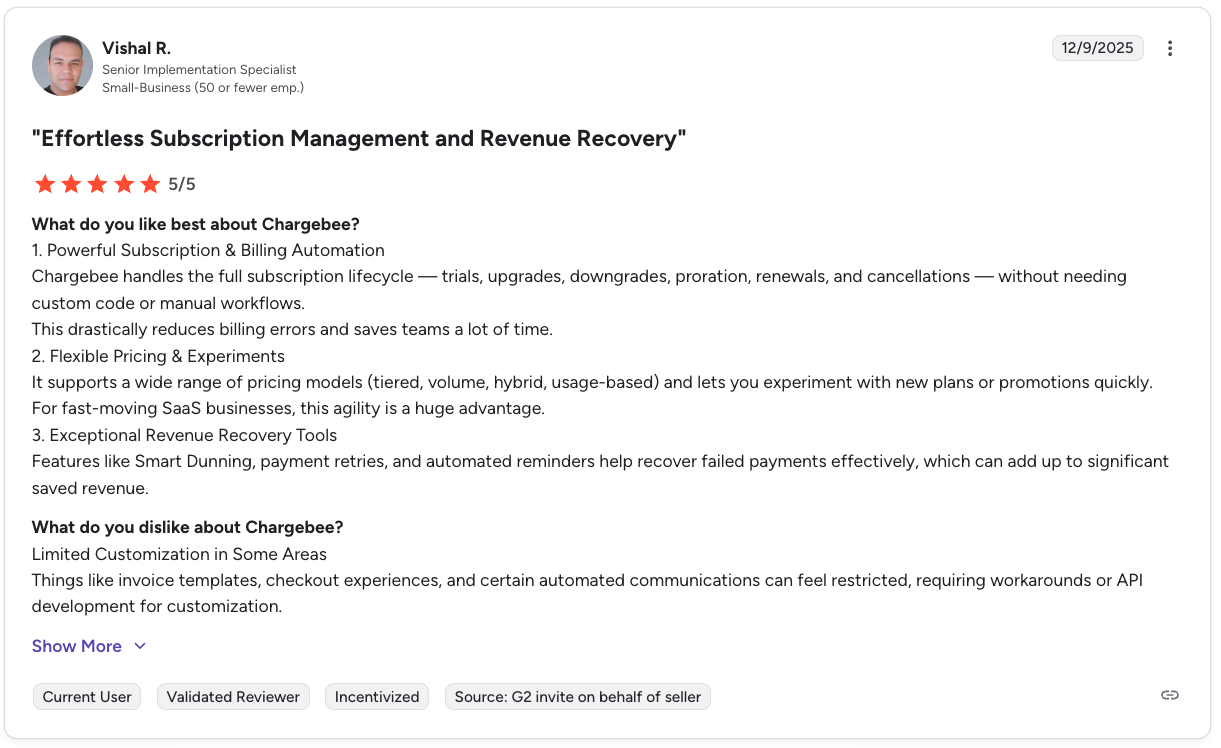
Pro: “Chargebee handles the full subscription lifecycle — trials, upgrades, downgrades, proration, renewals, and cancellations — without needing custom code or manual workflows.” (Verified User in Small Business, G2; December 09, 2025)

Con: “Reporting isn’t what I expected. Also, a few items that were introduced — such as RAMP, along with some invoice- and email-related features — aren’t provided with full context.” (Verified User in Small Business, G2; April 15, 2026)
Chargebee is right for your architecture if you are building around recurring billing and want a managed system for payments, invoicing, and dunning.
If your pricing model depends on usage, credits, or runtime enforcement, that logic will sit outside Chargebee, and the reported reliability issues are worth factoring into the decision. For usage-heavy pricing, our Chargebee vs Metronome breakdown shows where a usage-first platform pulls ahead.
What it does: Maxio is a billing and financial operations platform for B2B SaaS companies, focused on revenue recognition and complex contract management.
Best for: Finance and accounting teams at B2B SaaS companies that need ASC 606/IFRS 15-compliant revenue recognition and detailed contract schedule management.
Maxio stands out on the finance side, especially when billing is tied to complex contracts and revenue recognition requirements.
Maxio handles things like milestone billing, minimum commitments, and custom contract terms without forcing teams to build that logic themselves, which is useful when billing needs to align closely with accounting standards.
| Pros | Cons |
|---|---|
| Supports complex contract schedules and milestone-based billing logic | Requires multiple add-ons and systems, with a long and complex setup process |
| Built-in retry logic reduces the need for custom payment recovery flows | Limited reporting makes it hard to track customer cohorts, revenue, and product-level insights. |
| Integration with CRM systems reduces custom workflow development | Slow system and complex setup, with costly support and a hard-to-navigate knowledge base |

Pro: “I like that Maxio is an all-in-one platform. The accounts receivable (AR) function is particularly valuable because it makes it easier to find actual invoices that are outstanding or closed.” (Verified User in Small Business, G2; March 09, 2026)
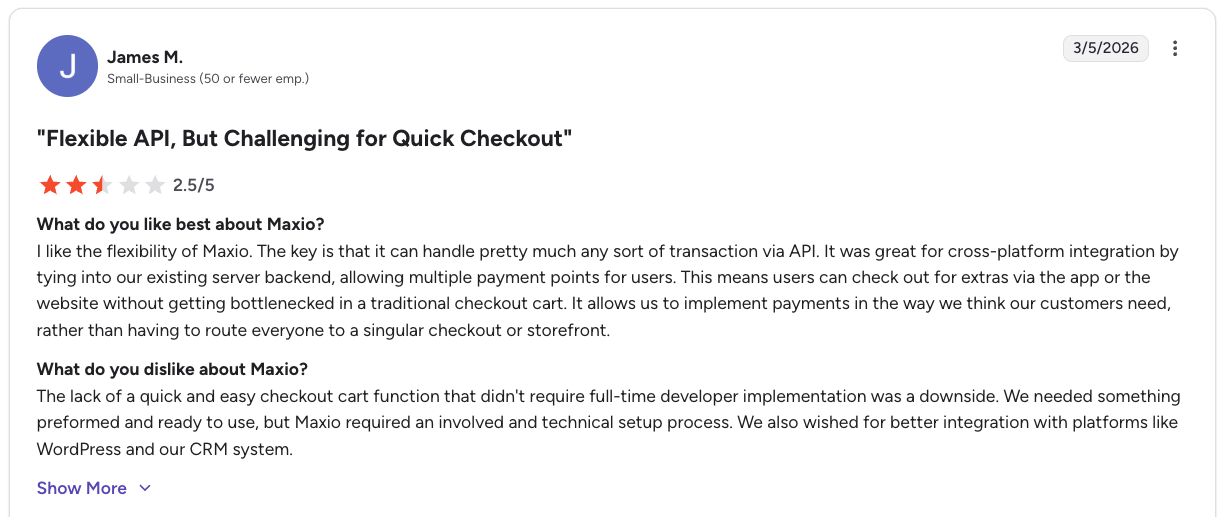
Con: “The lack of a quick and easy checkout cart function that didn't require full-time developer implementation was a downside … We also wished for better integration with platforms like WordPress and our CRM system.” (Verified User in Small Business, G2; March 05, 2026)
Maxio pricing starts at $599/month for the Grow plan, which supports up to $100K in monthly billing, with custom pricing for higher volumes and advanced enterprise features.
Maxio is right for your architecture if you want to offload complex billing and revenue logic to a system built for finance teams.
Maxio handles financial workflows well, but the complexity of setup, reliance on add-ons, and limited reporting can make life difficult for engineering teams that need faster changes or more visibility into product-level data.
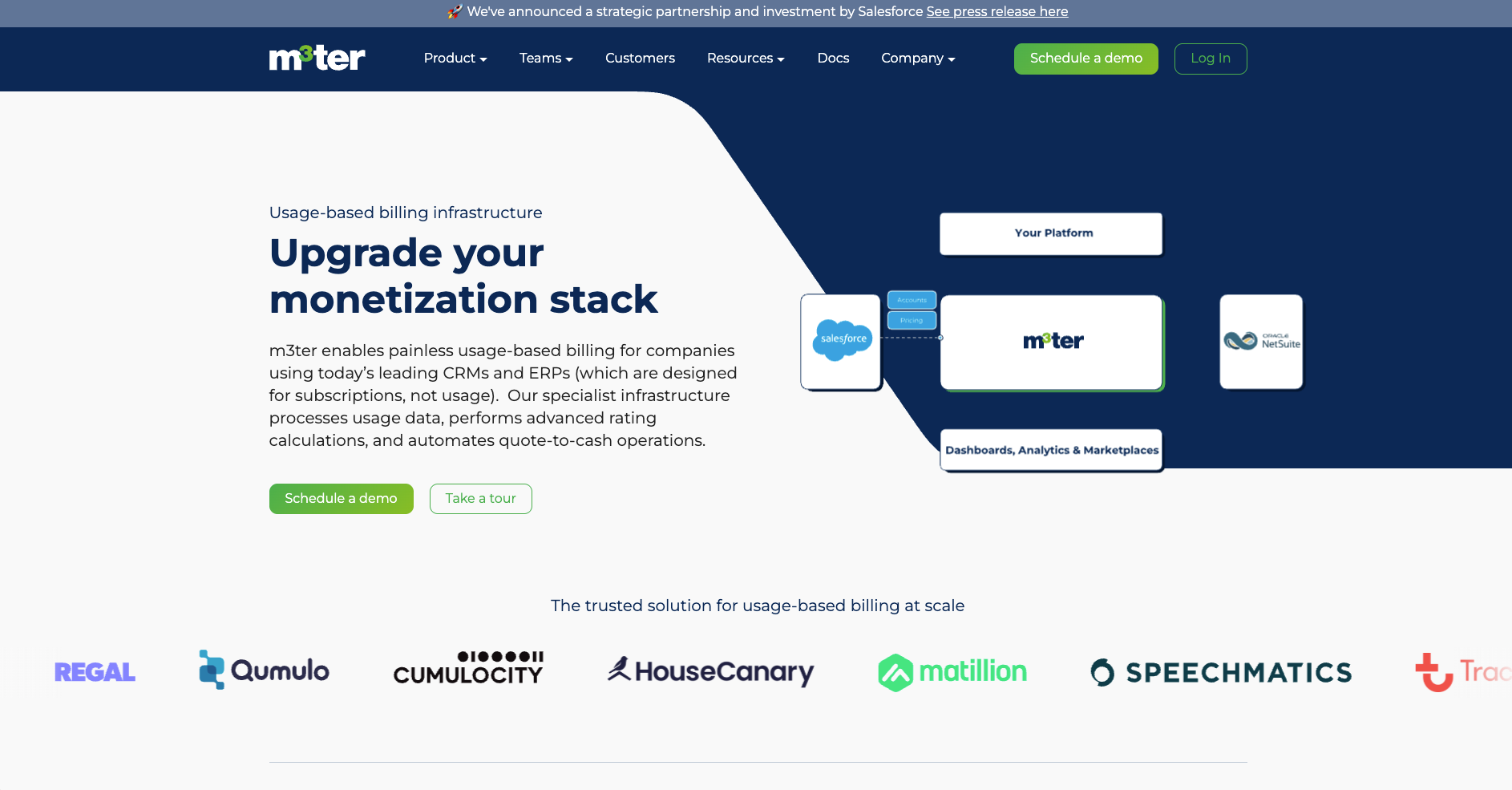
What it does: m3ter is a metering and billing platform focused on accurate usage tracking for businesses with usage-based pricing models.
Best for: Companies with high-volume usage data and complex, configurable pricing models that need billing accuracy at scale.
m3ter stands out for how it handles scale. It is built to process large volumes of usage data without forcing teams to design their own scaling logic, which matters once event throughput starts to grow and pipelines become harder to manage.
| Pros | Cons |
|---|---|
| Infrastructure that can scale for high-volume usage workloads | Learning curve for teams new to dedicated metering platforms |
| Accurate metering reduces discrepancies in billing calculations | May be overbuilt for companies with simple billing needs |
| Flexible pricing model configuration supports complex billing logic | Cost is higher than lighter-weight alternatives |
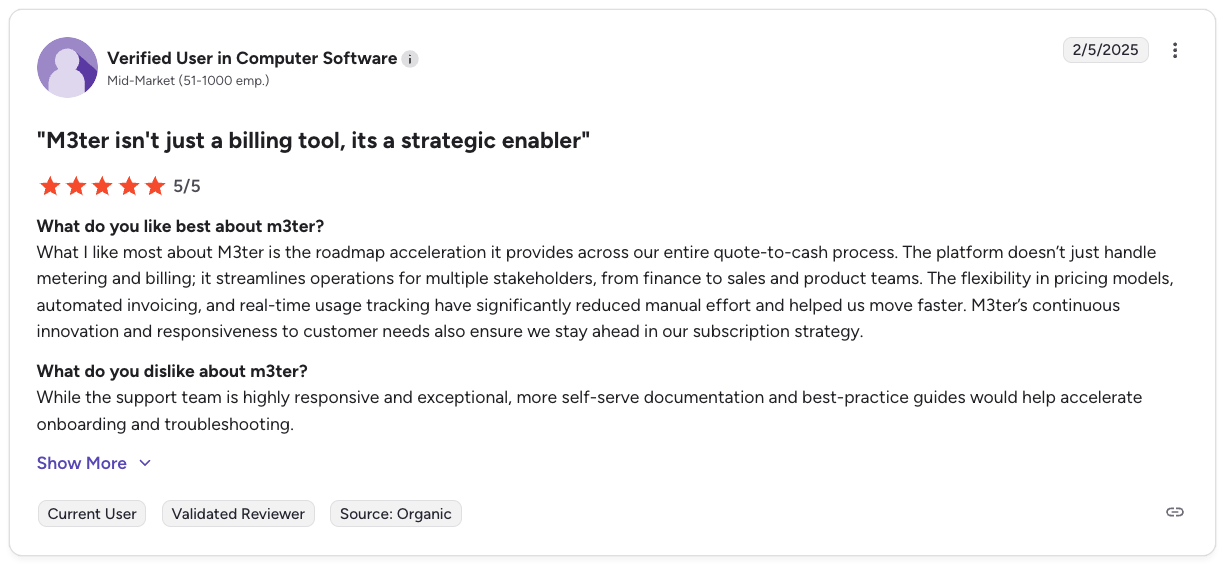
Pro: “It streamlines operations for multiple stakeholders, from finance to sales and product teams. The flexibility in pricing models, automated invoicing, and real-time usage tracking have significantly reduced manual effort and helped us move faster.” (Verified User in Computer Software, G2; February 05, 2025)

Con: “We have had a reliance on m3ter for professional services, their delivery has been exceptional, but it is an additional cost to consider.” (Verified User in Information Technology and Services, G2; January 24, 2025)
m3ter uses a custom pricing model based on platform usage, with a core fee plus add-ons, support tiers, and implementation services tailored to your billing scale and complexity.
m3ter makes sense if you are pushing a lot of usage data and do not want to deal with scaling ingestion, aggregation, and billing logic yourself.
It keeps billing accurate and moves data cleanly across systems, but it does come with a learning curve and higher cost, so it tends to pay off more once your billing setup is already getting complex.
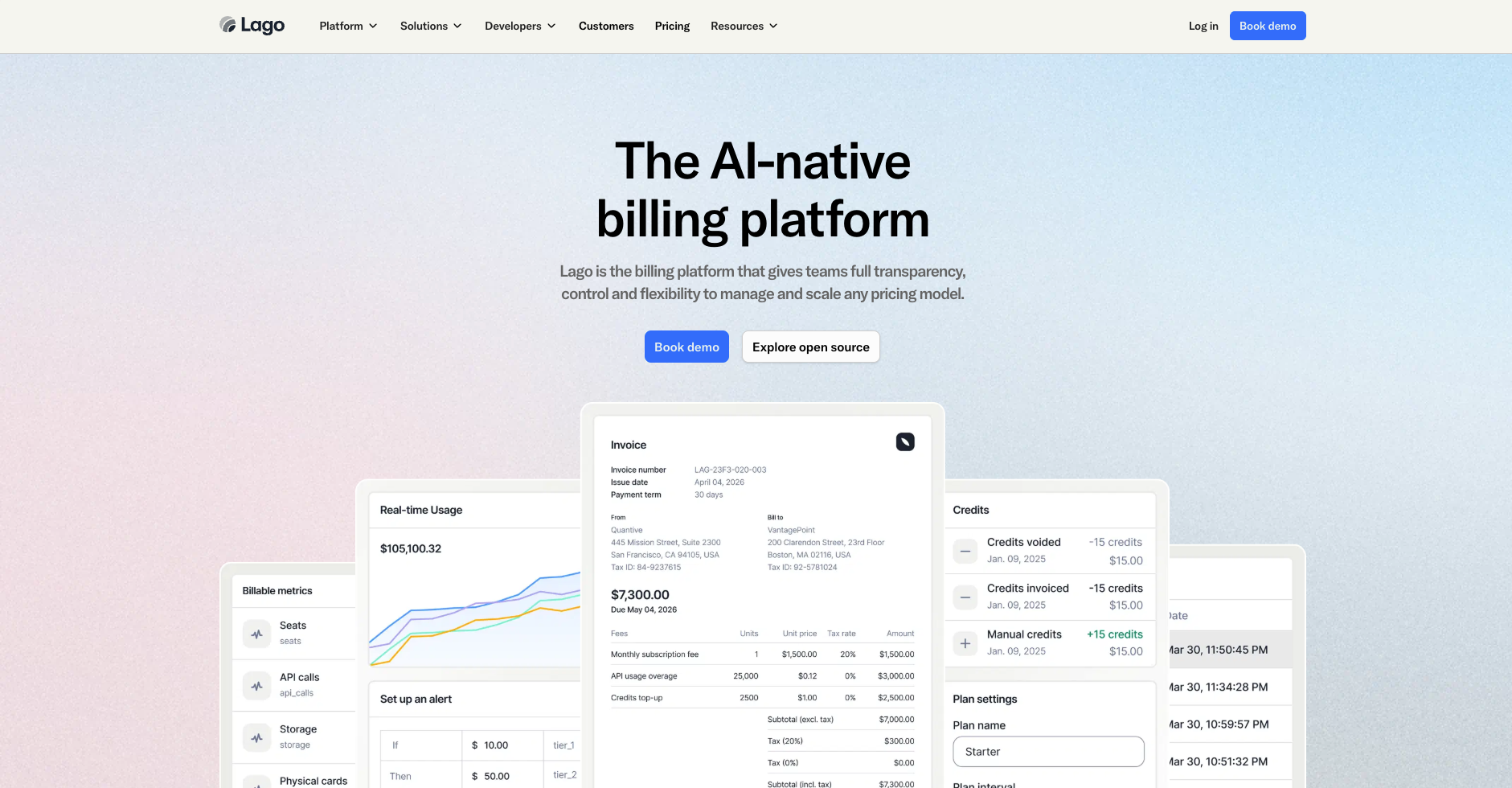
What it does: Lago is an open-source billing platform that supports usage metering, subscription plans, invoicing, coupons, and prepaid credit wallets.
Best for: Engineering teams that need full infrastructure ownership and can absorb Docker-based setup and ongoing maintenance.
Lago stands out for the level of control it gives you as an open-source billing system. You get full visibility into the codebase, along with both an API and a UI, which is not common in this category, and it includes things like prepaid credits and wallet management out of the box.
| Pros | Cons |
|---|---|
| Full codebase visibility and self-hosting for teams requiring infrastructure ownership | Requires Docker setup and ongoing infrastructure ownership |
| Architecture supports customization at the code and system level | The engineering team is responsible for setup, customization, and maintenance |
| Flexible integrations with payment processors, ERPs, and CRMs without lock-in | Flexibility comes with added operational overhead compared to managed tools |
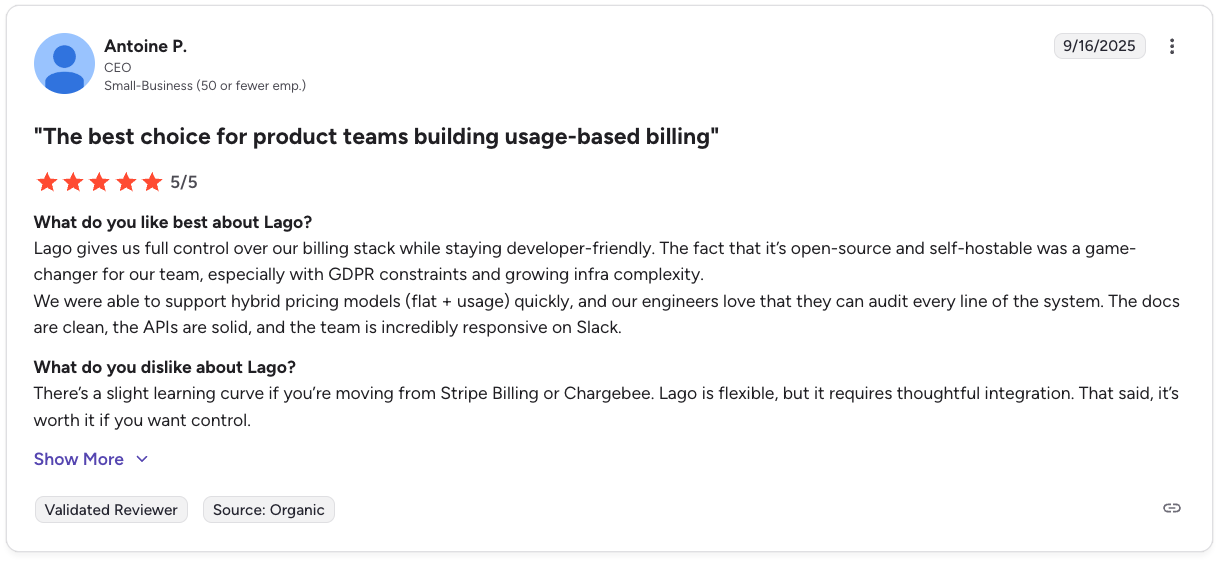
Pro: “Lago gives us full control over our billing stack while staying developer-friendly. The fact that it’s open-source and self-hostable was a game-changer for our team.” (Verified User in Small Business, G2; September 16, 2025)

Con: “Open source and highly customizable, though that also means more dev work on your side.” (Reddit User; July 03, 2025)
Lago offers custom pricing across Business and Enterprise plans, with features expanding from core billing and integrations to premium support, implementation guidance, and self-hosted deployment options.
Lago works when you prefer to keep billing logic close to your system and want the ability to inspect and extend it directly.
The trade-off is that you take on more operational demands, so it fits better when you have the engineering capacity to manage them long-term.
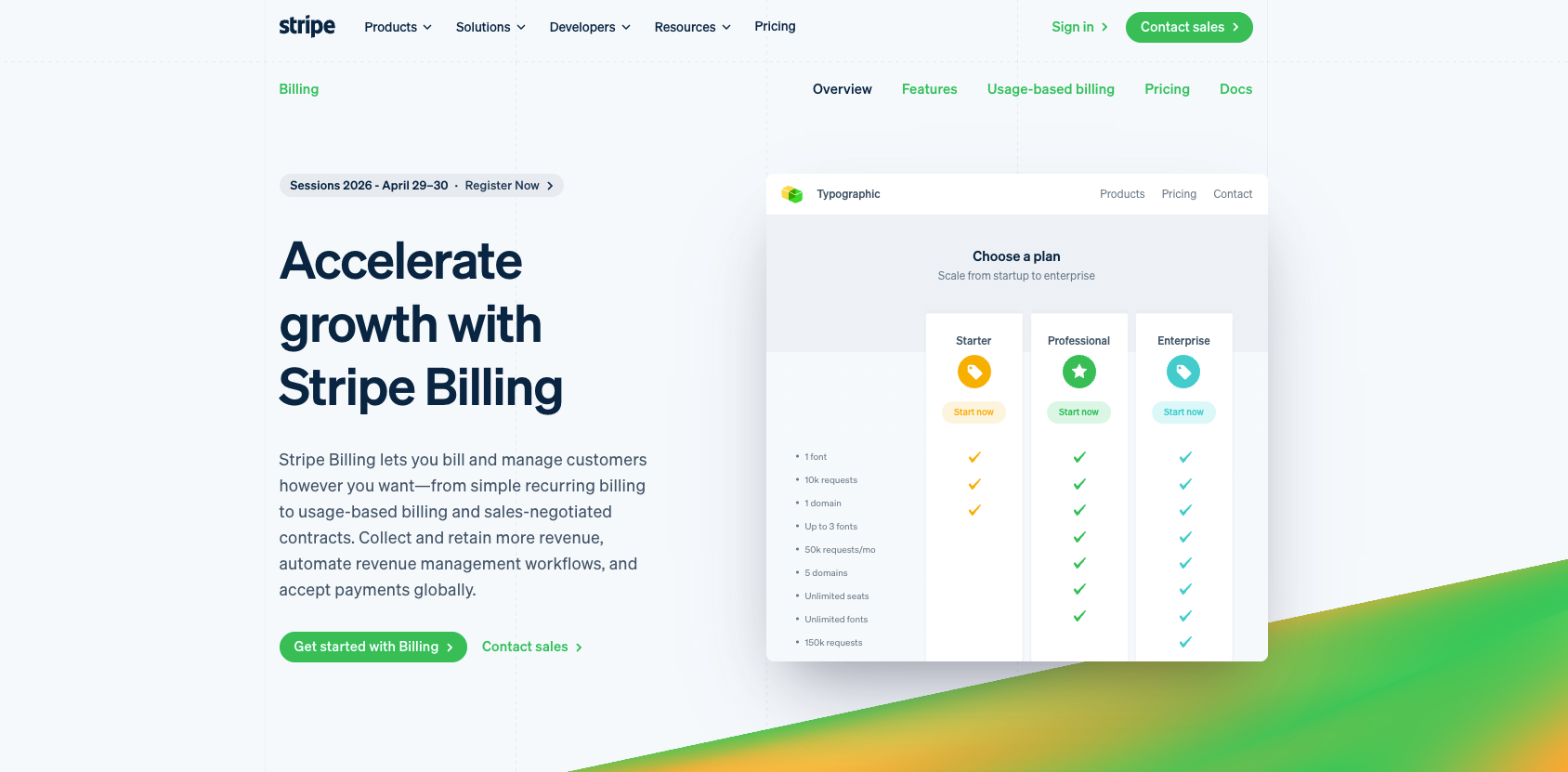
What it does: Stripe Billing adds subscription and usage-based billing on top of Stripe's payment infrastructure.
Best for: Engineering teams that need maximum API flexibility and own the internal capacity to build billing logic on top of clean, well-documented primitives.
Stripe stands out because the API just works the way you expect it to, which is why most engineering teams end up defaulting to it for billing and payments.
The documentation is clear, and the webhook system handles retries, idempotency, and deduplication out of the box, so you are not spending time fixing edge cases around failed requests or duplicate events.
| Pros | Cons |
|---|---|
| Predictable API design with strong documentation and consistent behavior across endpoints | Stripe does not handle entitlements or feature-level access control, so you’d usually add a dedicated entitlements layer alongside it |
| Unified API for payments, invoicing, and tax handling | Complex pricing models like hybrid plans or grandfathering often require custom logic in code |
| Broad integrations reduce the need for custom connectors | Advanced billing features and workflows are often gated behind higher tiers |

Pro: “Stripe Billing's developer experience is best-in-class — the documentation is clear, the API is well-designed and consistent, and the CLI makes testing and debugging a breeze.” (Verified User in Mid-Market, G2; February 17, 2026)
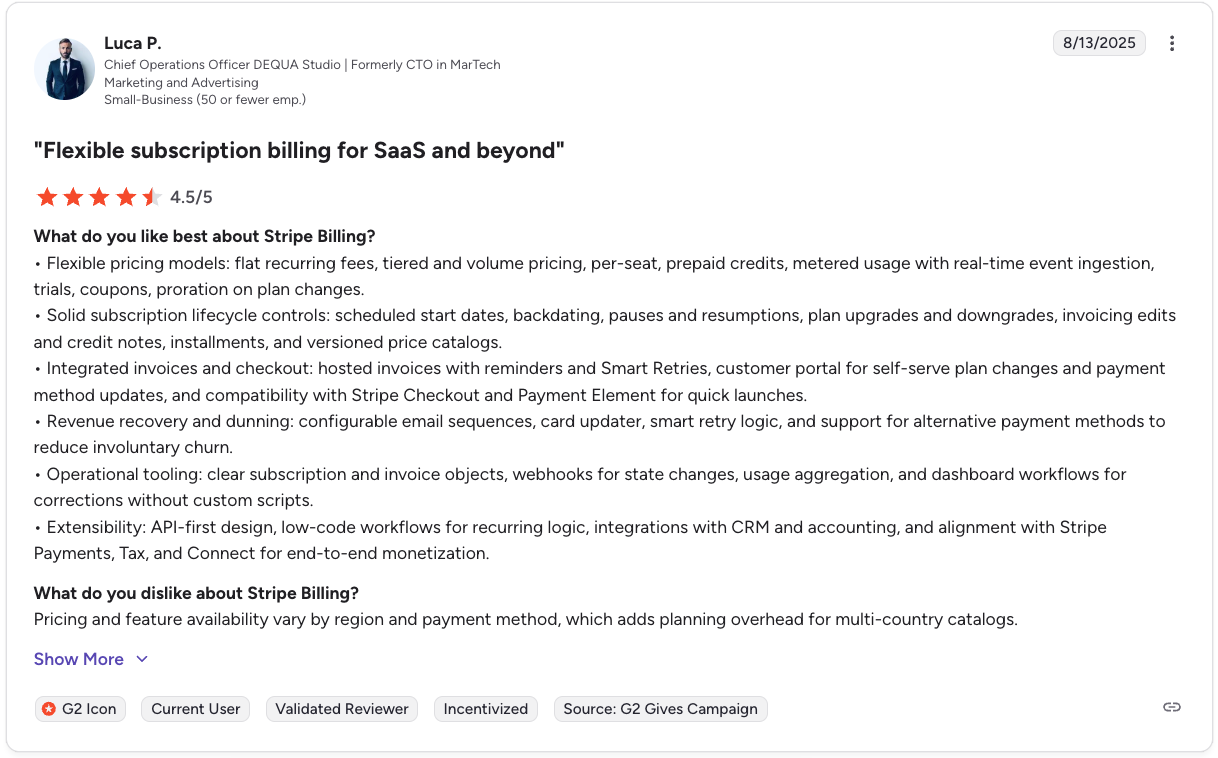
Con: “Pricing and feature availability vary by region and payment method, which adds planning overhead for multi-country catalogs.” (Verified User in Small Business, G2; August 13, 2025)
Stripe Billing offers pay-as-you-go pricing at 0.7% of billing volume or a monthly plan with volume tiers, with custom pricing available for larger or more demanding use cases.
Stripe makes sense if you are looking for a reliable billing layer with strong APIs and integrations that can scale with your system.
It covers the financial side well, but it does not handle how pricing maps to behavior inside the product, so enforcement and more advanced pricing logic typically live in a separate layer that sits alongside Stripe.

What it does: Zuora is an enterprise subscription management platform for large-scale organizations with multi-entity, multi-currency, and compliance-heavy billing requirements.
Best for: Engineering and finance teams at public companies or enterprises that manage multiple legal entities and global billing operations.
Zuora works well when you need a system that can handle complex pricing, billing, and revenue rules without building that logic yourself.
The combination of Monetization Catalog, consumption metering, and revenue automation covers most of the billing lifecycle, and it is one of the few tools that handles multi-entity setups cleanly.
| Pros | Cons |
|---|---|
| Built-in metering and rating engine handles large-scale usage data | Requires integration across multiple systems, such as CRM, ERP, and payment gateways |
| Supports high-throughput billing with large invoice volumes | Customization and extensibility can increase implementation and maintenance effort |
| The extensibility layer enables custom logic and workflows | API-based workflows may require careful handling for high-volume operations |
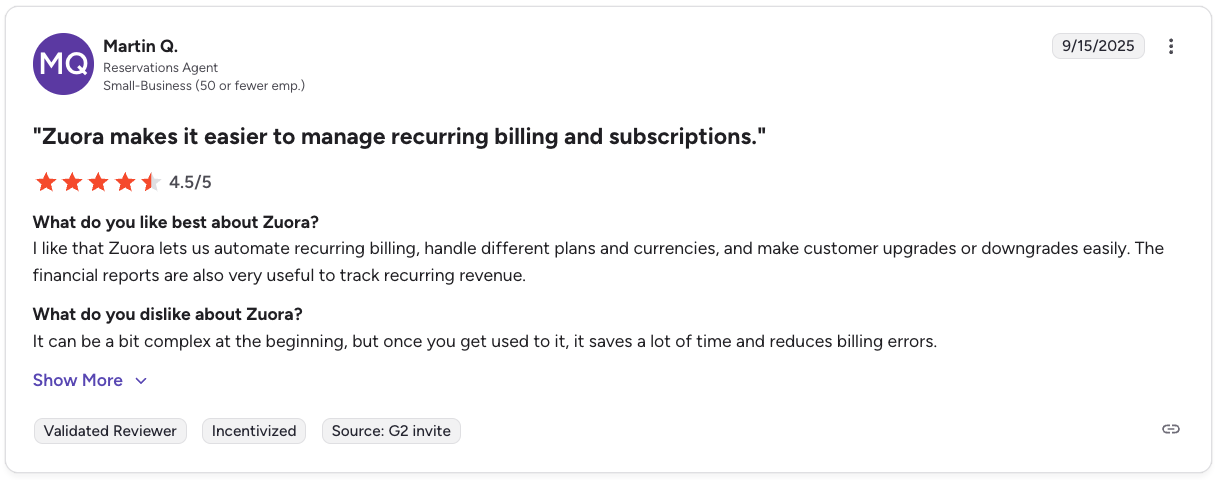
Pro: “I like that Zuora lets us automate recurring billing, handle different plans and currencies, and make customer upgrades or downgrades easily.” (Verified User in Small Business, G2; September 15, 2025)

Con: “The system can feel complex at times, especially during setup or when making configuration changes. Some processes require multiple steps that could be simplified.” (Verified User in Enterprise, G2; August 28, 2025)
Zuora uses custom pricing based on your billing volume and modules required, with costs varying depending on scale, integrations, and enterprise needs.
Zuora makes sense if your billing setup is large enough that you need a dedicated system to manage pricing, invoicing, and compliance across regions and entities.
This also means more setup and moving parts, and anything tied to feature access or real-time usage still sits outside Zuora.
You should choose an Amberflo alternative based on which layer in your billing stack is actually breaking down, since most tools solve different parts of the problem.
Most teams tend to fall into three patterns:
At a high level, the choice usually comes down to whether your bottleneck is pricing logic, system scale, or API foundation. If the bottleneck is access control and runtime enforcement inside the product, you are looking at a different layer of the stack entirely.
If you’re evaluating Amberflo alternatives at the intersection of AI products and infrastructure, the right answer is usually two layers: a billing platform from this list and Stigg running on top of it as the usage runtime.
Metering and invoicing are solved problems. AI credit governance, synchronous enforcement, and real-time access control are where teams consistently hit walls, and those problems live outside what billing tools were designed to solve.
For pure billing infrastructure, Stripe is the strongest default for API-first teams. Zuora is a good fit for enterprises with compliance mandates, and Metronome works well for engineering-led teams with usage billing at the core.
Stigg provides the runtime infrastructure for AI credits, entitlements, and access governance while continuing to work alongside existing billing systems. Engineering teams use Stigg to:
The runtime can run through a BYOC Sidecar deployed inside the customer’s VPC, supporting data residency and private cloud requirements without replacing the existing billing stack.
This layer becomes critical under AI-scale workloads. If enforcement loses access to current credit or entitlement state mid-execution, the system either blocks valid requests or allows spending to continue unchecked.
The runtime architecture is built to keep those decisions reliable under load.
If your system cannot enforce limits without custom code paths, your infrastructure is missing a control layer. See how Stigg fits into your architecture.
The best Amberflo alternatives for engineering teams are Stripe, m3ter, and Togai, because each one solves a different engineering bottleneck well.
Stripe is the strongest API-first billing foundation, m3ter is the best fit for high-volume usage billing at scale, and Togai works best when billing depends on transforming raw events into billable metrics.
Yes, Stripe is a solid Amberflo alternative for teams that want a reliable API layer for billing and payments. Stripe handles billing well, but access control, usage limits, and runtime enforcement still need to be addressed separately in your architecture.
Billing records usage and generates invoices once execution is complete, whereas entitlements (a usage runtime) evaluate access, credits, and limits while usage is still happening. Entitlements run checks before billing systems ever see the event. The two layers solve different problems at different stages of execution.
No, most Amberflo alternatives meter usage and generate invoices, but they do not enforce runtime access decisions inside the product. That requires a separate usage runtime layer.
%20(1).png)
%20(1).png)