Guides
m3ter Alternatives: 8 Free and Paid Options for 2026
Looking for m3ter alternatives after the Salesforce deal? Compare 8 tools by features, pros, cons and published pricing, including free and self-hosted options.

OpenMeter vs Stigg, compared on metering, entitlements, credits, and billing connection. See how each is hosted and when each one fits your AI product.


An AI voice agent starts a session with enough credits, then another session draws from the same balance. Your application needs accurate usage records, current entitlements, and a clear decision about how much each session can consume.
If you're comparing OpenMeter vs Stigg, the main differences are in how they handle credits, connect to billing, and fit into your existing infrastructure. Both support usage metering and entitlements, but their architectures and deployment options serve different needs.
OpenMeter brings usage metering, credits, entitlements, and invoicing into one open-source platform. You can run it on your own infrastructure or use Kong's managed Konnect Metering & Billing service.
Stigg is a usage runtime for AI products. It decides what each customer, user, and agent is allowed to do at the moment of the request, checking plan allowances, deducting credits, and enforcing spending limits before usage runs over budget.
OpenMeter can calculate charges from usage events and generate invoices. Stigg can reserve credits before an AI operation, settle the balance based on consumption, and sync billing data with providers such as Stripe or Zuora.
| Feature |  OpenMeter |
 Stigg |
|---|---|---|
| Core focus | Open-source usage metering and billing | Usage runtime and credits engine for AI products |
| Ownership | Kong, acquired September 2025 | Stigg |
| License | Apache 2.0 | Commercial |
| Hosting | Self-hosted or Konnect Metering & Billing | Stigg Cloud, BYOC, BYODB |
| Usage metering | CloudEvents, real-time aggregation, configurable meters | JSON events, deduplication, enrichment, dimensional aggregation |
| Entitlements | Metered, static, boolean | Boolean, configuration, metered, credit |
| Credits | Grants, expiry, priorities, prepaid wallets, transaction history | Grant blocks, cost basis, expiry, ledger, reserve and settle |
| Usage controls | Real-time entitlement checks and limits | Request-time checks, budgets, Sidecar caching and fallbacks |
| Invoicing | Native billing with Stripe and custom invoicing integrations | Optional invoicing module; works with existing billing systems |
| Free option | Free self-hosted software; Konnect free entry | Build plan with 10K entities and 5M monthly events |
| Published paid price | Konnect commercial pricing requires confirmation | Pro $399/mo annually or $499 monthly |
Disclaimer: Prices are subject to change without notice. Always visit the official company websites for the most up-to-date pricing information.
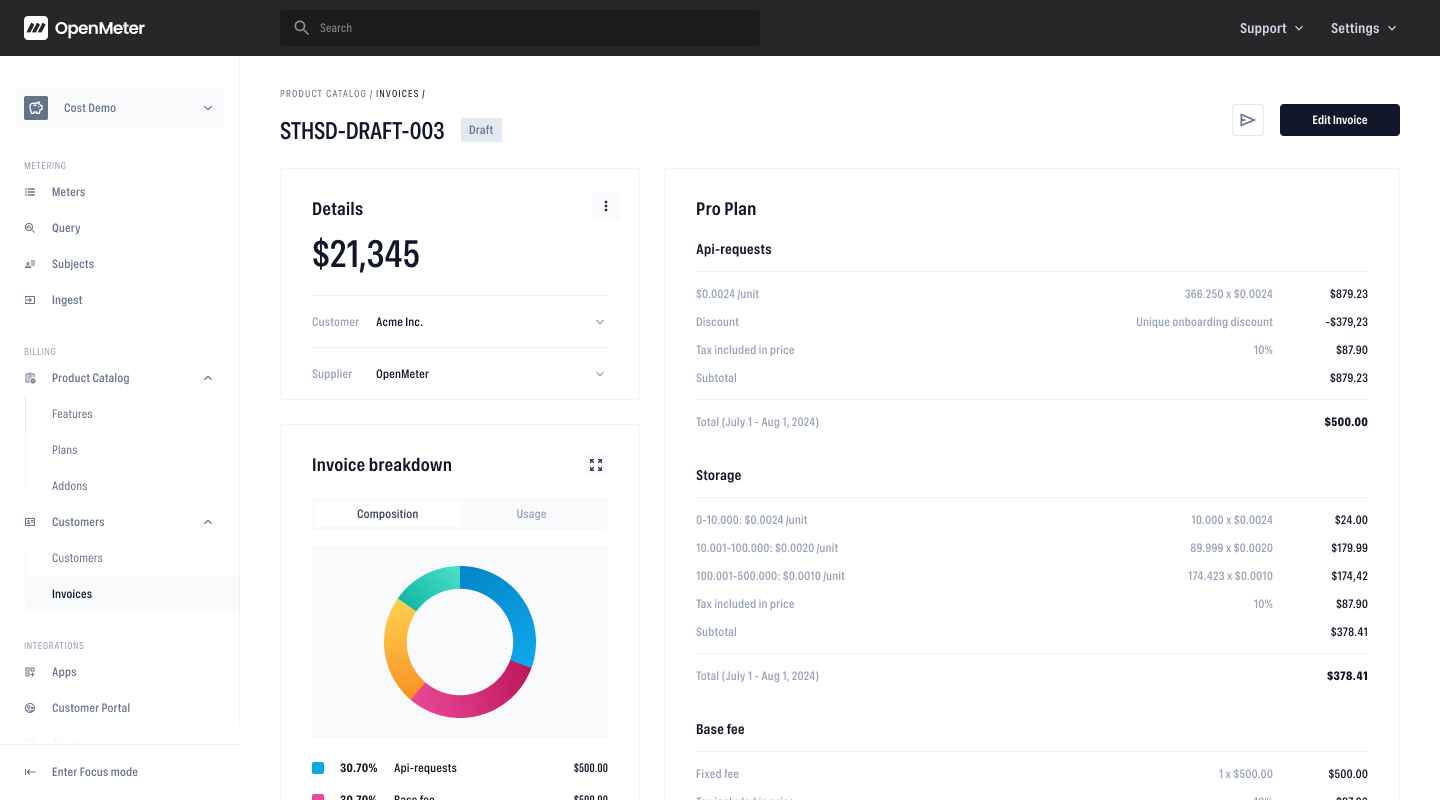
OpenMeter handles usage metering, entitlements, credits, and invoicing in one open-source platform. It collects consumption data from AI and API products, calculates usage totals, and applies the results to customer plans and billing.
OpenMeter accepts CloudEvents-compatible events. Each event identifies its source and consumer, allowing meters to aggregate usage such as AI tokens, API requests, or compute consumption.
OpenMeter also manages entitlements, which define the features and usage allowances included in a customer's plan.
Its entitlement documentation covers three types:
Metered entitlements support grants with priorities, expiration dates, and rollover rules. Applications can check current usage and remaining balances before allowing more consumption.
OpenMeter calculates usage charges and generates invoices based on customer plans and pricing rules. It supports Stripe integration for payment collection and tax calculations. Its invoicing documentation also describes custom integrations for connecting external invoicing systems.
OpenMeter suits companies that want metering and invoicing in one system, with the option to run the open-source infrastructure themselves.

Stigg handles feature access, credit balances, and consumption limits inside AI applications. It processes usage events and lets your application check customer allowances as requests come in.
Metering, entitlements, and credits run in one enforcement layer. Teams often start with one of them, such as entitlement checks, and add credits or spending controls later on the same platform.
Stigg supports four entitlement types:
Customer allowances can come from multiple sources, including plans, inherited plans, add-ons, trials, and overrides. Stigg applies the most generous applicable allowance when those rules overlap.
An entitlement check returns access status, usage limits, current consumption, and whether the customer has unlimited access.
Stigg connects usage and entitlement data to your existing billing provider. Stigg integrates with billing providers including Stripe, Zuora, and Chargebee, and sends invoices through Stripe Invoicing or Airwallex. Other systems can connect through Workflows or custom integrations.
You can also use Stigg's credits and entitlements without connecting a billing provider.
Stigg also offers invoicing on every plan, including the free Build tier. Its Contract Management and Invoicing module supports termed contracts, while external providers handle payment collection and tax.
Stigg fits AI products that need credit deductions, consumption limits, and spending controls during application requests, including cases where several users or agents draw from a shared balance.
Kong announced its acquisition of OpenMeter on September 3, 2025, bringing its metering, billing, and entitlement capabilities into the Kong product portfolio.
OpenMeter remains open source under Apache 2.0, as confirmed in Kong's acquisition announcement.
The managed offering is now Konnect Metering & Billing. Existing OpenMeter Cloud customers can continue accessing their environments.
You have two options for running OpenMeter:
The available features and infrastructure requirements vary by deployment, so it's worth checking which capabilities are supported in each option.
Stigg follows a commercial licensing model, with Cloud, BYOC, and BYODB deployment options. BYOC lets you run its usage runtime inside your own VPC, with Stigg managing the deployment.
OpenMeter and Stigg share several capabilities, but they process usage, manage credits, and connect to billing in different ways. Here's how those differences affect your application:
Both platforms collect usage events and calculate consumption. The main difference is how they process those events and use the results.
id, type, source, subject, and data. It supports deduplication and aggregation using SUM, COUNT, AVG, MIN, and MAX. You can query usage by customer and time period.Event handling is worth testing. Send duplicate and late usage events to both platforms, then compare the resulting counters. Stigg's usage metering guide explains how ingestion affects consumption records.
Both tools let you check what a customer can access and how much they've used, however, their entitlement models differ in a few areas.
Both platforms support plan versioning. OpenMeter lets existing subscriptions stay on an earlier plan version, while Stigg supports promoting versioned configurations from sandbox to production.
For either platform, test how entitlement checks behave when usage arrives late, multiple requests run at once, or the service becomes unavailable.
Both platforms support prepaid credits, expiration rules, and balance tracking. The differences become more relevant when an AI operation's final cost is unknown.
Stigg also offers reserve and settle. Your application can reserve an estimated amount before an AI task begins, then settle the credits against the final usage.
For example, an AI video-generation request might have an unknown final cost until rendering finishes. Reserving credits gives the application a way to account for the expected spend before starting.
Kong's credit_only settlement mode prevents an overage invoice from being generated. It doesn't stop the API request that produces the usage, so request-level limits need a separate check.
OpenMeter can use entitlement checks for access control. Billing settlement and request authorization are separate operations.
The billing setup is another major difference. OpenMeter includes invoice generation, and Stigg connects its usage runtime to billing systems you may already use.
If you already use Stripe, consider where you want pricing calculations and invoice generation to happen. OpenMeter can own those functions, and Stigg can manage product usage and credits alongside your existing billing setup.
Stigg's metering and billing guide explains how consumption data connects to invoices and payments.
OpenMeter and Stigg give you different levels of control over infrastructure. OpenMeter can run as a self-hosted service, while Stigg offers managed deployment options, including environments inside your own cloud.

OpenMeter supports self-hosting and managed deployment through Kong. If you choose to run it yourself, you'll need to operate the supporting infrastructure.
Its Kubernetes setup uses a Helm chart and several services:
Self-hosting gives you control over upgrades, data storage, and infrastructure configuration. You'll also be responsible for monitoring, backups, and keeping those services running.
If you don't want to operate the stack, Konnect Metering & Billing provides a managed option through Kong.

Stigg offers three deployment options, depending on where you want usage data and infrastructure to live:
With BYOC, raw usage events stay in your cloud environment, which is important when your customers have data residency requirements.
Stigg also has a Sidecar for entitlement checks. It's a Docker container that runs beside your application and communicates over gRPC.
Here's how it handles requests:
Redis is optional for persistent caching, and Node.js applications can use the SDK to perform these checks in-process without deploying the Sidecar. Stigg's Sidecar documentation covers the setup and fallback behavior.
OpenMeter is free to self-host, while its managed service, Konnect Metering & Billing, offers a free starting option. Stigg has a free Build plan and published paid tiers.
| Pricing detail | OpenMeter |
Stigg |
|---|---|---|
| Free option | Apache 2.0 self-hosted software; Konnect free entry | Build: 10K managed entities and 5M events/month |
| Paid pricing | Contact Kong for Konnect pricing | Pro: $399/month annually or $499 monthly |
| Usage charges | Self-hosting costs depend on your infrastructure; Konnect rates aren't publicly listed | Build: $50 per additional 1M events; Pro uses graduated rates |
| Enterprise pricing | Contact Kong | Custom enterprise pricing; BYOC starts at $40,000/year |
Disclaimer: Prices are subject to change without notice. Always visit the official company websites for the most up-to-date pricing information.
The costs depend on what you're running. Self-hosting OpenMeter means paying for Kafka, ClickHouse, PostgreSQL, and their upkeep. With Stigg, you'll need to estimate your managed entities and monthly event volume.
For managed deployments, compare Kong's quoted terms with Stigg's published pricing, including any usage charges beyond the plan allowances.
Choose OpenMeter when you want source-code access and control over your metering and billing engine.
Choose Stigg when your application needs a dedicated usage runtime alongside its existing billing infrastructure.
Already using OpenMeter? If its entitlement checks, credit grants, and invoicing meet your requirements, there's little reason to replace a working setup.
Check the work your engineers would still own. With self-hosted OpenMeter, that includes operating the event pipeline and databases. With Stigg, focus on integrating entitlement checks, credit operations, and your existing billing provider.
An AI task fails after consuming resources, and your application retries it. The next usage record needs to be correct, or the customer could be charged twice for the same operation.
For an OpenMeter vs Stigg evaluation, test duplicate events, failed settlements, and credit corrections.
Stigg is a usage runtime for AI products that enforces credits, entitlements, usage limits, and spend governance in the request path.
Here's what you can test against your application's requirements:
The Stigg Sidecar runs as a Docker container beside your application, caching entitlements and current usage in memory by default, with Redis as an option.
Cache hits resolve instantly. Cache misses call the Edge API at around 100ms, with a configurable timeout. If the API is unreachable, the Sidecar serves cached data or applies your fallback defaults when the cache is empty.
Node.js applications can skip the Sidecar and perform low-latency checks through the Node SDK.
Want to trace those operations through the runtime? Stigg's documentation covers the credit lifecycle, and you can book a demo to examine how the system would work with your existing billing setup.
The main difference between OpenMeter and Stigg is how they handle usage and billing. OpenMeter combines metering, credits, entitlements, and invoicing. Stigg manages request-time usage controls and connects with existing billing providers.
Yes, OpenMeter remains open source under Apache 2.0 following Kong's acquisition in September 2025. You can self-host the project, while Kong offers its managed version through Konnect Metering & Billing.
Yes, Stigg can replace OpenMeter's usage metering, credits, and entitlements for supported use cases. Stigg also offers invoicing, but payment collection and tax still require an external provider. Migrating involves mapping usage events, entitlement rules, and credit balances.
Yes, OpenMeter supports prepaid credits and real-time entitlement checks. Its metered entitlements track balances and usage limits, with grants supporting expiration, priorities, and rollover. Konnect also offers prepaid wallets and transaction history.
Stigg is a better fit for AI products with credit reservations, per-agent budgets, and request-time controls alongside existing billing. OpenMeter suits companies that want an open-source metering and billing engine with the option to self-host.