%20(1).png)
Guides
Different Types of Billing: 8 Models and How to Choose
A guide to the different types of billing, from subscription and usage to credits and hybrid models, and how to choose the right one for your product.

I tested 9 metered billing software platforms for metering accuracy, pricing, and real-time enforcement, with honest pros, cons, and prices for 2026.

%20(1).png)
Metered billing looks simple until a customer asks why the dashboard and invoice disagree. Then you’re tracing duplicate events, pricing versions, late usage, and whatever happened during the billing window.
The best metered billing software keeps that trail explainable from event to invoice. I compared nine platforms across metering, pricing flexibility, billing, developer experience, deployment, and how much product-side work remains.
Metered billing software captures product usage, turns it into billable quantities, applies pricing rules, and sends the resulting charges into an invoice.
The underlying metered billing flow looks roughly like this:
usage event → meter → aggregation → rating → invoice
Each handoff can break differently.
A retry can duplicate usage, a late event can land after its billing window closes, a pricing change can apply the wrong rate, or a customer can burn through credits while the billing pipeline is still catching up.
That last problem matters more for AI products. Good usage metering can tell you exactly how many tokens or agent actions were consumed. It still doesn’t automatically decide whether the next expensive request should run.
That distinction will matter when you compare the tools below.
Disclaimer: Prices are subject to change without notice. Always visit the official company websites for the most up-to-date pricing information.
A billing platform looks pretty good when every event arrives once, every customer stays on one plan, and nobody hits a limit early.
Production is less polite. I evaluated each platform around the cases engineers eventually inherit:
I’d weigh metering correctness and product controls heavily. Billing bugs are much easier to live with when you can trace where the wrong state entered the system.
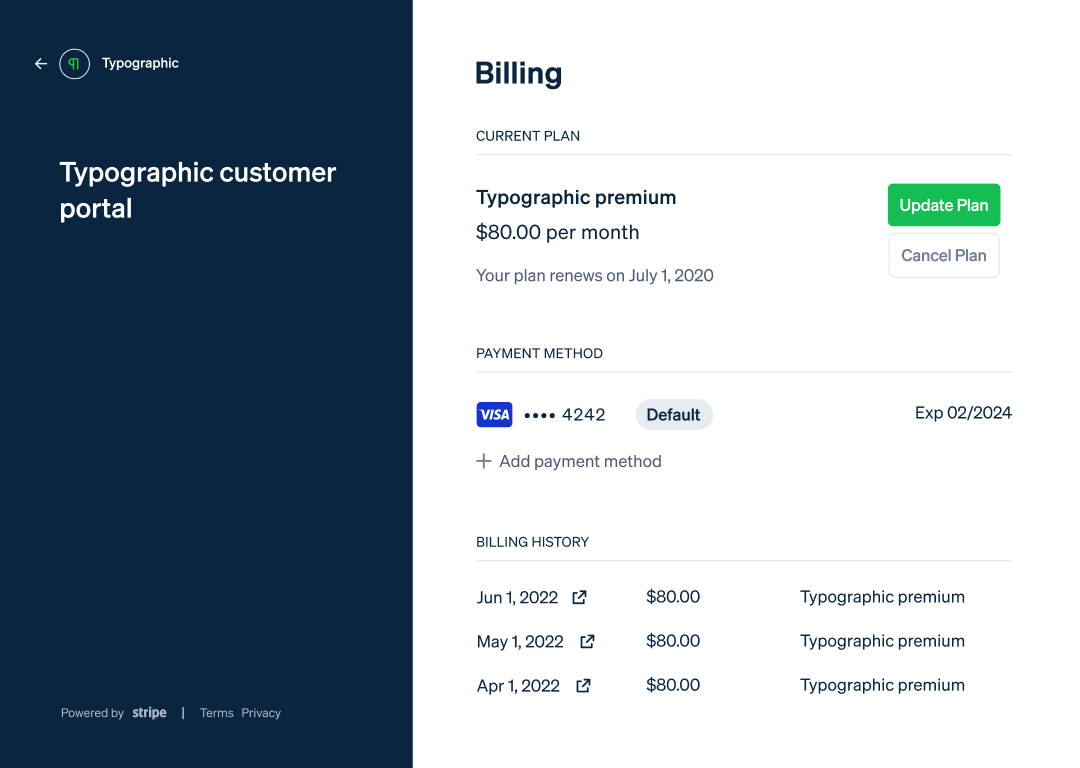
Stripe Billing makes the most sense when payments already run through Stripe and you want usage billing without introducing another financial system.
Stripe supports subscriptions, metered pricing, graduated and volume models, invoicing, and payment collection in the same ecosystem. Basic usage-based billing through Stripe Meters is included with Billing, while more complex usage billing now connects into Metronome.
That makes the starting architecture pleasantly small. Usage reaches Stripe, Stripe calculates the bill, and the same account can collect the payment.
The tradeoff appears when usage starts controlling product behavior. Billing the excess and stopping the excess are separate jobs. If credits or limits have to block an AI workload before compute begins, that decision still needs a product-side path.
Stripe Billing costs 0.7% of billing volume on pay-as-you-go pricing. The annual-contract option starts at $620/month.
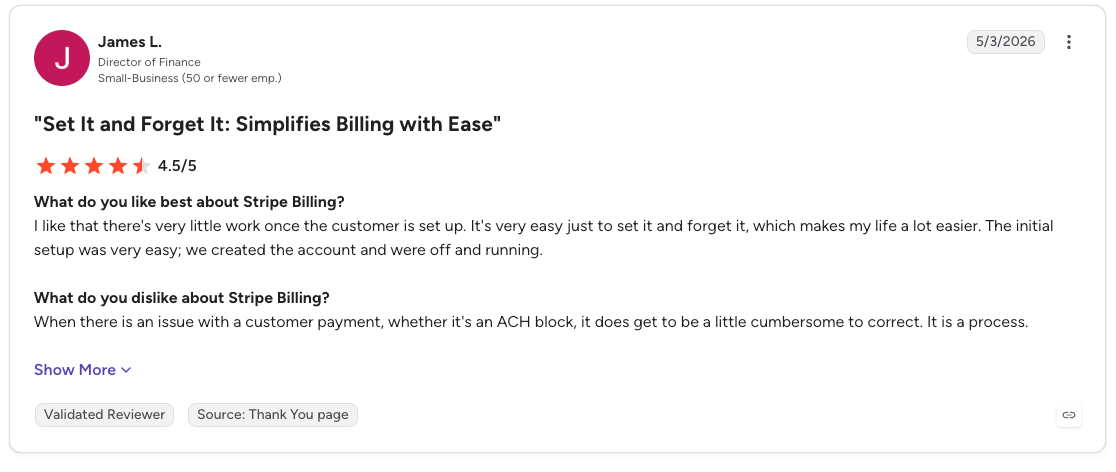
Stripe Billing: “I like that there's very little work once the customer is set up. It's very easy just to set it and forget it, which makes my life a lot easier… When there is an issue with a customer payment, whether it's an ACH block, it does get to be a little cumbersome to correct. It is a process.” [James L., G2 Review, May 3, 2026]
Stripe Billing is a good fit when Stripe already owns payments and your usage model is still fairly clean. You can keep metering, invoicing, and collection close together without adding another major system to the stack.
The point where it starts to feel different is when usage begins changing product behavior. Once a customer can run out of credits mid-session or a spend limit needs to stop another model call, billing is only half the job.
That’s the moment engineering usually starts building a second layer beside Stripe, with credit balances, entitlement checks, or request-time limits living in application code. If you can already see that coming, factor that work into the decision now.
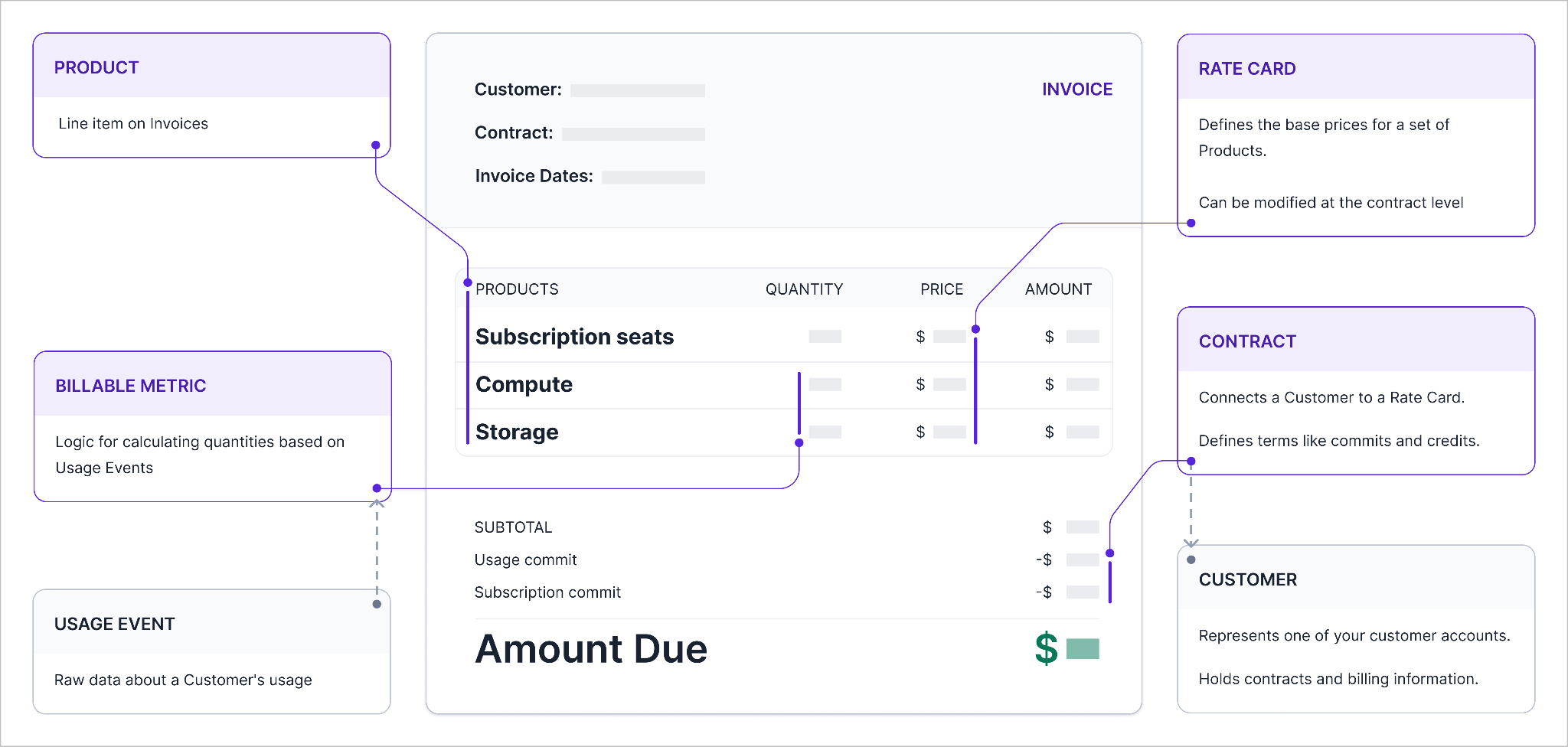
Metronome is built for products where usage data and pricing logic are demanding enough to deserve their own dedicated layer.
It handles real-time usage metering, hybrid pricing, commitments, custom contracts, and account-level revenue visibility. Stripe completed its acquisition of Metronome in January 2026, and the products are now being integrated more closely.
This is the tool I’d look at when the billing formula has stopped fitting comfortably inside a normal subscription system.
The architectural boundary is worth understanding. Metronome excels at turning high-volume usage into rated financial state. Your application may still need separate logic when that usage should approve or block the next request.
The Startup plan charges 0.8% of billing volume plus $0.04 per 1,000 ingested events. The Custom plan uses custom pricing and adds enterprise integrations, data exports, dedicated account management, and enhanced SLAs.
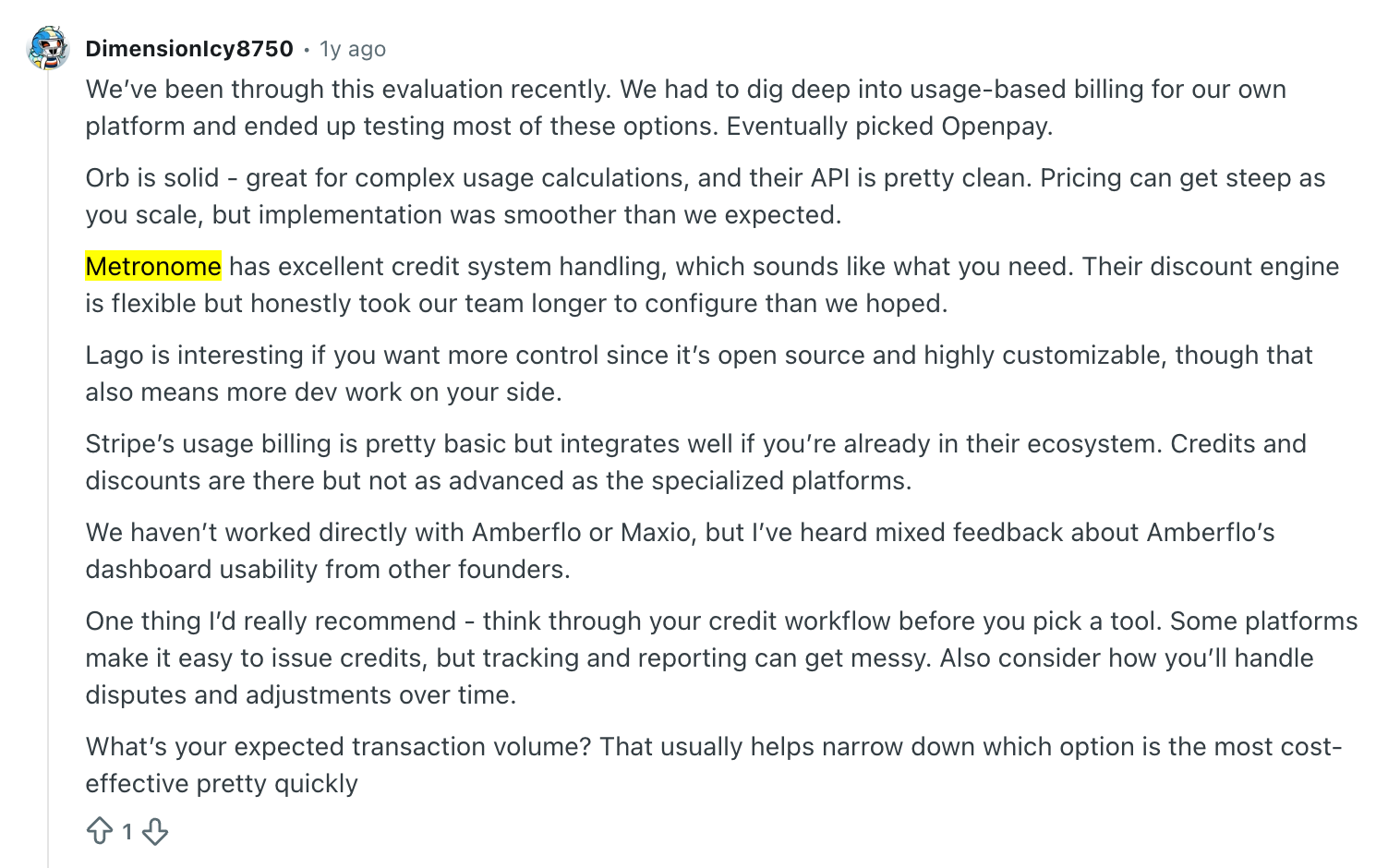
Metronome review: “Metronome has excellent credit system handling, which sounds like what you need. Their discount engine is flexible but honestly took our team longer to configure than we hoped.” [u/DimensionIcy8750, Reddit review, July 4, 2025]
Metronome is the kind of tool I’d look at after the second or third time someone says, “We can handle this in code.”
You can, for a while. Then commitments, overages, contract-specific pricing, and high-volume usage start piling up, and the rating layer becomes a product of its own.
Metronome gives that complexity a proper place to live. The Stripe acquisition makes the decision more strategic too. If Stripe is already home base, that may be a plus. If you want flexibility around billing providers, factor it in before the stack gets sticky.
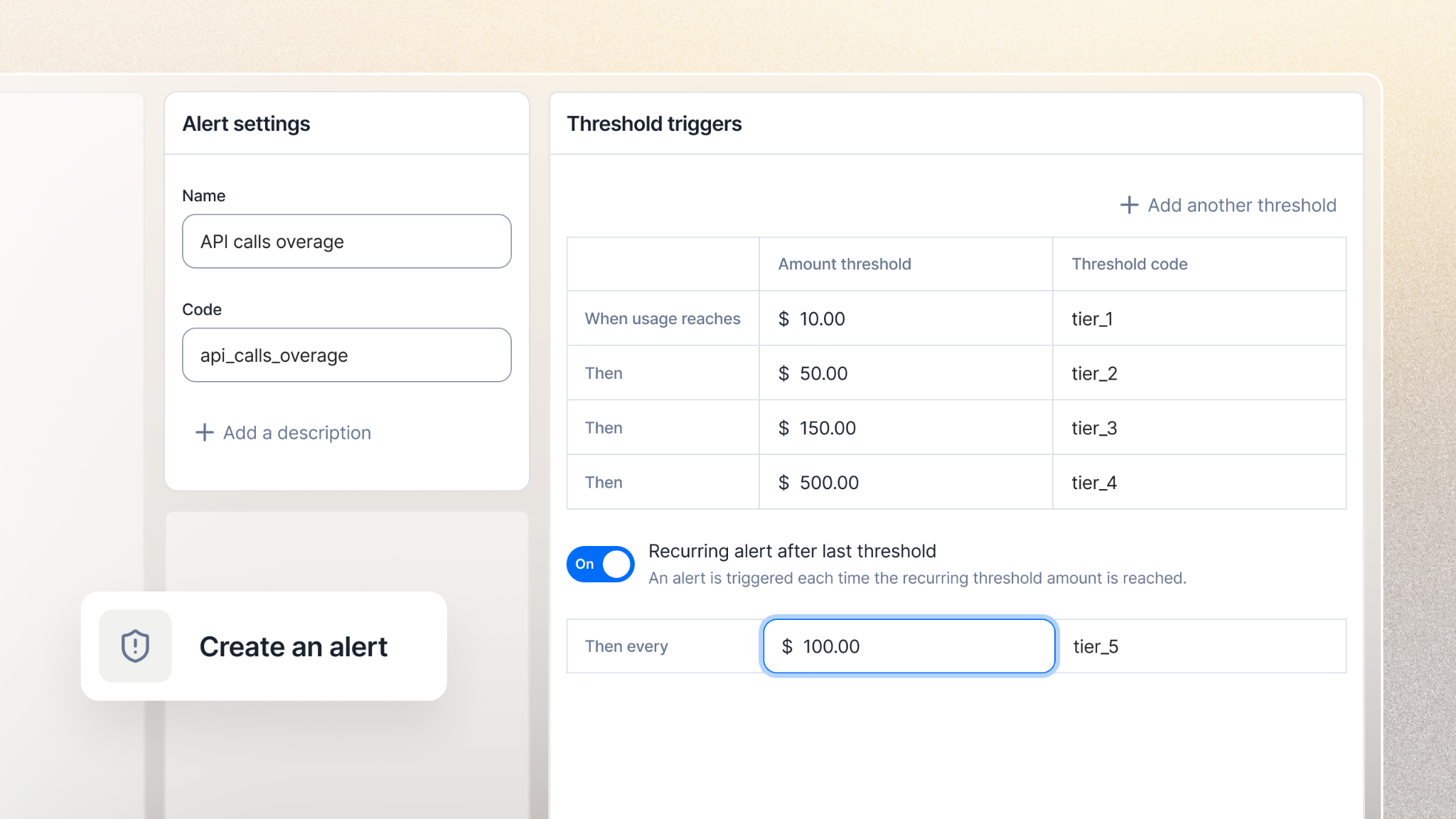
Orb’s billing engine supports real-time event ingestion, hybrid and usage-based billing, automated price changes, invoicing, alerts, and finance integrations. Core, Advanced, and Enterprise plans all use custom pricing.
That flexibility is useful when one customer contract might combine a platform fee, several meters, volume bands, minimum spend, and negotiated rates.
Adyen completed its acquisition of Orb in July 2026, so Orb now sits inside Adyen's payments stack, with Orb continuing to operate under an incubator model.
Orb also gives finance a clearer trail from usage into invoices. Its invoicing product supports real-time accrual visibility and integrates with payment platforms such as Stripe for collection.
Orb uses custom pricing across Core, Advanced, and Enterprise plans.
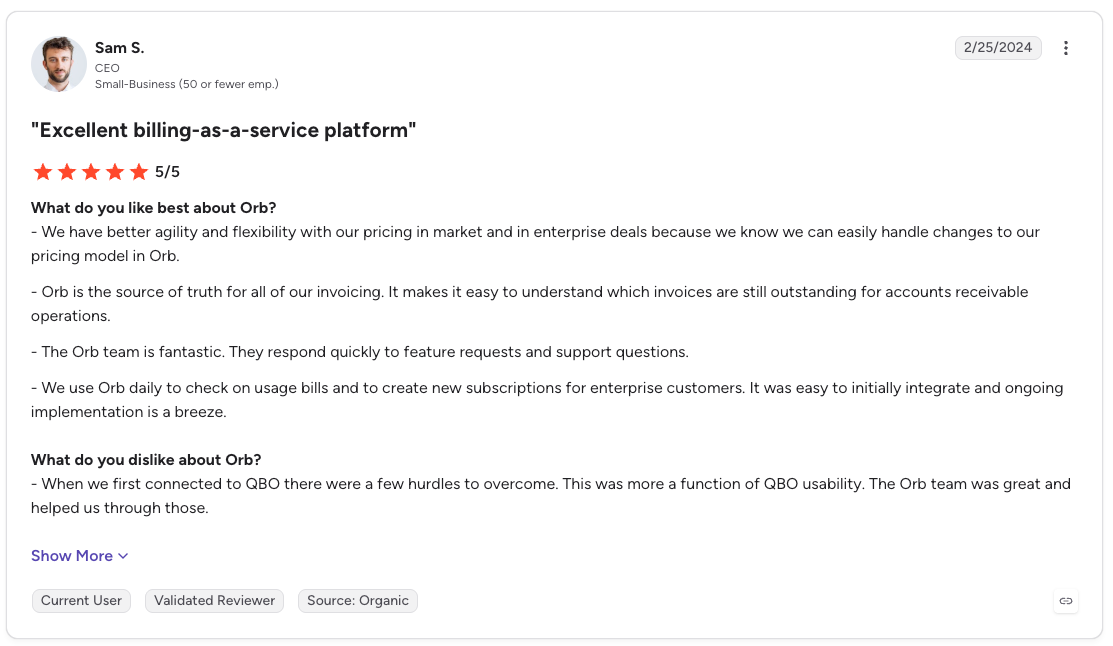
Orb review: “We use Orb daily to check on usage bills and to create new subscriptions for enterprise customers. It was easy to initially integrate and ongoing implementation is a breeze… When we first connected to QBO there were a few hurdles to overcome.” [Sam S., G2 Review, February 25, 2024]
Orb is best when your pricing logic has enough moving parts that finance and engineering need the same source of truth.
The warning sign is familiar. A customer asks how one line item was calculated, finance has one answer, and engineering has to trace the actual usage and contract rules to confirm it.
Orb gives you much more room to model those details cleanly. The payoff is easier-to-explain pricing and invoices. The work is keeping those pricing rules well structured as contracts pile up.
It’s also worth keeping in mind the recent Adyen acquisition, which could lead to changes further down the line.
Lago stands out when self-hosting, inspectable code, or infrastructure ownership matters as much as billing functionality.
The open-source core can run on your own infrastructure, while Lago Premium is available through managed cloud or self-hosted deployment. Lago supports usage billing, prepaid credits, subscriptions, hybrid pricing, invoicing, entitlements, and usage alerts.
That makes Lago more interesting than a basic “open-source Stripe alternative.” You can keep billing logic inside your environment and still avoid building the meter and invoice engine from scratch.
The tradeoff is ownership. Self-hosting moves operational responsibility back onto your engineers. Upgrades, availability, capacity, and incident response still belong somewhere.
Lago Premium uses custom pricing for both Cloud Deployment and Self-Hosted Deployment. Premium ingestion sources are available as an add-on.
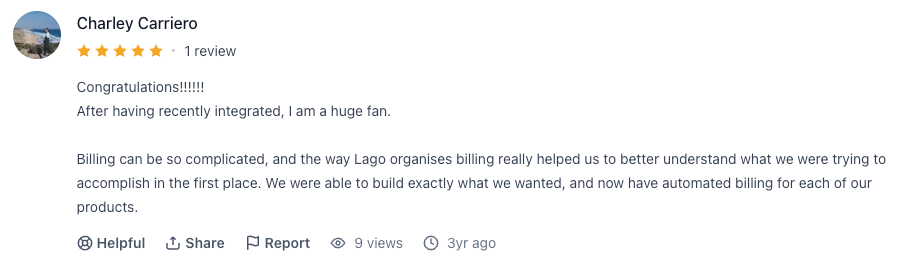
Lago review: “Billing can be so complicated, and the way Lago organises billing really helped us to better understand what we were trying to accomplish in the first place. We were able to build exactly what we wanted, and now have automated billing for each of our products.” [Charlie Carriero, Product Hunt review, April 3, 2023]
I’d put Lago on the shortlist when private deployment and source access are real requirements, not nice-to-haves.
That extra control is valuable, especially if you have the engineering depth to support it. The only thing I’d watch is whether you are solving the right problem. If the pain today is too much billing maintenance, taking on more infrastructure ownership may be the opposite of what you need.
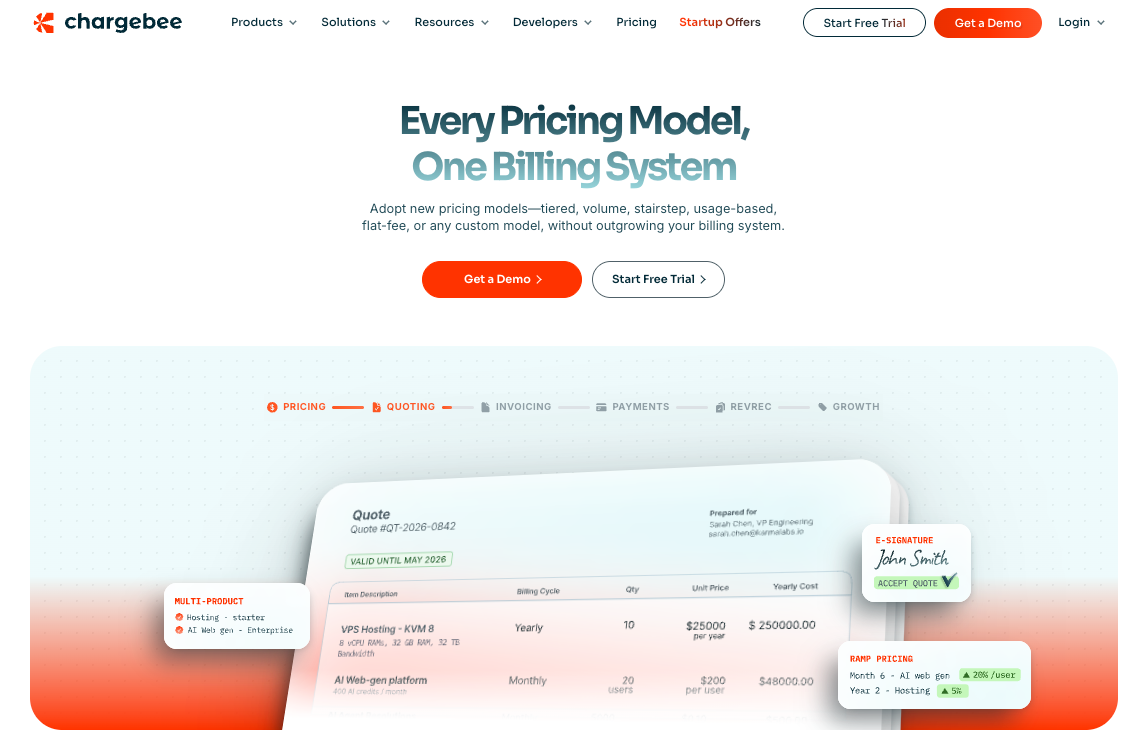
Chargebee fits companies that already think in subscriptions and now need usage to become another part of the revenue model.
Its current Flow offering supports real-time usage ingestion, near-real-time aggregation, usage limits and alerts, hybrid billing, and tiered, volume, block, and usage pricing.
The broader advantage is finance coverage. Chargebee connects subscription management, invoicing, metering, CPQ, and revenue recognition more closely than metering-only tools.
That makes it a natural fit when usage billing is growing out of an existing subscription business. The subscription management software decision matters here because plan lifecycle and usage pricing increasingly share the same commercial state.
One nuance is worth testing in a proof of concept. Usage limits and alerts are different from a synchronous pre-compute gate. If inference must stop before another token is spent, validate the exact blocking path and latency you need.
Chargebee Flow offers $0 + 0.80% of monthly invoicing volume or $99 + 0.65%. Both include 100 million usage events per month. Enterprise pricing is custom.
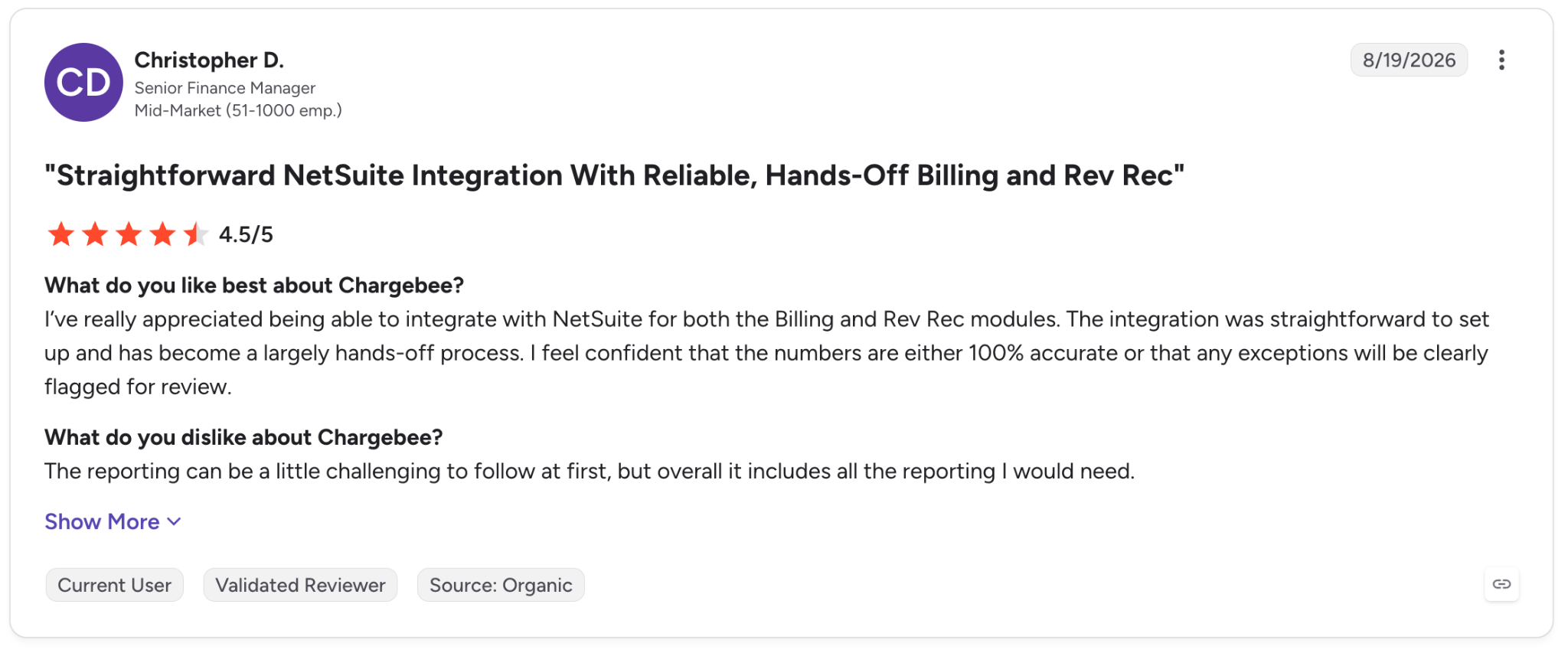
Chargebee review: “The integration was straightforward to set up and has become a largely hands-off process. I feel confident that the numbers are either 100% accurate or that any exceptions will be clearly flagged for review… The reporting can be a little challenging to follow at first, but overall it includes all the reporting I would need.” [Christopher D., G2 review, August 19, 2026]
If your product already has subscriptions and is layering usage on top, Chargebee can save you from building two separate revenue workflows.
The value is in bringing invoicing, usage, contracts, and finance operations closer together. That can be a lot cleaner than stitching a metering tool onto a subscription system later.
The one thing I wouldn’t assume is pre-compute enforcement. If credits need to stop usage before cost is created, prove that behavior in a real request flow.
Zuora fits companies where billing has become a web of contracts, subsidiaries, pricing models, and finance requirements.
Its strength is range. Recurring charges, usage billing, prepaid drawdown, commitments, tiered pricing, and volume pricing can all live in the same architecture.
That can remove a lot of awkward stitching between systems. It also means Zuora brings enterprise-system complexity with it, so expect more integration work, more configuration, and more stakeholders than you would with a lighter billing platform.
Zuora uses custom pricing based on products, scope, transaction volume, regions, and implementation requirements.
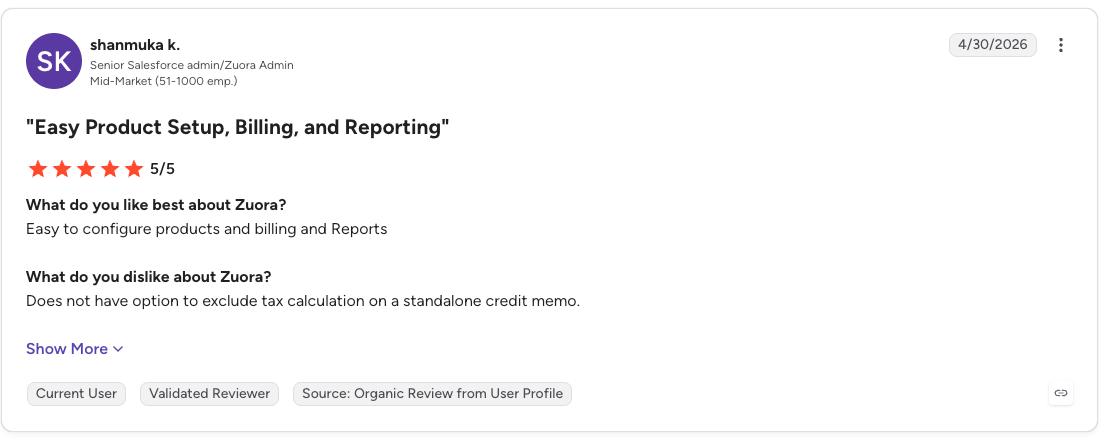
Zuora review: “Easy to configure products and billing and Reports… Does not have option to exclude tax calculation on a standalone credit memo.” [Shanmuka K., G2 review, April 30, 2026]
Zuora is less billing software and more commercial infrastructure for a complicated company.
Its value shows up in the unglamorous details that start to matter at enterprise size, like managing several entities under one customer, reflecting mid-term contract changes correctly, and keeping finance and sales working from the same commercial state.
Zuora can absorb these challenges well, but for a younger product, the structure and implementation work can arrive long before you truly need it.
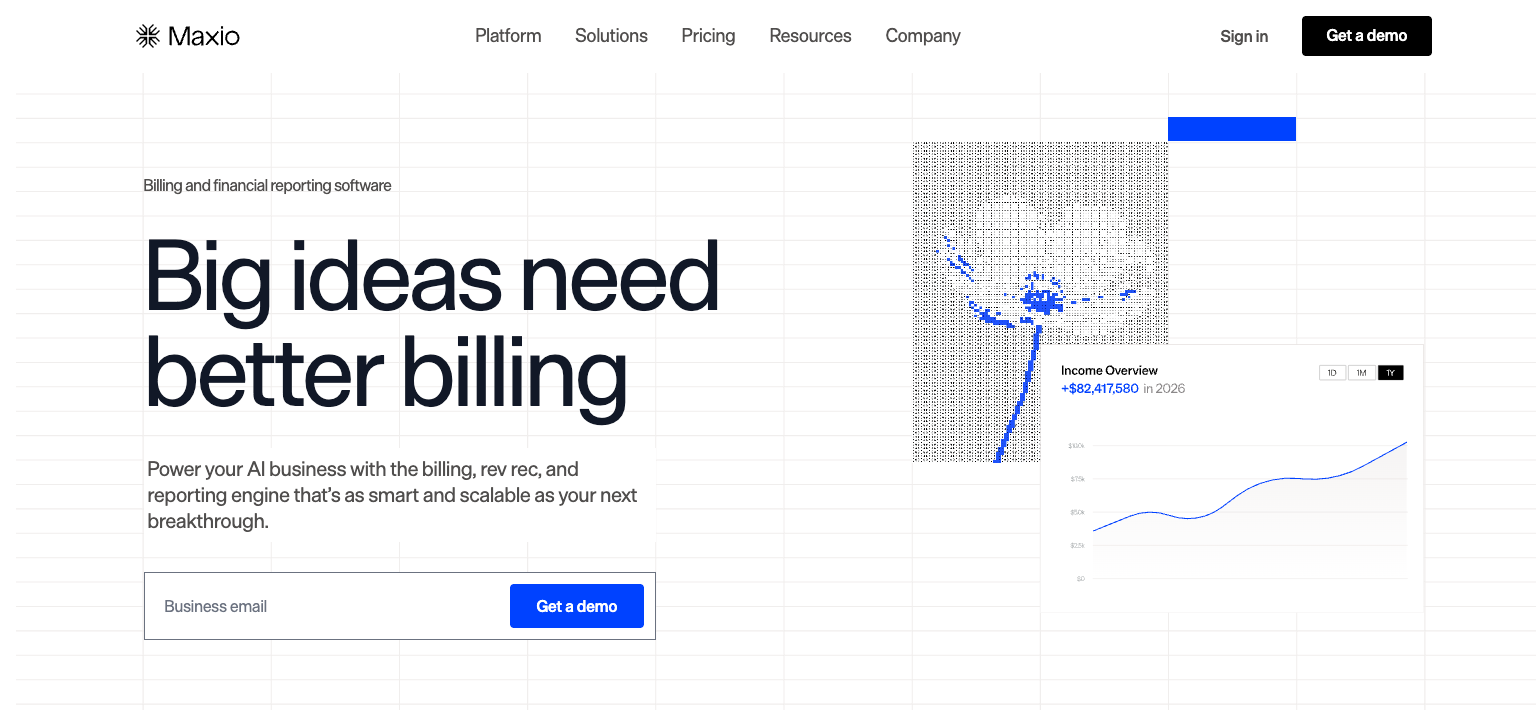
Maxio is a good example of how metered billing can sit inside a much broader SaaS finance stack.
You get usage billing and rating, but also subscription management, collections, dunning, reporting, and revenue recognition. That changes who gets value from the product.
Engineering gets the billing layer, and finance gets the context around it. If both groups need to work from the same customer and revenue state, that combination can remove a lot of awkward handoffs.
Maxio Grow costs $599/month for companies with up to $100,000 in monthly billings. Companies above that move to the Scale plan with custom pricing.
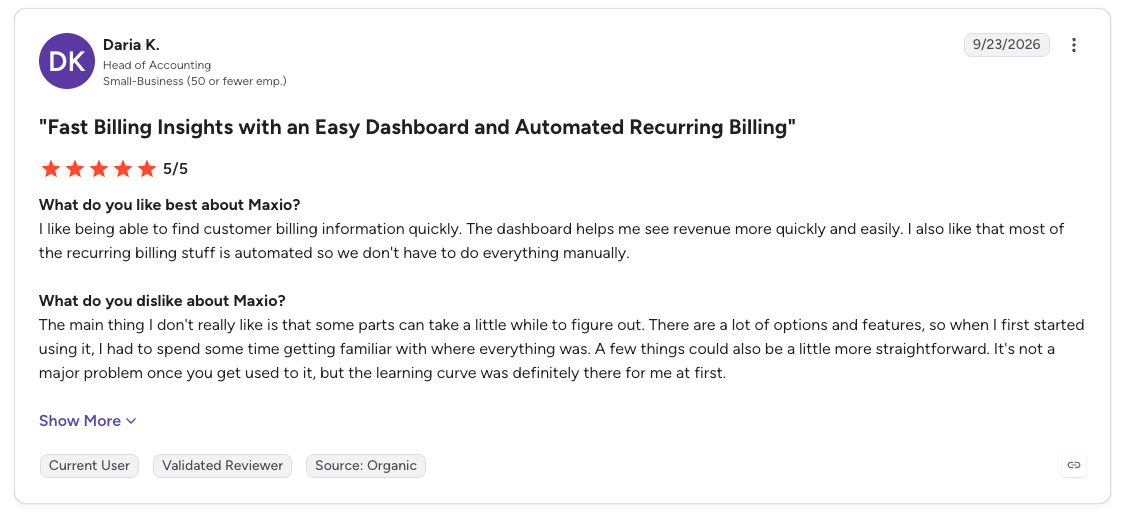
Maxio review: “I like being able to find customer billing information quickly. The dashboard helps me see revenue more quickly and easily... The main thing I don't really like is that some parts can take a little while to figure out. There are a lot of options and features, so when I first started using it.” [Daria K., G2 review, July 23, 2026]
Maxio is appealing when the meter is only the beginning of the story. Once usage becomes a charge, finance still has to invoice it, recognize it, reconcile it, and report on it, and that downstream work is where Maxio feels at home.
For an AI product generating a constant stream of token or inference events, I’d put more weight on how the metering layer behaves under that traffic.
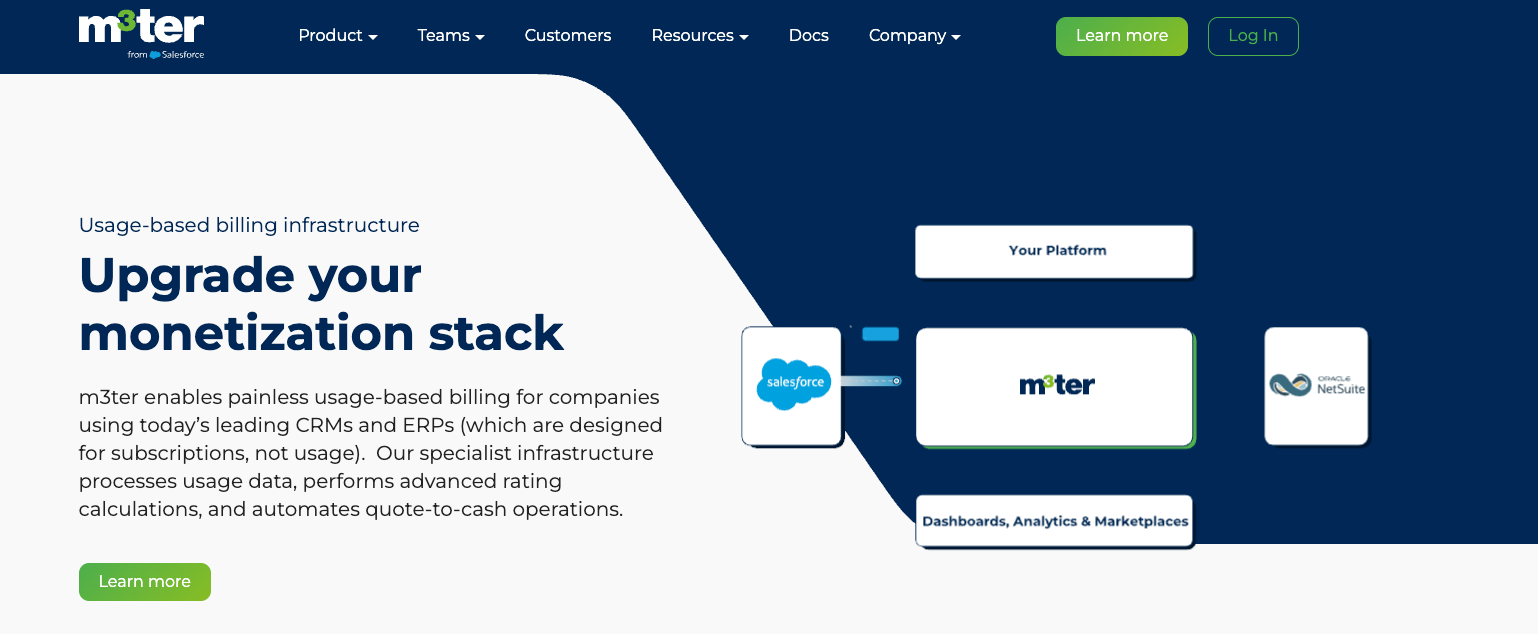
m3ter is useful when you already have systems for CRM, invoicing, and accounting but the usage layer between them has become painful.
It specializes in metering and rating. Raw consumption enters m3ter, gets converted into billable usage, then flows onward into the rest of the quote-to-cash stack.
Salesforce completed its acquisition of m3ter in July 2026, with plans to bring its high-volume metering and rating capabilities into Agentforce Revenue Management.
That makes m3ter particularly relevant for businesses already anchored in Salesforce.
Its commercial model also reflects enterprise implementation work. Pricing combines a core platform fee with optional capacity, integrations, support, and implementation services.
m3ter uses custom pricing built around a core platform fee, add-ons, support, and implementation services.
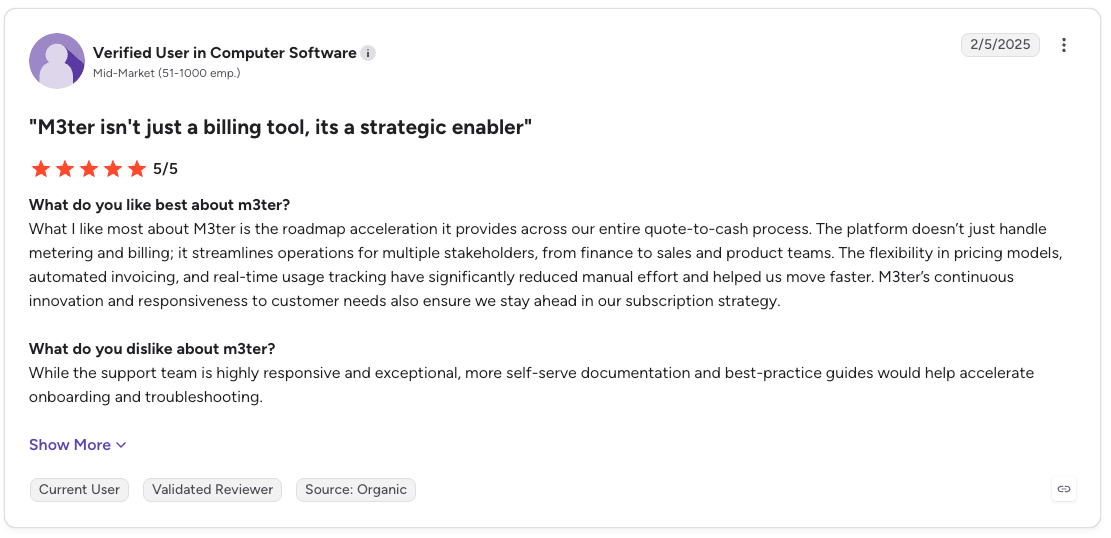
m3ter review: “What I like most about M3ter is the roadmap acceleration it provides across our entire quote-to-cash process… While the support team is highly responsive and exceptional, more self-serve documentation and best-practice guides would help accelerate onboarding and troubleshooting.” - [Verified User in Computer Software, G2 review, February 5, 2025]
m3ter is useful when the rest of your revenue stack already exists and the messy part is turning raw usage into something those systems can trust.
That is a specific problem. Salesforce may know the contract, NetSuite may own the financial record, but someone still has to normalize the usage, apply the right rates, and hand clean data downstream.
m3ter fits neatly into that middle layer. If you want one platform to take you all the way through invoicing and payments, though, you will still be stitching together more than one system.
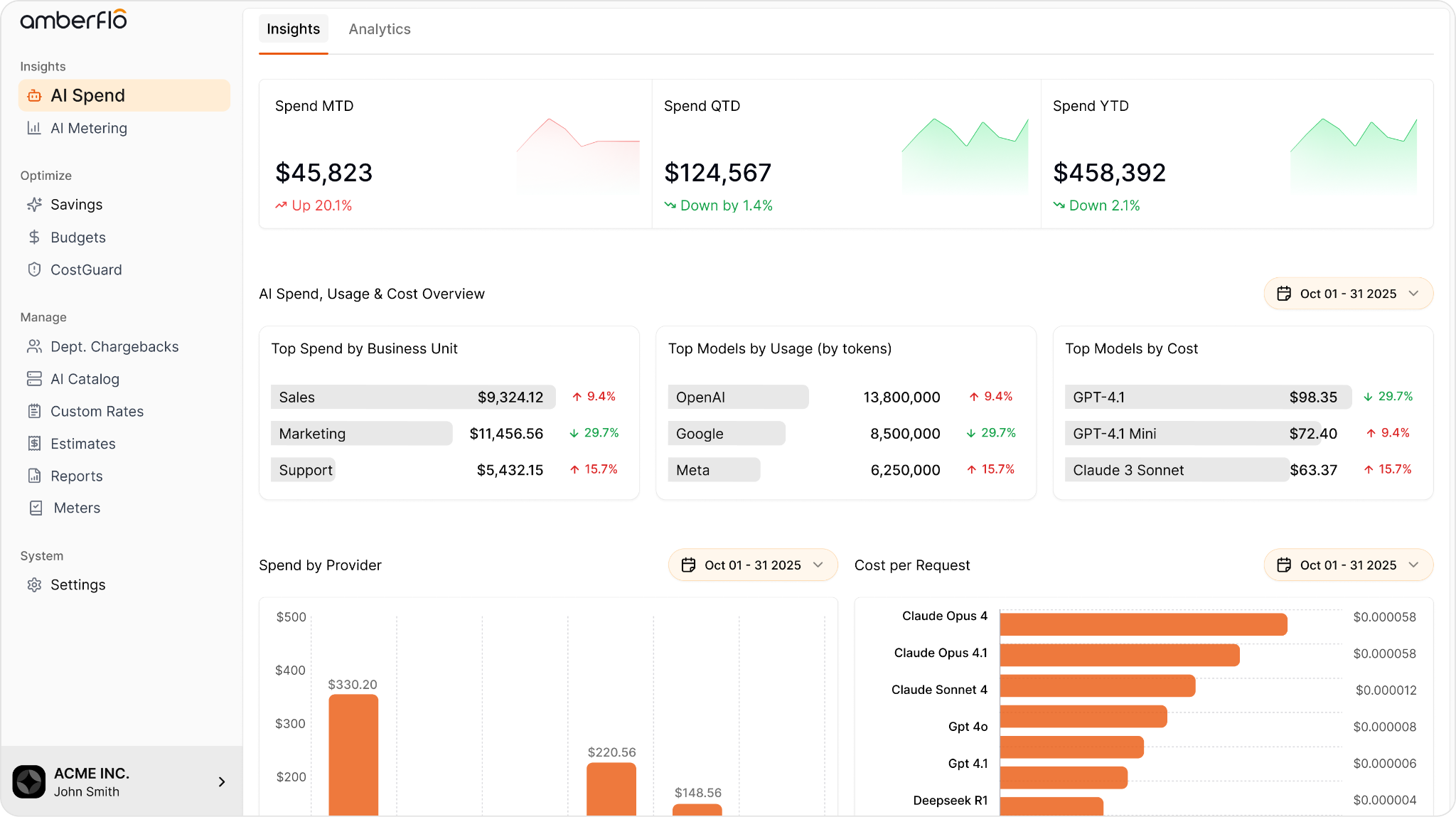
Amberflo is strongest when accurate event-level metering is the first problem you need to solve.
It meters tokens, API calls, GPU seconds, documents, and custom events, then applies pricing and generates invoices from that usage. Amberflo also supports prepaid credits, usage dashboards, and Stripe-powered collection.
The architecture feels metering-first. That is useful when your product generates a large stream of usage events and you care about customer-level cost visibility alongside billing.
Amberflo also exposes current usage and credit state, which helps with alerts and product experiences. If your requirement is a strict synchronous gate before compute (stopping a request before it runs rather than reconciling after) that decision lives closer to the product than the meter.
Amberflo uses usage-based pricing tied to event ingestion volume and the amount invoiced. Essential and Custom plans require a quote, with no seat-based pricing or artificial customer limits.

Amberflo review: “Amberflo team has done a tremendous amount for us in term of saving our development time and serves as our unified platform for tracking usage, rewards, custom credit, and billing; seamlessly plugs between our application and blockchain layer.” [Xiaoran Zhang, Product Hunt review, April 7, 2022]
Amberflo fits products that need current, attributable usage data first and billing built directly on top of it.
It is especially relevant for AI and API products where the billable event is generated continuously throughout the product session.
Choose metered billing software based on where pricing logic and usage state should live. That choice affects how quickly you can change packaging, debug billing issues, and control usage while it is happening.
Most architectures fall into three patterns:
The painful version is when every pricing change still needs an engineering deploy. A small credit adjustment or plan-limit change suddenly joins the release queue.
For AI products, the AI billing software decision gets more specific. Which system owns tokens and credits? Which one calculates the charge? Which one can stop the next request?
Generative workloads add another wrinkle. Generative AI usage-based billing software has to track models, token types, workloads, and credit conversion without losing the original usage trail.
A useful rule is simple. Use billing-first when usage only needs to affect the invoice. Add request-time infrastructure when usage also needs to affect what the product can do.
If you still charge one flat subscription with no measured usage, you probably do not need metered billing software yet.
There isn’t one metered billing platform that fits every architecture.
Stripe Billing makes the most sense when Stripe already owns payments and your usage model is still manageable inside one billing ecosystem.
Metronome and Orb are stronger choices when event rating and pricing logic are the difficult part. Metronome leans toward high-volume usage infrastructure, while Orb is compelling for multi-dimensional pricing and invoice detail.
Lago gives engineering more deployment and source-code control. Chargebee and Maxio fit businesses where subscription operations and finance workflows carry as much weight as raw usage metering.
Zuora is built for larger enterprise billing environments. m3ter makes sense when metering and rating need to plug into an existing CRM and ERP architecture. Amberflo is attractive when event-level metering and usage visibility are the first priorities.
Pick the software that owns the billing side you want to stop maintaining. Then decide separately whether usage also has to control the next request before it runs, because metering tells you what happened, but a layer closer to the product decides what's allowed.
A perfectly accurate meter can still be too late. A customer may have 100 credits available, burn through 120 in an afternoon, and leave you with a perfectly clean usage trail and a perfectly correct invoice.
The billing worked, but the control happened too late.
Metered billing software can tell you what happened, but it does not automatically stop the extra 20 credits from being consumed.
That live decision belongs closer to the product.
Stigg sits in that layer, where credits, entitlements, limits, and spend rules are checked while the request is still waiting to run.
For engineers, that changes the architecture in a useful way:
This is the part worth checking during a metered billing evaluation. Does the tool only tell you the customer crossed the boundary, or can your product react before the next expensive request runs?
The Stigg docs get into the mechanics of turning usage state into live decisions with metering, credits, entitlements, Sidecar, and BYOC.
Metered billing software measures customer usage, applies pricing rules, and turns that consumption into billable charges. Common meters include API calls, tokens, compute time, storage, seats, and credits.
The main difference between metered billing and usage-based billing is implementation versus pricing strategy. Usage-based billing defines what customers pay for consumption, while metered billing measures that consumption and calculates the charge.
The main difference between a rating layer and a billing platform is what each system owns. A rating layer converts raw usage into priced charges, while a billing platform typically manages invoices, subscriptions, payments, and financial records.
Yes, some metered billing platforms can track current usage, balances, limits, and alerts. Synchronous request blocking is a separate capability, so confirm whether the system can approve or deny usage before compute runs.
AI products should meter credits and tokens at the request level and tie each event to the correct customer, model, feature, or workload. Keep raw usage metering separate from the credit ledger, with stable event IDs, current balances, and defined depletion rules.
%20(1).png)
%20(1).png)