Industry Insights
Paying for Outcomes Is an Adjudication Problem
RFC v0.1: a vendor-neutral, research-backed proposal for pricing AI agents on outcomes, with a reference design and pre-registered predictions.

OpenAI’s “Beyond Rate Limits” reveals the entitlement-first architecture behind modern AI monetization and why billing alone is no longer enough.

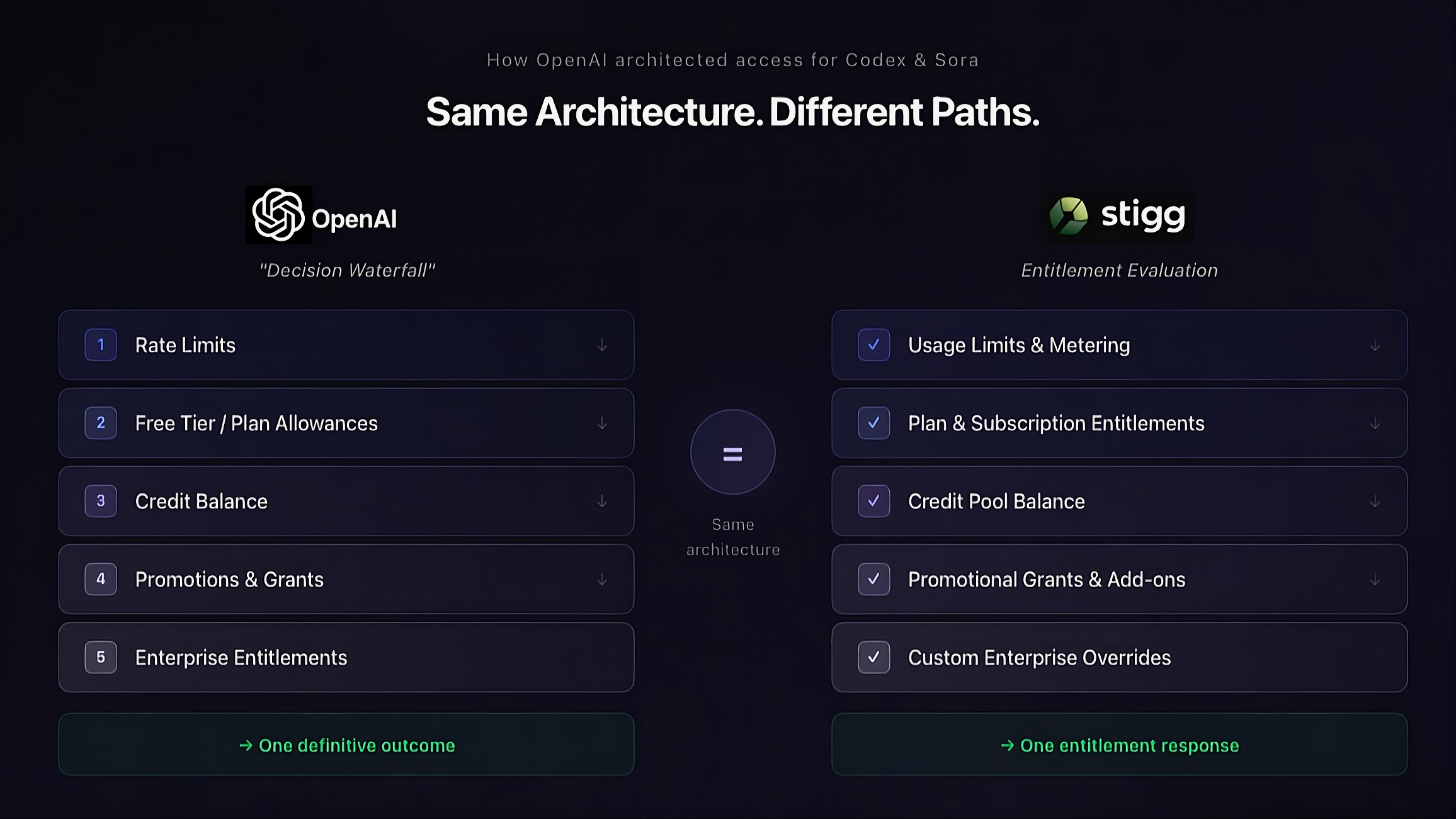
Last week, OpenAI’s engineering team published a post titled “Beyond Rate Limits.”
It describes a real-time access engine that unifies rate limits, credits, subscriptions, and enterprise entitlements into a single decision path.
If you are building AI products, you recognize the pattern immediately. Users dive in, find value quickly, and then hit a boundary. Sometimes that boundary makes sense. Sometimes it feels arbitrary. Sometimes it is simply wrong.
When monetization logic is fragmented across systems, users experience the seams. A request gets blocked even though credits are available. A balance looks wrong. An overage kicks in unexpectedly. Trust erodes quietly.
That is the problem OpenAI solved.
It is also the problem we set out to solve with Stigg.
OpenAI describes a conceptual shift: instead of asking, “Is this request allowed?”, their system asks, “How much is allowed, and from where?”
That difference shows up in the user experience.
A binary access model works when plans are static and limits are simple. But AI products are layered. A user might be rate-limited, but still have prepaid credits. They might have exhausted their monthly allowance, but still be covered by an enterprise commitment. They might be part of a promotion that applies only to certain usage types.
If your system asks only whether something is allowed, it forces a hard stop. Come back later. Upgrade your plan. Contact sales.
If your system understands how much is allowed and which balance to draw from, the experience changes. The user keeps going. The system draws down credits. The allowance updates. No surprise interruption.
If your system asks only whether something is allowed, it forces a hard stop. If your system understands how much is allowed and which balance to draw from, the experience changes.
From the outside, it feels seamless. Underneath, it requires a unified entitlement evaluation.
OpenAI calls this a decision waterfall. Rate limits, free tiers, credits, and enterprise agreements are layers in the same stack. The request flows through once and returns one answer.
That single decision path eliminates a common failure mode in AI monetization: different systems disagreeing about whether usage is valid. When the system is unified, the answer is deterministic and explainable.
Billing systems answer the question: what happened?
Access systems answer the question: what can happen right now?
Billing systems answer the question: what happened? Access systems answer the question: what can happen right now?
Those questions operate on different time horizons.
Billing can aggregate usage and reconcile it later. If something is slightly delayed, it usually does not affect the immediate experience.
Access cannot tolerate that delay. When someone sends a request to generate code or produce a video, the answer must reflect their exact entitlement state at that moment. If the system does not know whether credits are available until a background job runs, the user either gets blocked unnecessarily or allowed to overspend.
Both outcomes are visible.
OpenAI evaluated third-party usage billing systems and found they were well-suited for invoicing and reporting. But they could not guarantee real-time correctness inside the access path.
That is the architectural boundary.
Usage billing platforms see invoices. Entitlement engines see requests. In AI products, the request is where monetization actually happens. Our VP Engineering wrote a technical deep dive on AI Usage Governance and why billing systems can't enforce usage.
In traditional SaaS, usage accumulates quietly in the background. At the end of the month, an invoice reflects what happened. Occasional mismatches can be corrected before billing closes.
AI products are different. Every request consumes compute. Every token has cost. Usage spikes are immediate and sometimes unpredictable.
Consider an enterprise customer with a hybrid contract: a base subscription, a prepaid credit pool for experimentation, and overage billing beyond that. When a developer on that account sends a request, the system must decide instantly which economic layer applies. If the monthly allowance is exhausted but credits remain, the request should succeed. If credits are gone but overages are permitted, the request should still succeed. If neither applies, the request must stop.
If that decision is distributed across separate systems, inconsistencies appear. One system thinks credits exist. Another thinks they do not. The user sees an error that support cannot easily explain.
If that decision is distributed across separate systems, inconsistencies appear. One system thinks credits exist. Another thinks they do not. The user sees an error that support cannot easily explain.
Unifying that decision in a single entitlement evaluation removes that ambiguity. The system knows the full context. The answer is predictable. The user experience is stable.
OpenAI describes credits as just another layer in the waterfall. That phrasing is intentional.
When credits are bolted on as an afterthought, they behave like a balance counter. But once real money flows through them, they become a ledger.
When credits are bolted on as an afterthought, they behave like a balance counter. But once real money flows through them, they become a ledger. They require attribution, auditability, and idempotency. Retries cannot double-charge. Concurrent requests cannot race to consume the same balance.
If a request is approved but the credit deduction fails, the system drifts out of sync. If deductions are not serialized correctly, balances go negative or usage is misbilled. These edge cases are not theoretical. They surface at scale.
OpenAI chose to prioritize provable correctness, even tolerating slight balance update delays to preserve auditability and user trust. That trade-off reflects a deeper principle: in AI monetization, trust in the numbers matters as much as access itself.
When a user checks their balance, it must match reality. When finance reconciles usage, every unit must be explainable.
Embedding credits inside the entitlement engine ensures that approval, consumption, and audit trails remain tied together.
At Stigg, we model every access decision as an entitlement check for the same reason.
When an application asks whether a user can access a feature or consume additional usage, it makes a single real-time call. That call evaluates subscriptions, add-ons, credits, promotions, usage limits, and contractual overrides in one place.
The application does not orchestrate multiple checks. It does not guess which balance to inspect first. It does not reconcile differences after the fact.
It receives one answer.
That simplicity at the surface protects teams from a different kind of failure. Without a unified entitlement system, monetization logic often spreads across services. Product teams hard-code plan logic. Growth teams add promotional exceptions. Finance layers in credits. Over time, the system becomes brittle. Packaging changes become risky. Enterprise deals require custom patches.
Centralizing entitlements keeps monetization flexible without sacrificing correctness.
OpenAI’s post is significant because it articulates, in detail, why entitlement-first architecture is not just elegant but necessary for AI products.
Per-request evaluation. Deterministic enforcement. Real-time credit handling. Full auditability.
These are not optimizations. They are requirements for protecting user momentum and financial integrity at the same time.
Not every company can build this system from scratch.
The architecture OpenAI describes, the decision waterfall, fused entitlements and credits, atomic balance handling, and auditable financial records, is the architecture we have been building into Stigg for the past three years.
Billing providers remain essential. We integrate with them deeply.
But billing records what happened.
Entitlements ensure the next request behaves exactly as it should.
And in AI products, that precision is what keeps users moving instead of hitting walls.
If you’re designing this layer right now and weighing whether to build it yourself, it’s worth seeing how we’ve structured it in practice.