%20(1).png)
Guides
Best Metered Billing Software: 9 Tools Ranked (2026)
I tested 9 metered billing software platforms for metering accuracy, pricing, and real-time enforcement, with honest pros, cons, and prices for 2026.

Compare Chargebee vs Metronome on usage metering, entitlements, pricing, integrations, and revenue workflows to see which fits your stack.


Chargebee and Metronome overlap on usage billing, but their center of gravity is different.
Chargebee is built around a broader billing and revenue workflow, while Metronome is built around metering and rating usage at a deeper level. I compared their catalogs, pricing approaches, and product workflows to see what that means for different setups.
I’ll also explain where Stigg fits when you need live usage rules enforced inside the product.
Choose Chargebee if you want billing, payments, CPQ, and revenue recognition under one login, and you'd rather not stitch together multiple vendors.
Choose Metronome if usage is complex enough (tokens, GPU-seconds, hybrid models) that you want an engine built solely to meter it, at a volume closer to OpenAI's than a typical startup's.
Before settling on either stack, it helps to understand where Stigg, the usage runtime for AI products, fits. Its focus is live usage control, which sits beside billing and metering.
Chargebee is a full billing and revenue platform that covers the commercial flow from pricing and product catalog management through invoicing, payments, usage billing, CPQ, and revenue recognition.
For AI products, it supports credits, tokens, outcomes, agent actions, commitments, and hybrid pricing alongside more traditional subscription models.
Who it’s for: Companies that want billing connected across product, sales, and finance, especially when they have several pricing models, currencies, payment methods, or enterprise contracts.
Best for: Broad billing and revenue operations in one system. Chargebee makes more sense when usage billing is one part of a larger stack that also needs invoicing, payments, CPQ, RevRec, and catalog management.
Key features include:
Metronome is a billing and monetization infrastructure built around usage data and flexible pricing. It ingests product usage, meters and rates it, applies contract terms, such as credits and commitments, generates billing data, and provides customers with visibility into usage and spend.
It now supports usage-based, subscription, seat-based, and hybrid pricing.
Stripe acquired Metronome in January 2026, and it now operates as Stripe's usage-billing product line.
Who it’s for: Product, engineering, and finance organizations with complex consumption data, custom enterprise contracts, or pricing that changes frequently.
Best for: Usage-heavy products with complex metering and rating requirements. Metronome is particularly strong when pricing depends on multiple usage dimensions or when self-serve pricing must coexist with negotiated enterprise commitments.
Key features include:
Disclaimer: Prices are subject to change without notice. Always check the official Chargebee and Metronome sites for current numbers.
The meaningful differences show up in four areas: usage metering, entitlement controls, published pricing, and how much of the revenue stack each platform covers.
Chargebee: Ingests raw or pre-aggregated usage through APIs, S3, data warehouses, and files. Its metering engine supports SQL for complex metrics, event-level failure tracking, and idempotency controls.
Chargebee publishes a standard live-site throughput of up to 200,000 usage events per second, with 100 million events per month included on the free tier.
Metronome: Stores raw usage events and lets you build SQL-based billable metrics without pre-aggregating the data first. Streaming metrics add low-latency usage and spend alerts, while rate cards let you change how events are priced without changing the underlying instrumentation.
Winner: Metronome.
Both publish credible throughput numbers, but Metronome is the one running at the volumes only a handful of AI companies reach, like OpenAI's entire API billing stack, Anthropic, Databricks, and NVIDIA. If you're worried about hitting a metering ceiling, that lived-experience advantage matters.
Chargebee: Entitlements are a first-class part of the platform. You can map feature access, model access, token or credit allowances, and usage limits to plans, then apply customer-specific overrides.
Chargebee also says these limits can be enforced at runtime and tied to the same subscription record used for billing.
Metronome: Metronome does have entitlement controls, and they’re often underestimated. Rate cards and contract overrides can mark products as entitled or disabled, and its docs show these states being read by the product to gate access.
It also supports spend limits, credit thresholds, alerts, and automated actions when thresholds are reached.
Winner: Chargebee.
Metronome can handle feature gating and entitlement states, but Chargebee offers a more explicit entitlement management layer that covers feature access, quotas, usage limits, model tiers, and customer overrides, all from the same catalog and subscription model.
Chargebee: Flow starts at 0.80% of monthly billing value with no platform fee and includes 100 million usage events per month. Its monthly-commit option costs $99/month + 0.65% of billing value.
Metronome: Startup pricing is 0.8% of billing volume + $0.04 per 1,000 ingested events. Larger deployments move to custom pricing.
Winner: Chargebee on the published starting price. The billing-volume percentage starts at 0.8%, but Chargebee includes 100 million monthly usage events, whereas Metronome charges separately for ingestion. Custom contracts can change the economics at higher volumes.
Chargebee: Goes well beyond usage billing. Its platform spans billing and invoicing, payments, CPQ, receivables, revenue recognition, pricing experiments, retention, reporting, and entitlements, all built around the same commercial record.
Metronome: Its scope is broader than metering alone. It covers metering, rate cards, contracts, credits and commitments, invoicing, usage reporting, customer billing dashboards, spend controls, and integrations with Stripe, Salesforce, NetSuite, and cloud marketplaces.
Its focus remains much more concentrated around pricing, consumption, and billing infrastructure.
Winner: Chargebee.
If breadth is the criterion, Chargebee clearly covers more of the revenue lifecycle. Metronome is the narrower platform, with more of its product centered on metering, pricing, contracts, and usage-driven billing.
G2 and Reddit reviews converge on the same picture. The numbers are reliable, but the reporting has a learning curve on Chargebee, and Metronome's credit handling is strong, but its discount engine takes work.
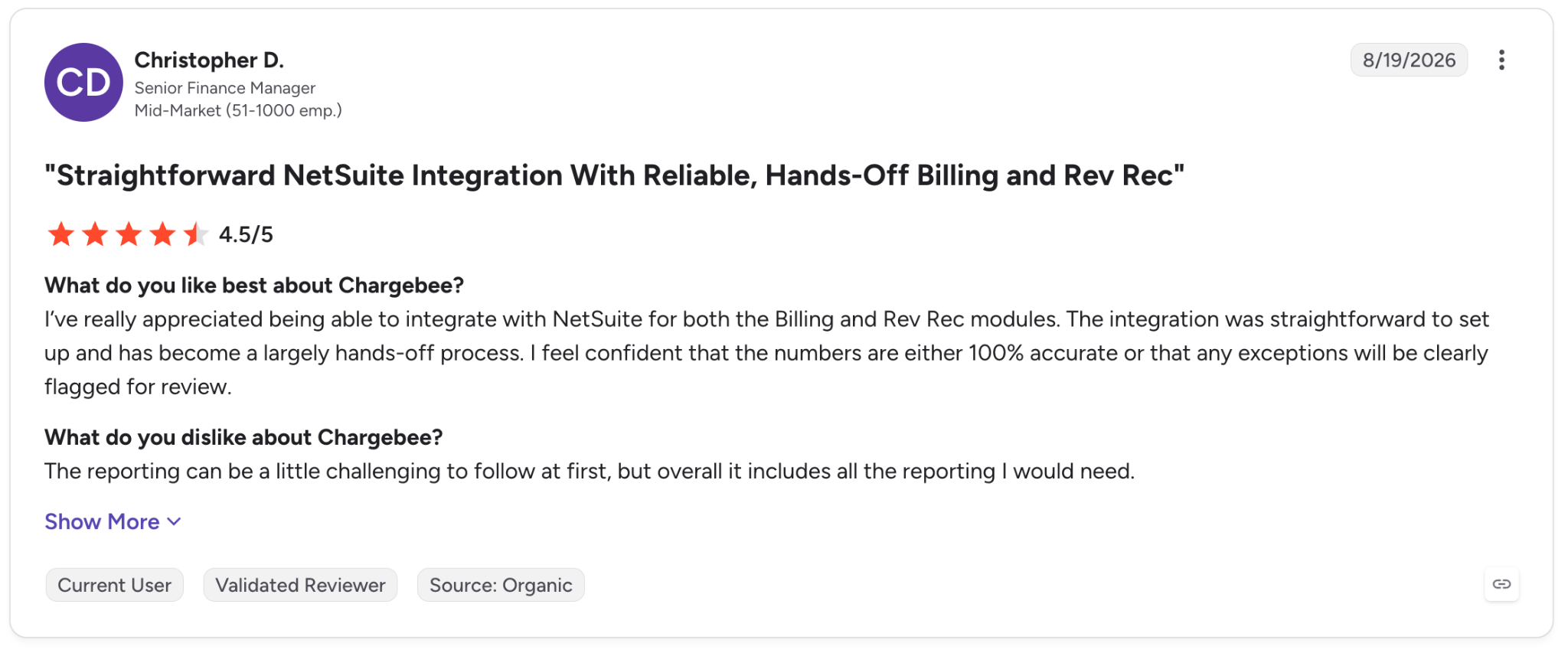
Chargebee review: “The integration was straightforward to set up and has become a largely hands-off process. I feel confident that the numbers are either 100% accurate or that any exceptions will be clearly flagged for review. The reporting can be a little challenging to follow at first, but overall it includes all the reporting I would need.” [Christopher D., G2 review, August 19, 2026]
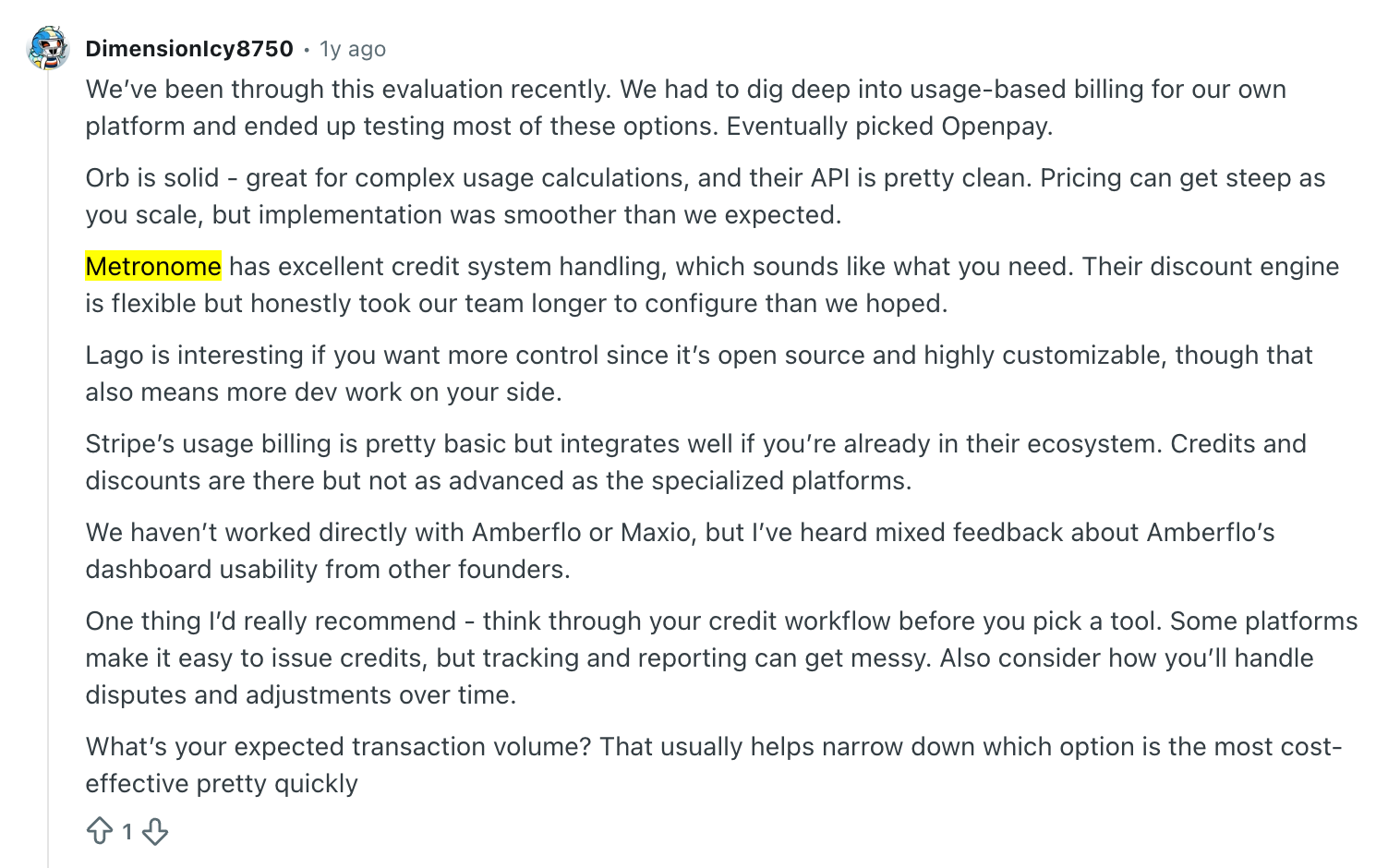
Metronome review: “Metronome has excellent credit system handling, which sounds like what you need. Their discount engine is flexible but honestly took our team longer to configure than we hoped.” [u/DimensionIcy8750, Reddit review, July 4, 2025]
If you want to compare Metronome with more vendors, explore the best Metronome alternatives.
The better choice depends on how much of the revenue stack you want the platform to own and how central usage-based billing is to your product.
Choose Chargebee if you:
Choose Metronome if you:
Lean toward Chargebee when billing is one piece of a wider revenue operation, and you want CPQ, invoicing, and RevRec in the same place.
Metronome makes more sense at the extreme end, with high-volume metering and multi-year enterprise contracts, which is why it's the billing engine behind OpenAI and Anthropic.
Neither of them decides what a customer is actually allowed to do at request time, though. That's a separate problem, and it's what Stigg exists to solve.
There is one separate requirement that neither comparison settles. Billing and metering tell you what usage should cost, but runtime infrastructure decides whether the next request is allowed to run. That is where Stigg fits.
The Chargebee vs Metronome comparison mostly centers on billing breadth, metering, and revenue workflows. Stigg sits in a different part of the stack. It focuses on the product side, where usage rules must be checked as customers and AI agents consume resources.
Stigg can work alongside an existing billing provider, with commercial rules kept close to the request path.
Key capabilities include:
That makes Stigg most relevant when the harder problem is controlling usage inside the product, while Chargebee or Metronome continues handling the billing side.
If you’re mapping this against your own stack, the Stigg docs are a good place to see how the runtime pieces fit together.
The main difference between Chargebee and Metronome is platform breadth versus usage-billing depth.
Chargebee covers billing, payments, CPQ, revenue recognition, entitlements, and usage pricing, while Metronome concentrates more heavily on metering, rating, contracts, credits, and consumption-based billing.
Yes. Chargebee supports usage-based and hybrid billing, including real-time event ingestion, custom SQL meters, included usage, overages, and usage-based pricing models. Its Flow plan currently includes up to 100 million usage events per month.
Yes, Stigg is built to sit alongside an existing billing stack. Stripe and Zuora are native integrations; Chargebee, Metronome, and Orb connect via Stigg's workflow integrations. Any other billing system can connect through Stigg's APIs.
The main difference between usage-based billing and entitlements is what each rule controls. Usage-based billing measures consumption and turns it into charges, while entitlements define the features, allowances, or access a customer receives.
Chargebee supports both, while Stigg centers its product around entitlements, credits, and request-time usage governance.
Chargebee Flow starts at 0.80% of monthly billing value with no platform fee and 100 million usage events included.
Metronome starts at 0.8% of billing volume + $0.04 per 1,000 ingested events. Stigg has a free Build plan, while Pro is $399/month with monthly billing or $331/month with annual billing.
%20(1).png)
%20(1).png)