%20(1).png)
Guides
Best Metered Billing Software: 9 Tools Ranked (2026)
I tested 9 metered billing software platforms for metering accuracy, pricing, and real-time enforcement, with honest pros, cons, and prices for 2026.

A hands-on look at Metronome, Stripe Billing, and Stigg for AI product billing on tokens and credits. Pricing, features, and real user feedback inside.


Metronome vs Stripe isn't a fair fight anymore. They're both under the same roof now, which means you're mostly choosing between two products from one company instead of two rivals.
I spent weeks in the docs and pricing calculators sorting out which one wins for usage-based billing.
Two Dropbox engineers founded Metronome in 2019, and it built its reputation metering usage for OpenAI, Anthropic, Databricks, and NVIDIA. Stripe completed its acquisition of Metronome in January 2026.
Metronome now runs in two ways at once: standalone on metronome.com with its own pricing and sales team, and within Stripe Billing as the engine, listed as "Powered by Metronome, a Stripe product."
Stripe processed $1.9 trillion in payments in 2025 and now runs nearly 200 million active subscriptions through Stripe Billing.
Billing covers recurring subscriptions, invoicing, tax, dunning, and, since the Metronome deal, usage-based pricing. Its Meters API is included in Billing pricing at no added cost for up to 100 million events a month, before you need Metronome itself.
Disclaimer: Prices are subject to change without notice. Always check the official Metronome and Stripe sites for current numbers.
Four things separate these two once you get past the marketing pages: how metering works, what credits look like, what you pay, and how deep the integration goes.
Here's where Metronome and Stripe split on each one:
Winner: Metronome for complex, high-volume usage; Stripe if the free Meters API covers your volume and you'd rather not add a second vendor yet.
Winner: Metronome, for now. Its credit tooling has more real-world mileage on it than Stripe's still-maturing preview feature.
Winner: Depends on your volume. Stripe is cheaper and simpler if you're already processing payments there; Metronome's dedicated metering only charges a fee once usage becomes complex enough to require rate cards.
Winner: Stripe if you want a single dashboard and a single vendor relationship; Metronome if usage complexity outweighs that convenience.
G2 and Reddit threads point in a consistent direction, so here's what shows up most often.
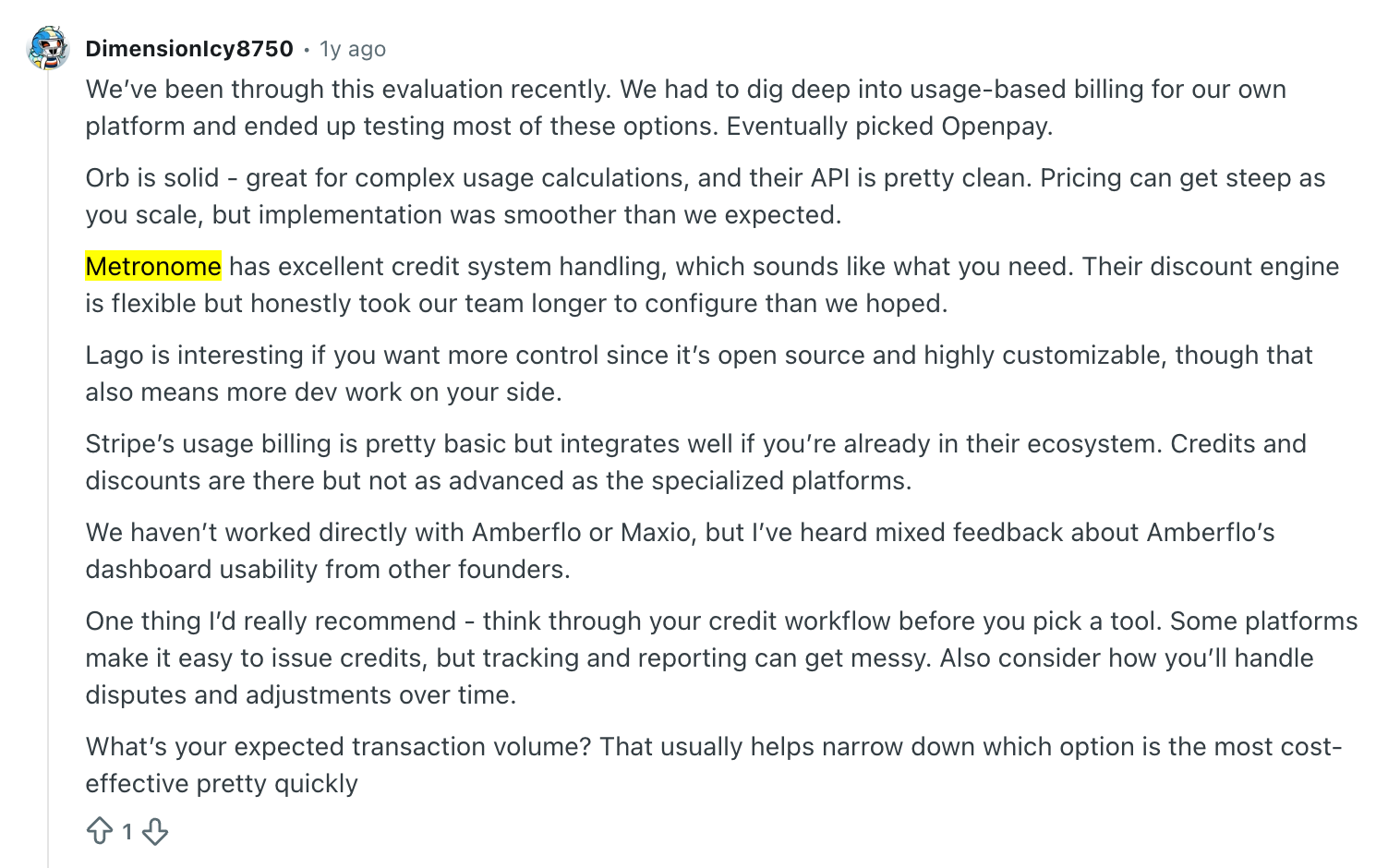
Metronome review: “Metronome has excellent credit system handling, which sounds like what you need. Their discount engine is flexible but honestly took our team longer to configure than we hoped.” [u/DimensionIcy8750, Reddit review, July 4, 2025]
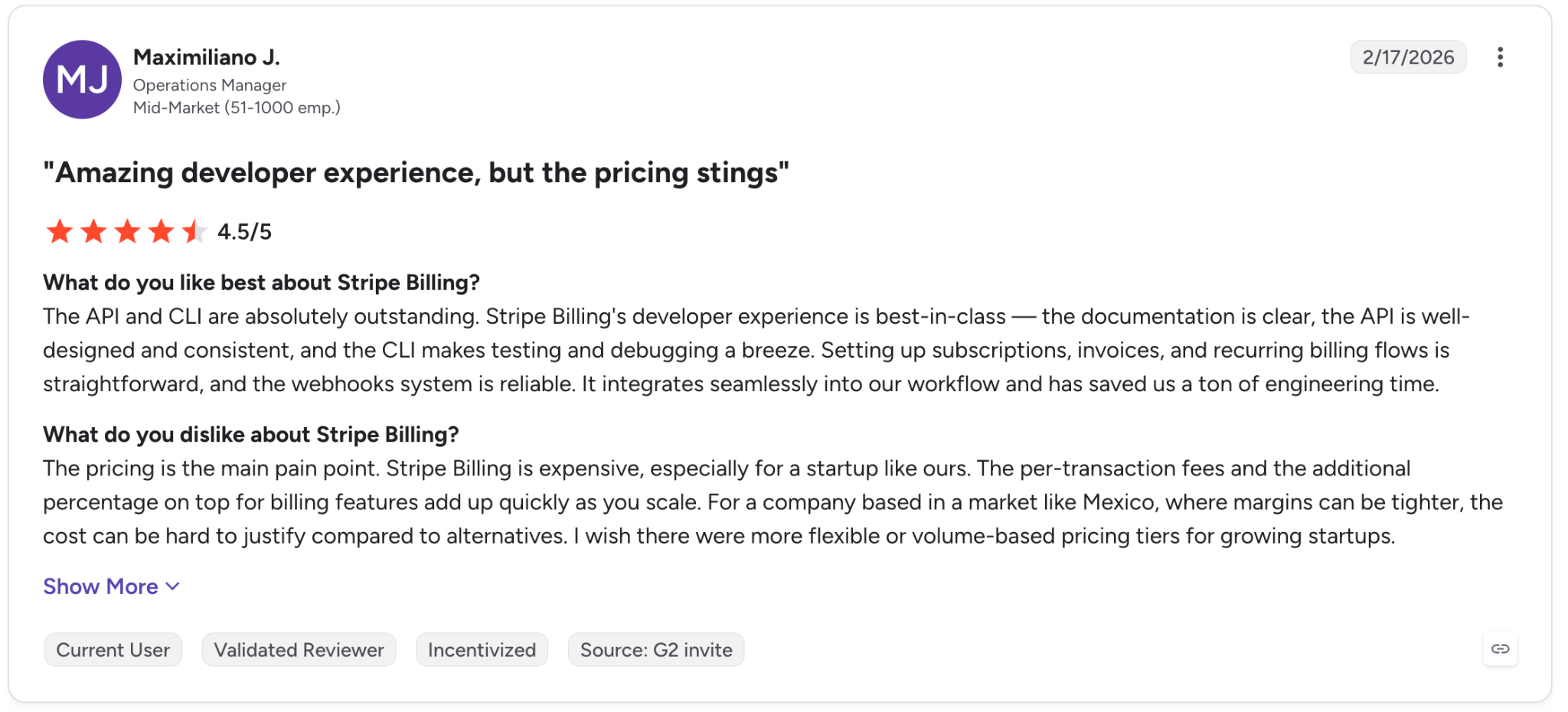
Stripe Billing review: “The API and CLI are absolutely outstanding. Stripe Billing's developer experience is best-in-class — the documentation is clear, the API is well-designed and consistent, and the CLI makes testing and debugging a breeze. Stripe Billing is expensive, especially for a startup like ours. The per-transaction fees and the additional percentage on top for billing features add up quickly as you scale.” [Maximilliano J., G2 review, February 17, 2026]
Most people want to know which tool is "better," when the more useful question is how much of your revenue depends on usage nobody predicted 6 months ago. If you can answer that, the choice mostly makes itself.
Choose Metronome if you:
Choose Stripe if you:
If you're still stuck, here's the gut check I use: does usage make up most of what you charge for, or is it one line item on an otherwise normal invoice?
The first points to Metronome, while the second points to Stripe.
If the question is who should handle payments and subscriptions, Stripe is the obvious pick for most companies already on its rails.
If the question is who should meter complex usage at real volume, Metronome earns that job, and Stripe agreed enough to pay roughly $1 billion for it.
Either way, you're picking between two products under one company now, not two rivals.
But there's a question neither one answers: what happens between the moment a request lands and the moment it either runs or gets blocked? That's where Stigg comes in.
Stigg sits above whatever billing stack you already run, and it isn't competing for the job Metronome or Stripe already do. It doesn't process payments, and until recently, it didn't send invoices either, though it just added an invoicing option.
Its actual job sits between your product and whatever billing stack you already run: real-time entitlement checks, AI credits, metering, and usage governance.
Stigg is the usage runtime for AI products. Entitlements, credits, usage limits, and spend governance are enforced synchronously in the request path, not bolted onto whichever billing engine you already picked.
Metronome and Stripe both answer a money question. They calculate how much a customer owes for what they used. Stigg, on the other hand, decides what a customer, user, or agent is allowed to do right now.
Here's where that difference shows up:
Metronome and Stripe meter and bill for usage after the fact. Neither makes a synchronous "is this allowed right now" call inside the request path, because that's not a billing engine's job.
Stigg's Sidecar resolves entitlement checks instantly from a local Redis cache on a cache hit. On a cache miss, it falls back to Stigg's Edge API at around 100ms, with a configurable timeout to prevent upstream latency from cascading into your application.
Stigg ships a full credit engine on every plan, including the free tier. You get wallets, an append-only ledger, burn-down rules, and expiry. Governance layers on top, with per-user, per-team, and per-agent budget caps enforced at call time.
Neither Metronome nor Stripe goes this deep on credits yet.
Stigg syncs bi-directionally with Stripe, Zuora, and Chargebee. Adding entitlements and credits doesn't mean leaving Metronome or Stripe behind, and you can swap billing providers later without touching the underlying entitlement layer.
For teams with data-residency requirements or that don't want usage events leaving their VPC, Stigg also runs as BYOC (Bring Your Own Cloud). That means self-hosted runtime, no per-event billing, and events never transit Stigg's infrastructure.
Stigg bills by managed entities and events instead of a cut of billing volume.
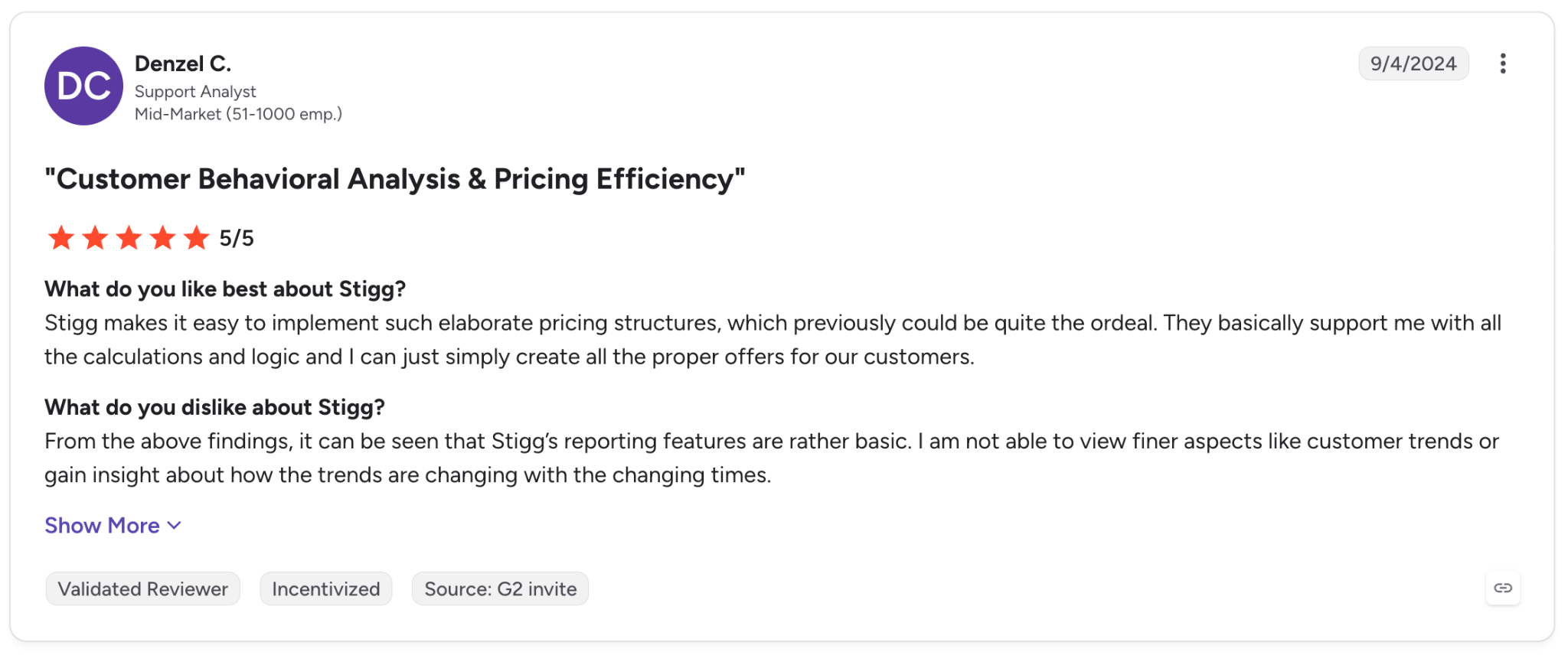
Stigg review: “Stigg makes it easy to implement such elaborate pricing structures, which previously could be quite the ordeal. They basically support me with all the calculations and logic, and I can just simply create all the proper offers for our customers.” [Denzel C., G2 review July 4, 2024]
None of this requires ripping out Stripe or Metronome first.
You can adopt Stigg one component at a time (start with just AI Credits, or just entitlements, or just the Sidecar), point the SDK at your existing billing provider, and see what your logic looks like outside a spreadsheet or a cron job.
The Stigg docs walk through the setup end-to-end.
Yes. Stripe completed its acquisition of Metronome in January 2026, in a deal reported to be worth around $1 billion.
Metronome still operates under its own brand, sells standalone through metronome.com, and also runs within Stripe Billing as the engine behind Stripe's usage-based pricing features.
Stripe Billing includes a free Meters API that covers up to 100 million events per month for basic usage-based pricing. Beyond that volume, or for multidimensional rate cards and complex contracts, Stripe routes customers to Metronome, its own product, which is priced and sold separately.
No. Stigg calls itself a usage runtime, not a billing platform. It handles entitlements, credits, metering, and usage governance, and it syncs with whatever billing provider you already use (Stripe, Zuora, Chargebee) rather than replacing it.
Yes. Stigg's integration model runs on bidirectional sync with existing billing providers, including Stripe. Stripe or Metronome handles payments and invoices, while Stigg decides in real time what a customer, user, or agent is allowed to do.
Usage-based billing, what Metronome and Stripe Billing do, counts what happened and generates a bill for it, often after the fact.
Entitlements, what Stigg does, decide what's allowed to happen in the first place, synchronously, before the request completes.
%20(1).png)
%20(1).png)