%20(1).png)
Guides
Best Metered Billing Software: 9 Tools Ranked (2026)
I tested 9 metered billing software platforms for metering accuracy, pricing, and real-time enforcement, with honest pros, cons, and prices for 2026.

Compare the best AI monetization software and generative AI monetization platforms for 2026, including Stigg, Zuora, and Metronome for usage billing.


When engineers start evaluating generative AI monetization software, it often feels like a pricing problem solved by adding usage tracking on top of what already exists.
That holds until real usage kicks in, a single session burns through credits, enterprise customers demand budget controls, and pricing logic starts leaking across services.
At that point, it stops being about billing and becomes a question of control. These 7 platforms are what engineers turn to when they need exactly that. If you're earlier than that and still choosing a pricing model, start with the basics of AI monetization.
| Tool | Strengths | Best for | Starting price |
|---|---|---|---|
| 1. Zuora (with Togai) | Enterprise billing, compliance, multi-entity finance | Large enterprises with complex contracts and global operations | Custom pricing |
| 2. Stigg | Real-time enforcement, credit control, request-path decisions | AI products with credits, tokens, and usage limits | Free; Pro from $331/month |
| 3. Orb | API-first billing, full programmability | Developer-led teams owning billing logic | Custom pricing |
| 4. Metronome | High-scale metering, real-time billing visibility | AI/API infra companies with large event volumes | Free tier, custom enterprise pricing |
| 5. Chargebee | Fast setup, strong subscription workflows | Early-stage teams with simple usage needs | Free tier, ~$7,188/year |
| 6. Alguna | All-in-one quote-to-cash, no-code pricing | Teams wanting unified pricing and billing without engineering | Free tier, from $699/month |
| 7. Paid.ai | Agent-based pricing, cost-to-value tracking | AI agent products pricing by outcomes | Free tier, from ~$300/month |
Disclaimer: Prices are subject to change without notice. Always visit the official company websites for the most up-to-date pricing information.
To evaluate these AI monetization platforms, I focused on how they behave in production systems. That included reviewing APIs and documentation, testing key flows where possible, and mapping each platform to real scenarios like credit-based pricing, hybrid models, and request-level enforcement. Each review below applies that lens to all seven AI monetization tools: features, pricing, what users say, and where each one stops.
The goal was to understand which systems can make decisions in the request path and which ones operate after usage has already been recorded.
I evaluated each platform across a consistent set of dimensions:
Once you compare them in context, the difference shows up in how they behave under load. Some systems keep up with billing, while others actually control what happens as requests come in. That difference only becomes visible when usage stops being predictable.
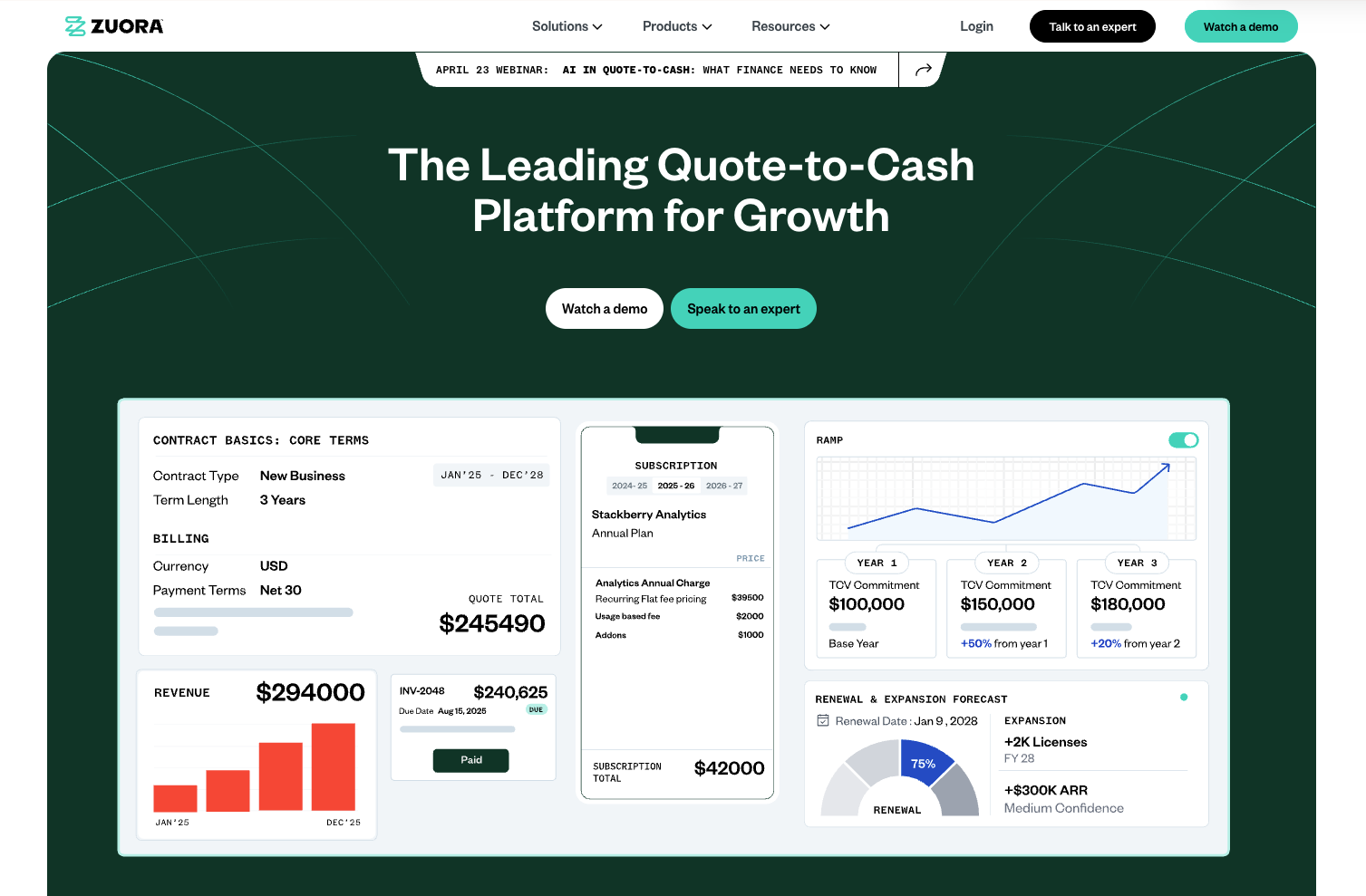
What it does: Zuora is a quote-to-cash and billing platform built for large enterprises. Togai, acquired by Zuora, adds a usage metering layer that feeds directly into billing and invoicing workflows.
Best for: Global AI or API companies with multi-entity operations, complex contracts, strict compliance requirements, and very high transaction volumes.
Zuora has been used by large SaaS companies for years, which shows in how it handles billing at scale. It supports audit trails, revenue recognition, and approval workflows, while giving engineering teams a system that can process high volumes of billing data reliably.
Togai adds a usage metering layer by ingesting events, aggregating them into billable metrics, and connecting that data to billing. Engineers send usage events into Togai, while sales and finance teams configure pricing without touching application code.
Together, they handle billing and usage across multi-entity systems, where keeping financial data consistent across regions matters as much as generating invoices.
| Pros | Cons |
|---|---|
| Handles high billing complexity at scale without requiring custom workarounds | Implementation requires a dedicated project and often external consultants |
| Built-in compliance, audit trails, and approval workflows for enterprise requirements | Annual costs are typically high and can create overhead for smaller teams |
| Togai adds usage metering without replacing existing Zuora deployments | No native support for AI-specific units like tokens or agent actions |
| Fits organizations where finance, legal, and engineering all have strict system requirements | Mapping AI usage to billing units requires additional engineering effort |
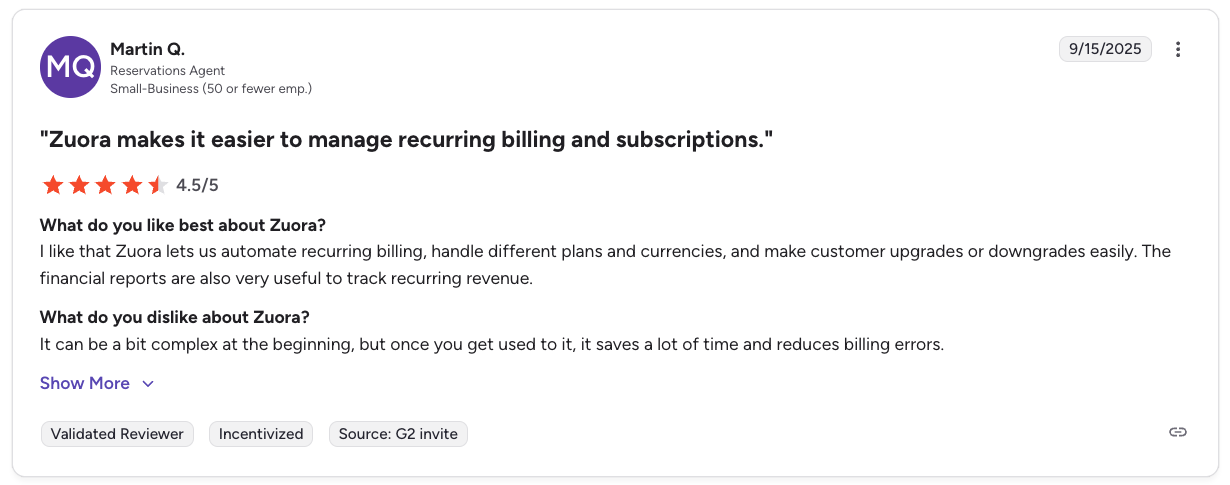
Pro: “I like that Zuora lets us automate recurring billing, handle different plans and currencies, and make customer upgrades or downgrades easily. The financial reports are also very useful to track recurring revenue.” [Martin Q., Small Business, G2 (September 15, 2025)]
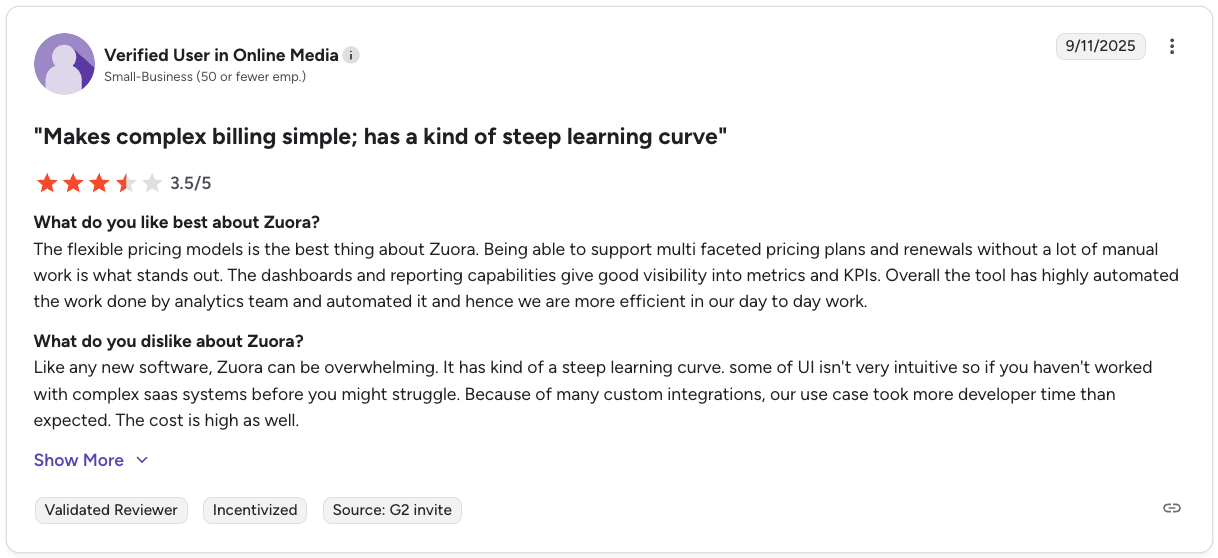
Con: “Like any new software, Zuora can be overwhelming. It has kind of a steep learning curve. Some of the UI isn't very intuitive, so if you haven't worked with complex SaaS systems before, you might struggle. Because of many custom integrations, our use case took more developer time than expected. The cost is high as well.” [Verified User in Online Media, G2 (September 11, 2025)]
Custom pricing based on billing volume and implementation scope.
Zuora makes sense when billing has already become a system problem, with multiple entities, custom contracts, and finance requirements that need to hold up under real scale. It gives teams a way to manage that without having to build everything from scratch.
The tradeoff is the effort it takes to get there. Setup can be heavy, the system takes time to learn, and engineering often ends up supporting integrations and configuration longer than expected.

What it does: Stigg is the usage runtime for AI products. It enforces entitlements, manages credit and token balances, governs AI spend, and meters usage in the request path before any cost is incurred.
Best for: AI-native companies charging customers by credits, tokens, API calls, or agent actions that need request-path enforcement, per-team budget controls, and an auditable credit ledger working alongside their existing billing stack.
Billing platforms work after usage happens. They record events and generate invoices later. Stigg works earlier in the flow, checking credits and entitlements before a request runs.
Entitlements are the rules that define what a user or agent is allowed to do based on their plan or credit balance. For AI products, that matters because a single session can burn through significant LLM spend very quickly.
The runtime runs through a BYOC Sidecar deployed inside your own infrastructure. Cache hits resolve instantly from local Redis. Cache misses fall back to Stigg's Edge API at around 100ms, with a configurable timeout. Credit and access controls apply across users, teams, departments, and agents.
Stigg works alongside Stripe, Zuora, and existing billing systems rather than replacing them.
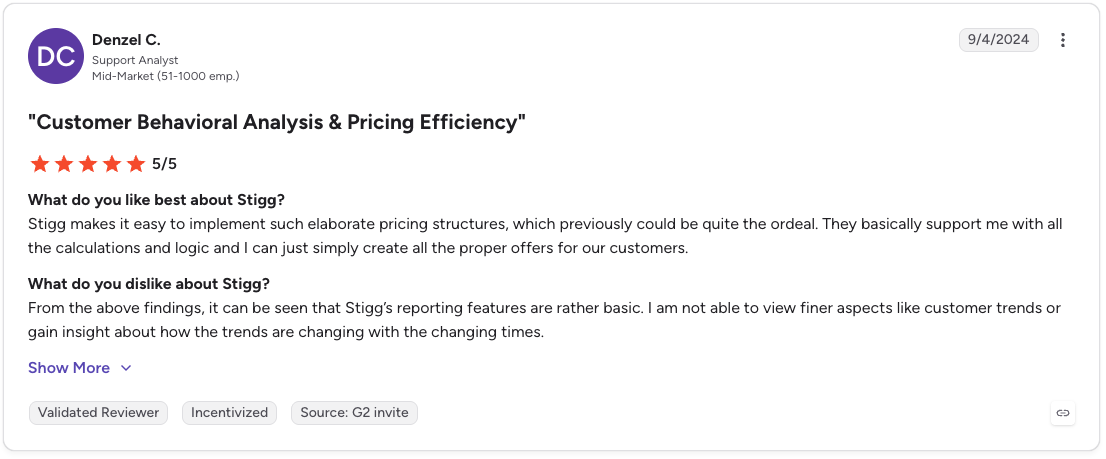
Pro: “Stigg makes it easy to implement such elaborate pricing structures, which previously could be quite the ordeal. They basically support me with all the calculations and logic and I can just simply create all the proper offers for our customers.” [Denzel C., G2 (September 4, 2024)]
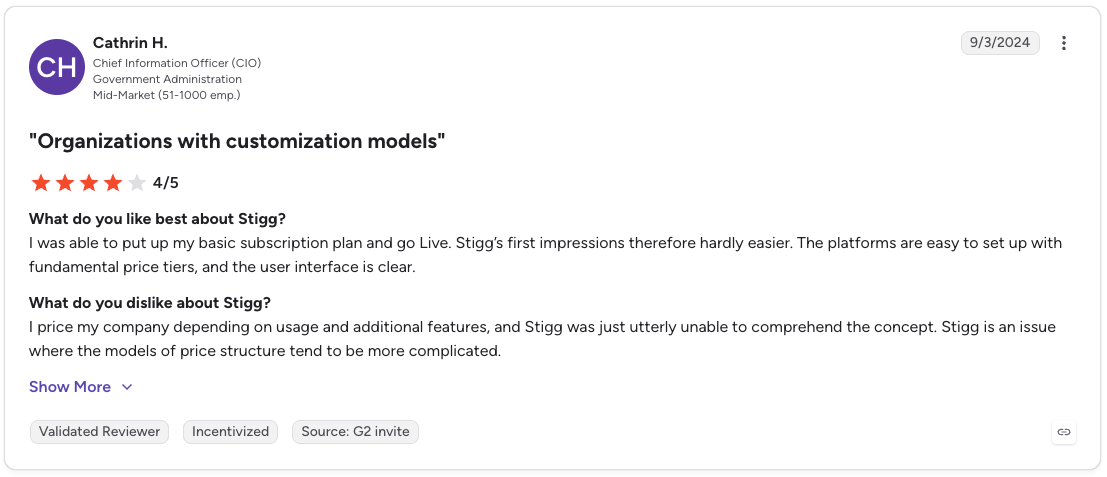
Con: “I price my company depending on usage and additional features, and Stigg was just utterly unable to comprehend the concept. Stigg is an issue where the models of price structure tend to be more complicated.” [Cathrin H., G2 Review (September 3, 2024)]
| Pros | Cons |
|---|---|
| Enforcement runs in the request path, so access decisions happen before costs are incurred | Requires a separate billing system for invoicing, tax, and payments |
| Bridges PLG and SLG motions under one product catalog | Growth and enterprise plans require a sales conversation for custom configurations |
| Supports multiple billing providers simultaneously, which simplifies migrations | |
| Credit ledger is auditable and supports finance and revenue recognition requirements | |
Stigg's Pro plan costs $331/month when billed annually, while Scale and BYOC plans use custom pricing. The free Build plan is available for startups, and higher tiers add committed capacity, enterprise features, and deployment options.
Stigg is built for AI products that have moved past basic credit counters and need reliable enforcement under real usage conditions.
If enterprise deals are stalling due to usage visibility, costs can spike within a single session, or an in-house system breaks under team-level limits and concurrent requests. Stigg provides the runtime infrastructure to handle it.
Products running on flat subscriptions with no usage-based pricing require more infrastructure than the current model.
What it does: Orb is a usage-based billing platform built around programmable APIs and event infrastructure for engineering teams that want complete control over their billing logic.
Best for: Developer-driven teams with the bandwidth to own billing integration and products with highly custom usage metrics that do not map cleanly to off-the-shelf schemas.
Orb treats billing as part of the backend rather than a separate system. Engineers define pricing rules through APIs, including tiering, volume discounts, and custom metrics, and build billing workflows directly into their application logic.
Its event ingestion layer handles high volumes reliably, allowing teams to track and aggregate usage in real time. This flexibility makes it a strong fit for infrastructure and API products where pricing models are tightly coupled to product behavior.
The tradeoff is that teams take on the responsibility of building and maintaining much of the billing logic themselves, which increases engineering ownership compared to a configuration-driven approach.
| Pros | Cons |
|---|---|
| Gives engineering teams full control over billing logic through APIs | Requires ongoing engineering time to implement and maintain |
| Supports flexible pricing models, including hybrid and usage-based approaches | No native CPQ support for custom contracts or sales-led workflows |
| Scales well with high event volumes and complex usage data | The learning curve can be steep and requires dedicated ownership |

Pro: “Orb enabled us to introduce our new pricing and billing strategy for our cloud product. Despite having a dedicated billing team to manage our usage-based billing scenarios, we faced numerous challenges earlier. Leveraging Orb to help with our billing and pricing allowed us to redirect our top engineers to focus on other critical aspects of our product.” [Verified User in Computer Software, G2 (March 15, 2024)]

Con: “Orb is decent if you want your engineers to be in charge of just billing. If you want accountants and finance to oversee invoicing then avoid Orb.” [Reddit User (July 09, 2024)]
Custom pricing across Core, Advanced, and Enterprise tiers, with features and integrations scaling by plan.
Choose Orb if you want billing to behave like part of your backend and your team has the bandwidth to manage it. You get flexibility and control where standard tools fall short.
If billing needs to be handled by finance with structured processes and less engineering involvement, this model is likely not the right fit.
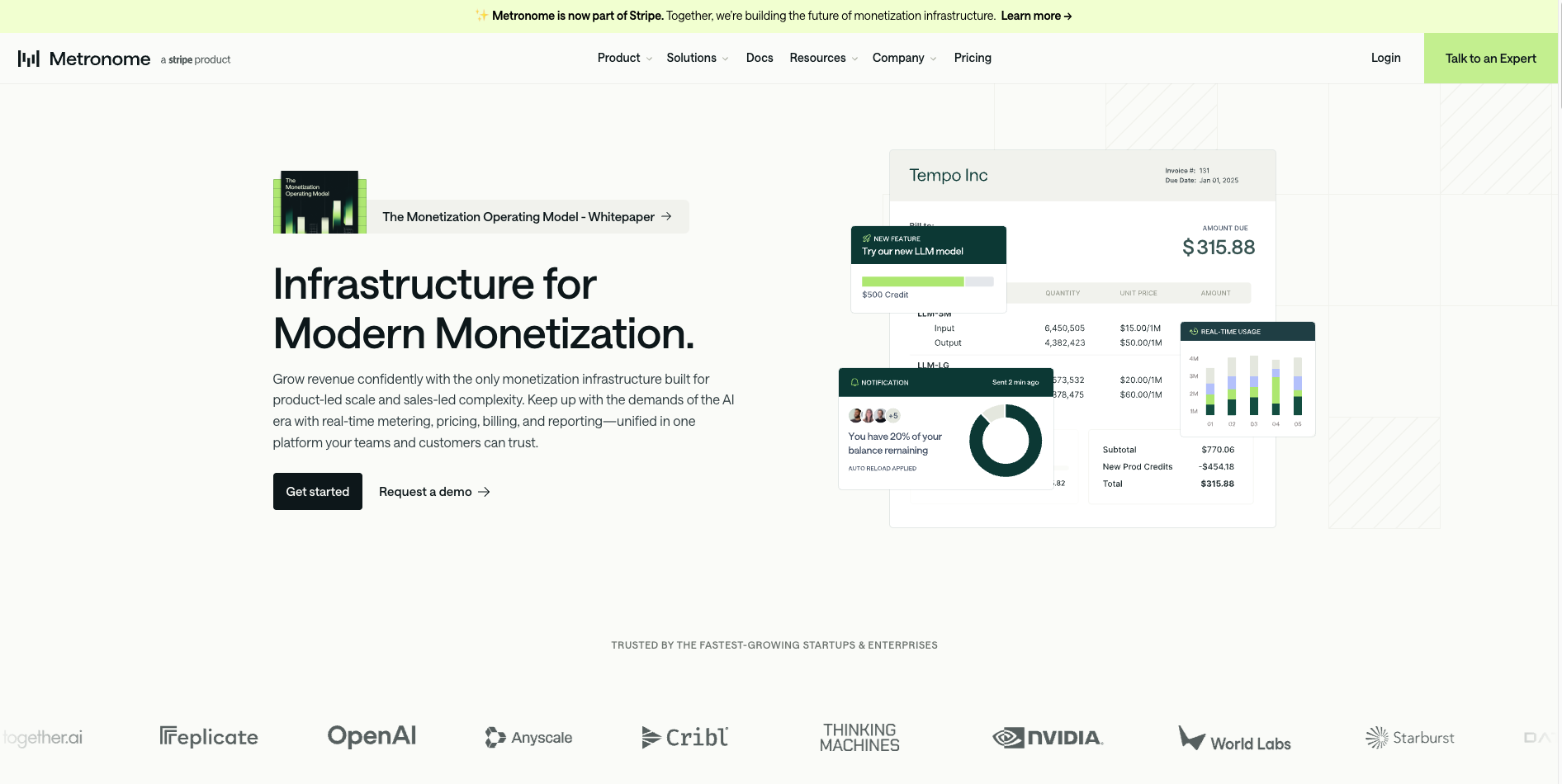
What it does: Metronome is a usage-based billing platform built for API-first and AI companies that need to process large volumes of events under complex billing models.
Best for: AI infrastructure companies and enterprise teams with custom contracts, high event volume, and strict requirements for billing accuracy and compliance.
Metronome is designed for systems with high usage and billing that need to stay accurate under load. Its metering and rating engine processes large event streams reliably, while customers can see usage and charges updates in real time instead of waiting for end-of-cycle invoices.
Stripe completed its acquisition of Metronome in January 2026, bringing its metering engine into the Stripe Billing platform.
It integrates with tools like Salesforce and NetSuite, which makes it a strong fit for enterprise sales cycles where approvals, custom pricing structures, and audit trails are expected.
| Pros | Cons |
|---|---|
| Handles large event volumes reliably in production environments | Implementation requires engineering time and coordination with vendor support |
| Provides real-time visibility into usage and spend | Pricing is custom and typically out of reach for early-stage teams |
| Includes customer-facing usage tracking and alerts | Workflows for non-technical teams require additional setup |
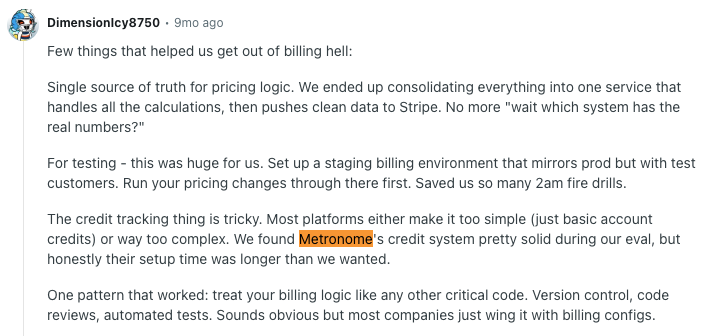
Pro: “The credit tracking thing is tricky. Most platforms either make it too simple (just basic account credits) or way too complex. We found Metronome's credit system pretty solid during our eval.” [Reddit User (July 21, 2025)]

Con: “Metronome is very expensive and is the only rating and metering solution you listed that works for enterprise level usage volumes” [Reddit User (July 09, 2024)]
Free starter tier available, with custom pricing for higher-scale usage and enterprise needs.
Metronome is the right pick when billing accuracy at high event volume is the hard constraint and the team has the engineering resources to implement it.
The Stripe acquisition adds long-term platform stability, but the tool still requires substantial setup effort and custom pricing, which puts it out of reach for most early-stage teams.
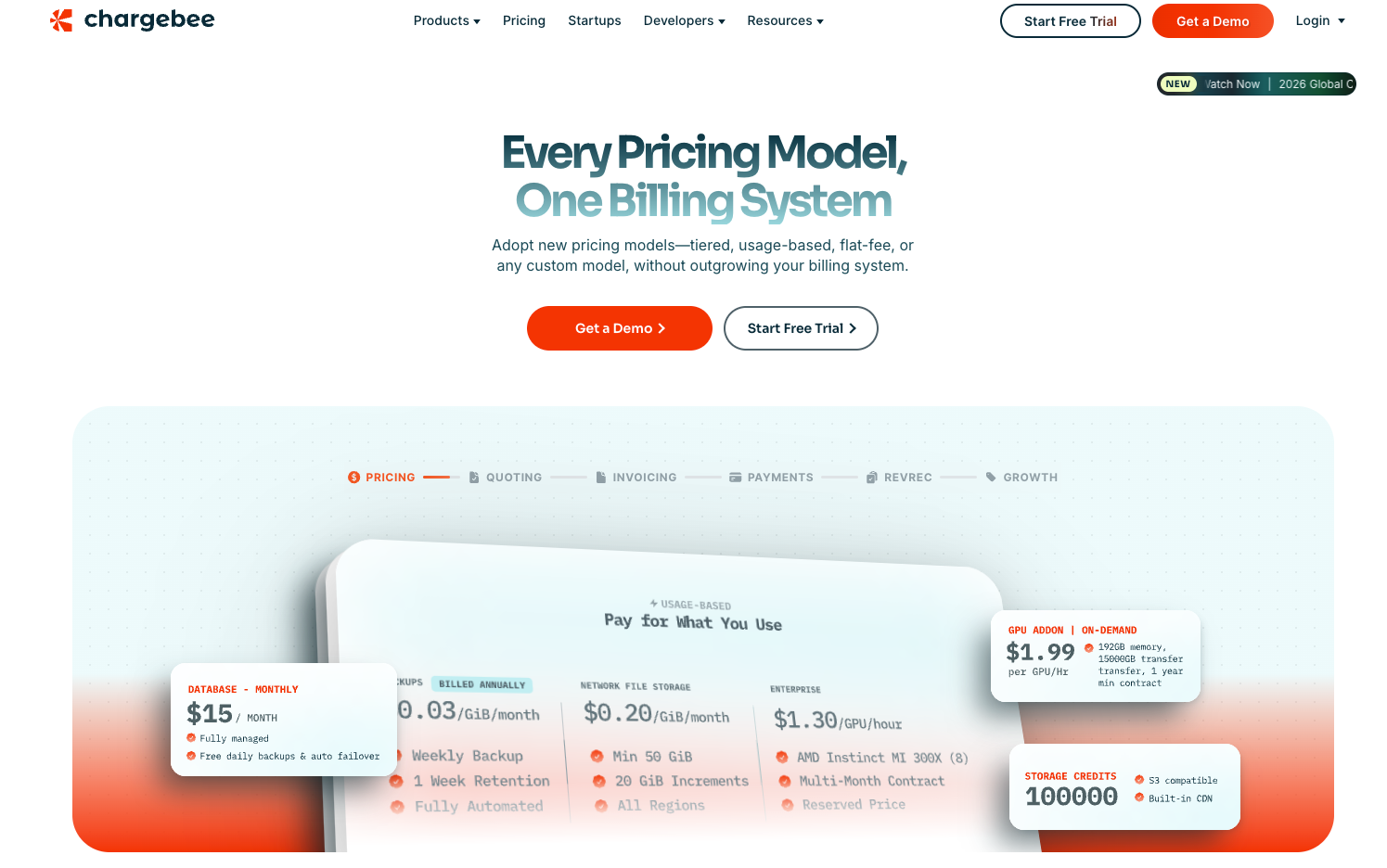
What it does: Chargebee is a subscription billing platform with support for basic usage-based charges, built around recurring SaaS billing workflows.
Best for: Early-stage AI teams with subscription-heavy pricing and light usage components, especially those without dedicated billing engineers.
Chargebee is built around subscription workflows, so it handles invoicing, payments, and lifecycle management reliably out of the box. Usage-based billing is layered on top, which means product usage has to be mapped into its metered components rather than modeled directly.
This works for simple, single-metric use cases. As usage becomes multi-dimensional or tied to real-time behavior, teams end up building translation logic to convert product events into billable units and maintaining that mapping across services.
| Pros | Cons |
|---|---|
| Quick to implement and usable by non-engineering teams | Usage billing runs in batches with no real-time visibility |
| Strong subscription management with a broad integration ecosystem | Complex usage models are difficult to represent |
| Scales well for subscription-driven businesses | Requires manual mapping of AI usage to generic billing units |
| Non-technical teams manage plans directly | No built-in support for real-time enforcement or usage control |

Pro: “It's dependable. It has all the features I need. The initial use without paying a fee is very generous. Whenever I needed help support was there and provided it in a timely manner. I've been able to integrate easily with my other platforms. Performance has been consistent.” [Trevor E., G2 (April 20, 2026)]
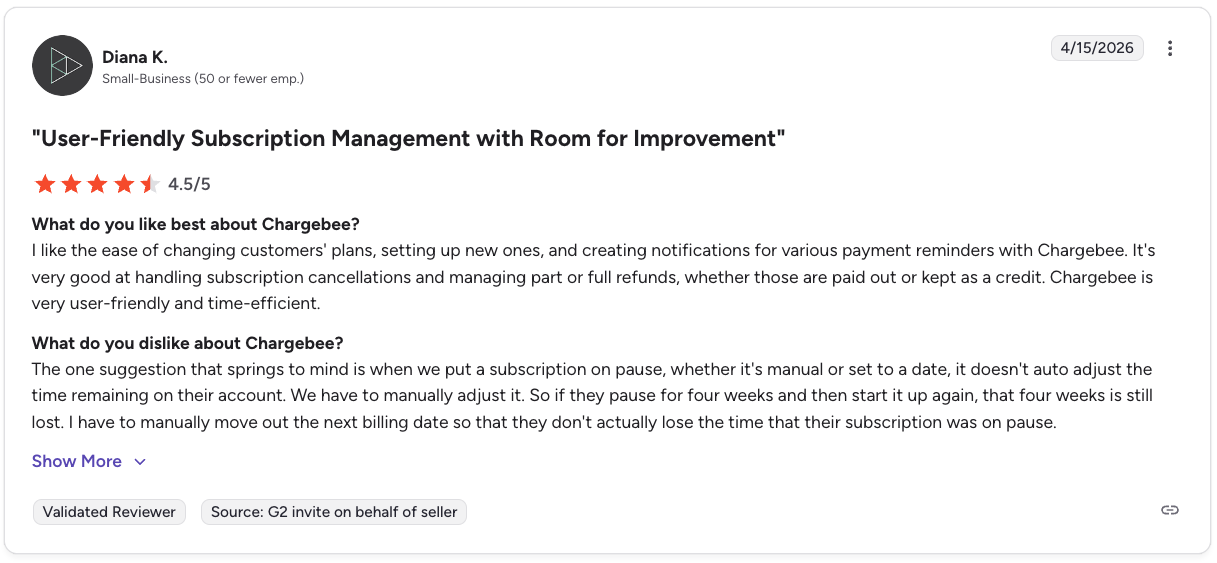
Con: “The one suggestion that springs to mind is when we put a subscription on pause, whether it's manual or set to a date, it doesn't auto adjust the time remaining on their account. We have to manually adjust it. So if they pause for four weeks and then start it up again, that four weeks is still lost.” [Diana K., G2 (April 15, 2026)]
Free starter tier available, with paid plans starting around $7,188 per year and custom pricing for enterprise needs.
Chargebee is a good fit if your product is mostly subscription-driven and you want something that works out of the box. It is dependable, integrates well, and has responsive support when you need help.
If your pricing starts to depend on usage or multiple metrics, the system becomes harder to extend. At that point, teams either accept the constraints or start adding custom logic on top.

What it does: Alguna is an end-to-end monetization platform that combines usage metering, pricing, quoting, billing, and revenue recognition in one system.
Best for: AI and SaaS teams that want to manage pricing and billing without building internal systems, and organizations running hybrid models across multiple markets.
Alguna brings pricing, billing, and revenue workflows into a single layer, which removes the need to stitch together separate tools. Product, RevOps, and finance teams can define pricing, launch new metrics, and update plans directly through the UI without waiting on engineering.
Under the hood, the platform handles usage ingestion and billing at scale, so teams get real-time visibility into usage and revenue without building their own pipelines. This makes it easier to move quickly, especially for teams that do not want billing logic to live in application code.
| Pros | Cons |
|---|---|
| Combines pricing, billing, and revenue workflows in one platform | Newer platform with less enterprise track record |
| Enables non-engineering teams to manage pricing and updates | Less control for teams that want billing logic in code |
| Real-time usage visibility for internal teams and customers | Focused on B2B use cases |
Alguna's Growth plan costs $699/month, while the Starter plan is free. Enterprise Scale uses custom pricing for organizations with advanced integration and compliance requirements.
Alguna fits teams that want to consolidate pricing, billing, and revenue workflows into one system without building and maintaining separate tools. It works well when speed and simplicity across teams matter more than deep engineering control.
For teams that prefer to define billing logic in code or already operate complex billing infrastructure, the abstraction can feel limiting.
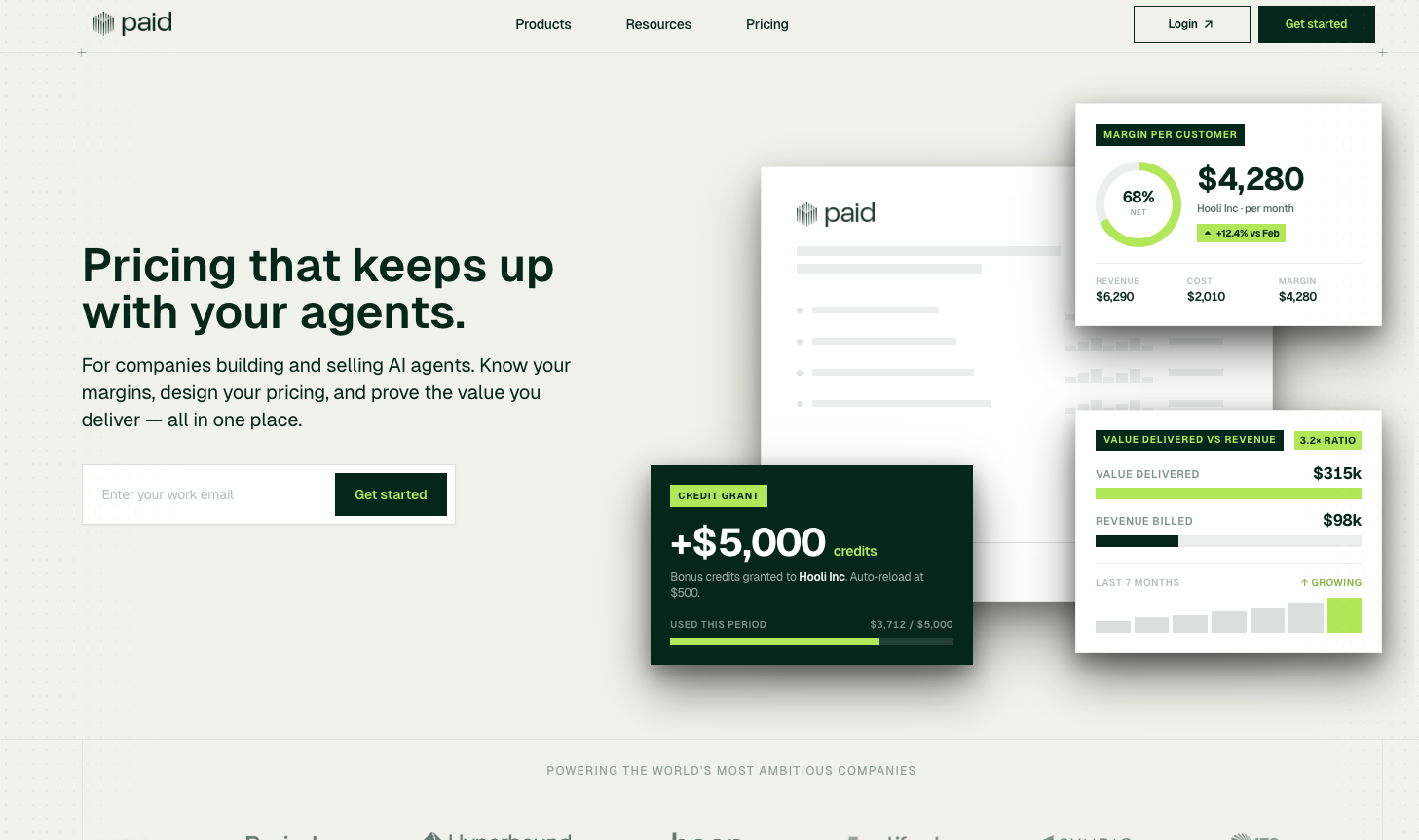
What it does: Paid.ai is a monetization platform built for agentic AI products, tracking LLM costs in real time and linking them to pricing models based on agent outcomes.
Best for: Teams building agent-driven products such as copilots, assistants, or autonomous workflows that want to price based on outputs like tasks completed or results delivered.
Paid.ai focuses on tying cost and value together at the level of each agent action. Developers instrument agent code with a lightweight SDK to send usage signals, while product and finance teams define pricing rules through the UI.
This gives teams visibility into margin per action as it happens, which is difficult to get from general billing systems that operate at the level of aggregated usage.
| Pros | Cons |
|---|---|
| Built for agent-based products with outcome-driven pricing | Narrower scope compared to general billing platforms |
| Connects LLM cost directly to revenue at the action level | Enterprise billing and CPQ features are still developing |
| Simple SDK and UI for pricing setup | Requires instrumentation across agent workflows |
Paid.ai's monthly plans start at $300/month (Grow), $600/month (Scale), and $1,000/month (Accelerate). An Enterprise plan with custom pricing is available for organizations with unlimited billing volume.
Paid.ai fits teams building agent-based products where pricing is tied to outcomes rather than raw usage. It gives visibility into cost and value at the level where decisions are made.
For teams that need broader billing infrastructure, multi-product entitlements, or enterprise governance, it will likely need to be paired with other systems.
The decision comes down to where your system needs control. Are you trying to manage financial complexity, enforce usage in real time, or process usage at scale? The right generative AI monetization platform depends on which of those problems is actually yours.
Choose Zuora if you:
Zuora solves for financial correctness and compliance at scale.
Choose Stigg if you:
Stigg is modular by design. You can start with AI credits in a single integration and add entitlements, governance controls, and spend limits as the product grows.
Choose Metronome if you:
Metronome solves high-scale metering and billing accuracy challenges.
If your product is still a flat subscription with no meaningful usage component, you likely don’t need any of these yet.
These platforms sit in the same space, but they solve different layers of the system. The key is to be clear about where your problem actually lives.
Billing platforms like Orb, Metronome, Chargebee, and Zuora focus on recording usage and generating invoices. They handle financial accuracy, contracts, and reporting. That works well when the challenge is billing correctness at scale.
Other systems operate closer to the product:
A useful signal is where your logic starts to break down. When entitlement checks are spread across services, credit logic is duplicated, or limits are applied inconsistently, the problem has moved beyond billing into system design.
The infrastructure you choose at that point determines how maintainable your enforcement logic stays as the product adds users and pricing becomes more complicated.
Enforcement logic embedded in application code makes things even more complex with every new feature. A dedicated runtime layer keeps those decisions centralized and auditable from the start.
If the enforcement layer is what's missing from your stack, you can explore Stigg's architecture and get started without replacing your existing billing infrastructure.
The right generative AI monetization software depends on where the problem sits in your stack. Stigg is built for teams that need request-path enforcement and credit control as runtime infrastructure.
Tools like Alguna cover billing and revenue workflows at a different layer. Most AI products end up requiring both.
Billing records usage after requests are complete and generate invoices based on that data. Entitlements operate earlier, at the point of the request, checking what a user or agent is authorized to consume before the call goes through.
The two systems serve different functions and are designed to work together, not replace each other.
No. Stripe handles payments and financial compliance. Orb handles programmable billing logic and invoicing. Stigg sits above both as a runtime layer, enforcing entitlements and governing credit spend in the request path before billing events are created.
Usage-based billing is a pricing model where customers pay based on what they consume, such as API calls, tokens, or compute time. It requires metering usage, aggregating it into billable units, and generating invoices from that consumption data.
Billing platforms handle invoicing, payments, and financial compliance. Tools built for AI usage go further, adding credit management, entitlement enforcement, and request-path access control that billing systems were not designed to provide. The distinction matters most when usage is unpredictable, and costs need to be governed before they are incurred, not after.
The best API monetization platform depends on what you need to control. If you mainly need to meter calls and invoice them, a billing platform covers it. If your API also needs per-customer limits, credits or plan-based access enforced before each call runs, look for a platform that resolves entitlements in the request path, which is what Stigg is built for. Most API-first teams end up pairing the two: billing for invoices, and an entitlement layer for real-time control.
%20(1).png)
%20(1).png)