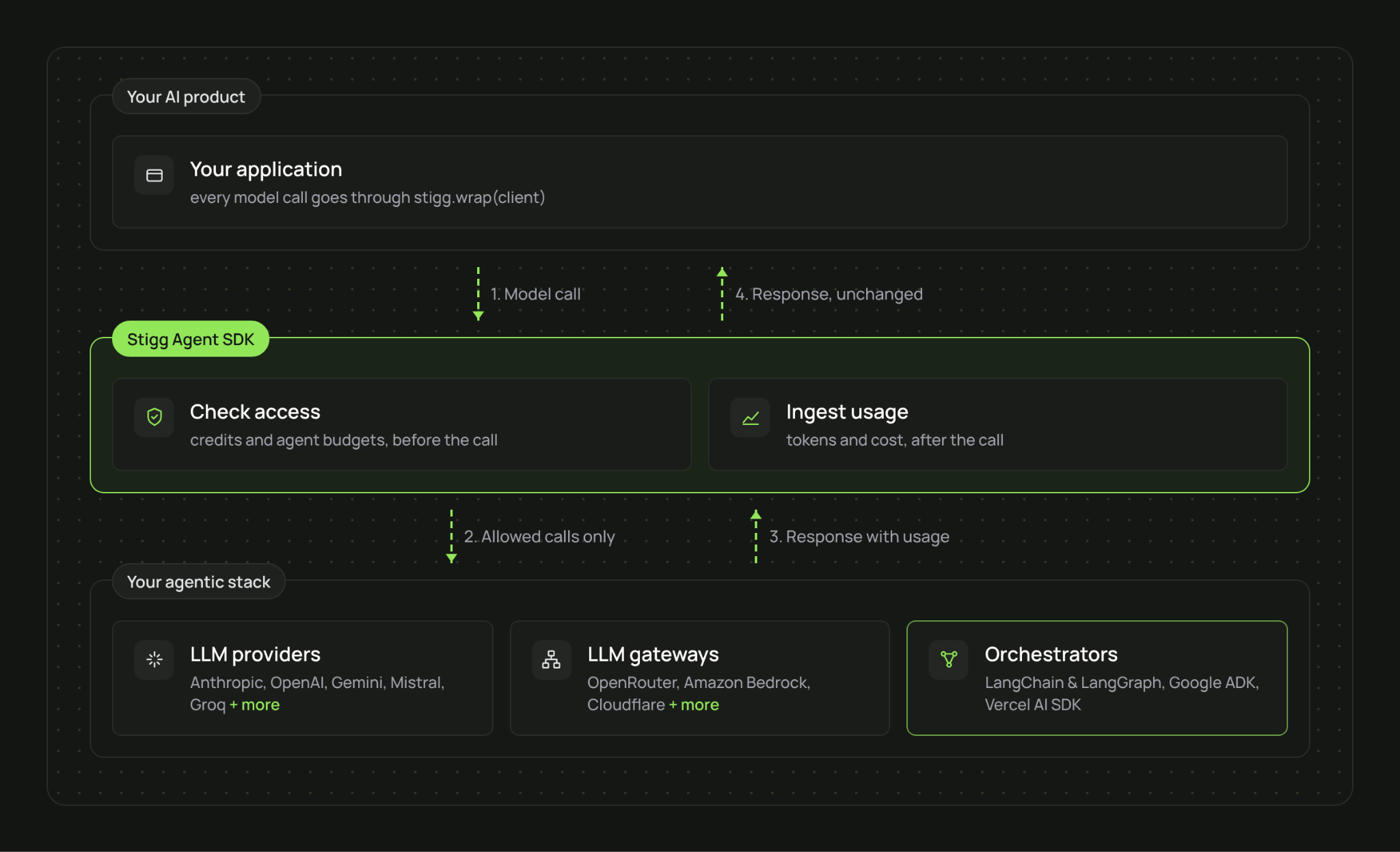
A few weeks ago, we introduced Stigg Agent SDK, which gives you control at the LLM level: every model call is checked before it runs and metered after it.
Today we're extending Stigg for Agents to agent orchestrators: LangChain and LangGraph, Google ADK, and Vercel AI SDK. Your orchestration layer now gets the monetization context it was missing: entitlements, credits, and budgets, at every step of the run.
With that context, your agents can plan the run around what the customer can use, then decide mid-run whether to proceed, take an alternative execution path, or stop.
It's available to every Stigg customer today, and the Agent SDK is open source under the MIT license.
Your agent knows your workflow. Not how you monetize it.
Complex agentic workflows, especially ones that trigger sub-agents or use multiple AI tools, run on an orchestration layer. That's where the workflow's decisions are made: which model to call, which tool to run, when to hand the next step to a sub-agent. Each of those decisions has cost implications for you, your customers, or both.
Until now, the orchestration layer didn't have the monetization context: what the customer is entitled to, how many credits they have left, and which budget applies. That leaves two bad options:
Run anyway, and leak revenue. Agents keep using credits and features the customer isn't eligible for, and you find out after the run.
Block the run, and lose the outcome. The check happens once, before the entire workflow is executed. A run that might exceed the budget never starts, even when an alternative execution path would have finished the job.
Agents spend during the run. Usage gets counted after it.
Billing tracks spend after the run, when it's already too late to change what the agent did. Stigg for Agents moves the decision inside the run, with a short loop around each step:
Check. Before a step runs, your orchestrator checks the customer’s usage, credits, and budgets with Stigg, in milliseconds.
Act. The step runs only if the check allows it, on the path your orchestrator chose: the planned model, a cheaper one, or a different tool.
Track. Usage is metered and feeds the next check.
For LangChain and LangGraph, you add Stigg's callback handler to a run. Each model call and governed tool call is checked before it runs and billed after it succeeds, as the agent that made it. For other orchestrators, the same logic is available as framework-neutral middleware.
What your agents can do with monetization context
Use a cheaper model instead of stopping the run
Stigg tells your workflow how many credits each customer has left and which models their plan includes. If the customer is running low, or doesn't have access to the premium model, your workflow can use a cheaper model and still finish the job.
Agentic workflows that plan around the budget
Stigg provides the context: entitlements (access, current usage, and next reset), credit balances, and budgets. Your orchestrator uses it as part of the execution path. It picks the steps, tools, and models that fit, limits how many times a tool runs, and applies agent rate limits based on the customer's entitlements.
Run agents in parallel without exceeding the budget
Agents in the same workflow can run in parallel on one shared pool of credits. Each agent gets its own allocation from that pool, and its steps are checked and billed against it, so one expensive agent doesn't use up the allowance of the others.
Each agent in the graph can point at its own entity in Stigg, so its steps are checked and billed against that agent's budget. A run with no customer attached is refused before its first step.
Track every agent's usage in one place
Multi-agent workflows spread usage across agents, sub-agents, and tools. Stigg meters every agent, sub-agent, and action in one centralized location, so you can track adoption and cost per customer and per agent, without piecing it together from logs.
Each execution generates usage events with the context behind them: which customer and agent made the call, which model was used, and what it cost. Stigg's metering pipeline, including ingestion, deduplication, and aggregation, handles 1M+ events per second.
Price from real runs
Stigg meters each run end to end, so you know what a workflow actually costs. Use that data to make pricing and packaging decisions, whether you use token-based or outcome-based pricing, and keep iterating as your costs change or as your agents deliver more value.
Get started
Stigg for Agents moves the spend decision into the run. Your agents plan around the budget, adjust mid-run, and stop only when they have to, while every call is metered in one place so you can price from real costs.