%20(1).png)
Guides
Platform Pricing Strategy for AI Products in 2026
Build a platform pricing strategy that connects customer value, usage, credits, margins, packaging, entitlements, and product architecture.

Evaluating Orb alternatives? We broke down five platforms by metering depth, pricing iteration speed, open-source availability, and contract readiness.

Orb handles straightforward usage metering well until a deal requires a contract structure that Orb lacks a field for, and you're rebuilding pricing logic in a spreadsheet. Here's where the five Orb alternatives pull ahead:
Below, we break down what each one gets right and where it still falls short.
I went straight to the source for each platform. That meant the live pricing page, the product docs, and the GitHub repo for any open-source projects.
Then I checked that against G2 and Reddit, since that's where the real complaints tend to show up. I also read the comparison pages vendors publish about each other. They're self-interested, sure, but still useful. Vendors often highlight a competitor's weakest point, including details that generic reviews miss.
I weighed each platform against five questions:
That last one matters more than it used to. Orb itself just closed its acquisition by Adyen in July 2026, and Stripe completed its Metronome acquisition back in January, so the question of who owns the roadmap has changed on both the tool you're leaving and one of the tools you're weighing.
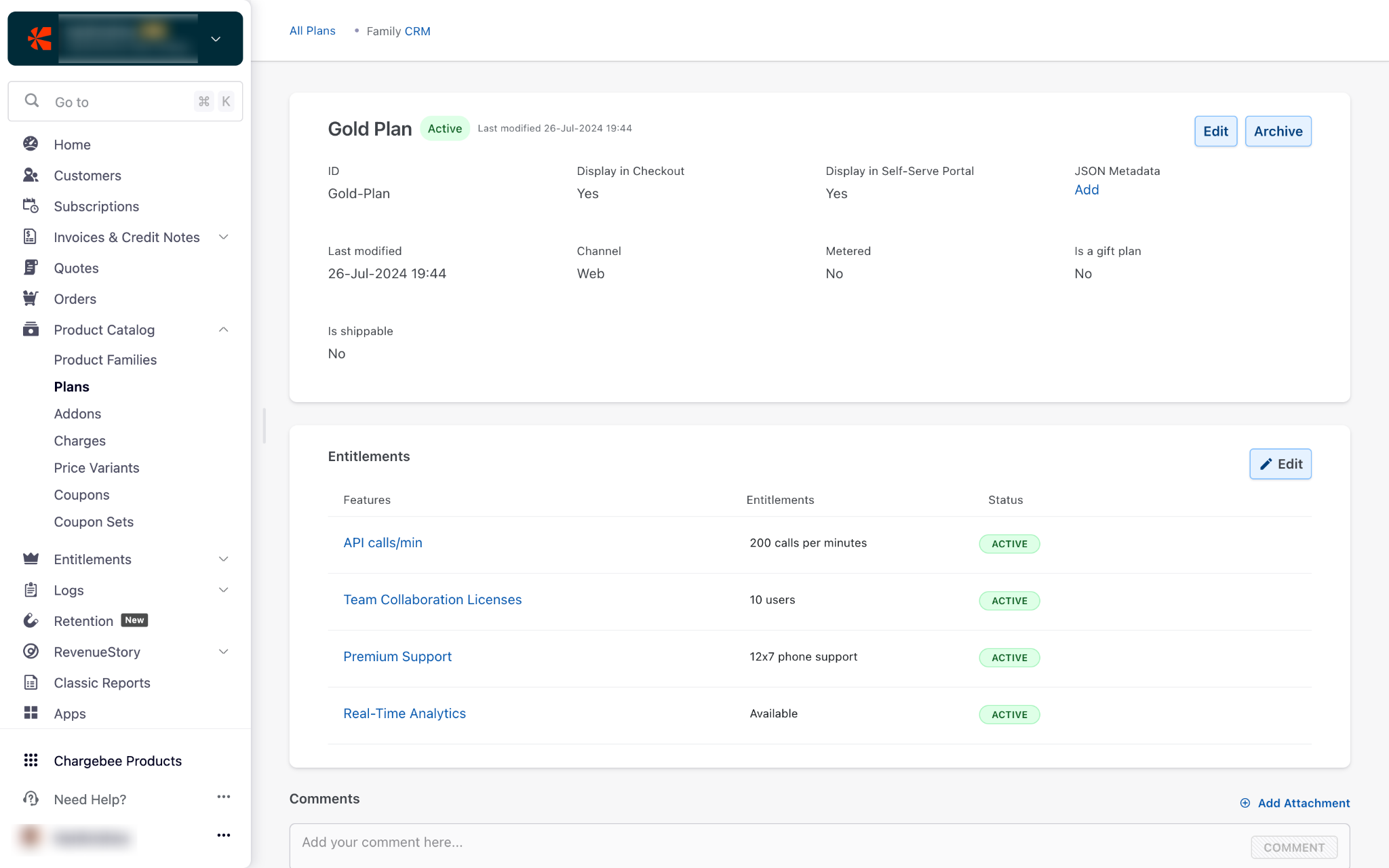
What it does: Chargebee started as subscription billing for SaaS and has spent the last few years extending into usage-based and hybrid pricing, without asking you to abandon the plans, dunning, and revenue workflows already running in production.
Best for: Companies whose revenue is still mostly subscription-shaped but need to bolt on metered components like AI credits, API calls, or seats-plus-overage, without a full replatform.
Once billing becomes more complex than pure event metering, Orb starts to feel thin. Chargebee brings dunning, invoicing, and subscription lifecycle tooling that Orb never tried to cover, plus UI-driven entitlements, so product managers can flip feature access without filing a ticket.
Add in solid CRM, accounting, and global payment integrations, and it's the pick for teams whose billing problem is bigger than "meter events, send invoice."
The gaps show up once your pricing gets AI-shaped. There's no native feature-level entitlement check at the request level, so "can this customer do X right now" logic still has to live outside Chargebee.
Credits here mean invoice offsets and credit notes, separate from a programmable customer-facing wallet. Credit-based products still need to build that layer elsewhere. Pricing changes can also take months, and the 0.75% overage fee scales with revenue.

Pro: “Subscription management and updates work exactly as we expected. The UX is really great, and Chargebee’s copilot is especially helpful for day-to-day tasks. We’re also able to use Chargebee’s integration with HubSpot, which fits well into our workflow.” [Anand K., G2 Review (March 15, 2026)]

Con: “Some sections feel a bit counterintuitive to me, but there are specific knowledge articles that help me troubleshoot issues on my own. The initial setup was fine overall, although we still spent quite a bit of time doing manual work during the migration.” [Verified User in Financial Services, G2 Review (June 25, 2026)]
Chargebee's Starter plan is free until you cross $250K in cumulative billing, then a 0.75% fee kicks in. Performance runs $7,188/year (billed monthly) for up to $100K in billing per month, and Enterprise is a custom quote from sales once you outgrow that.
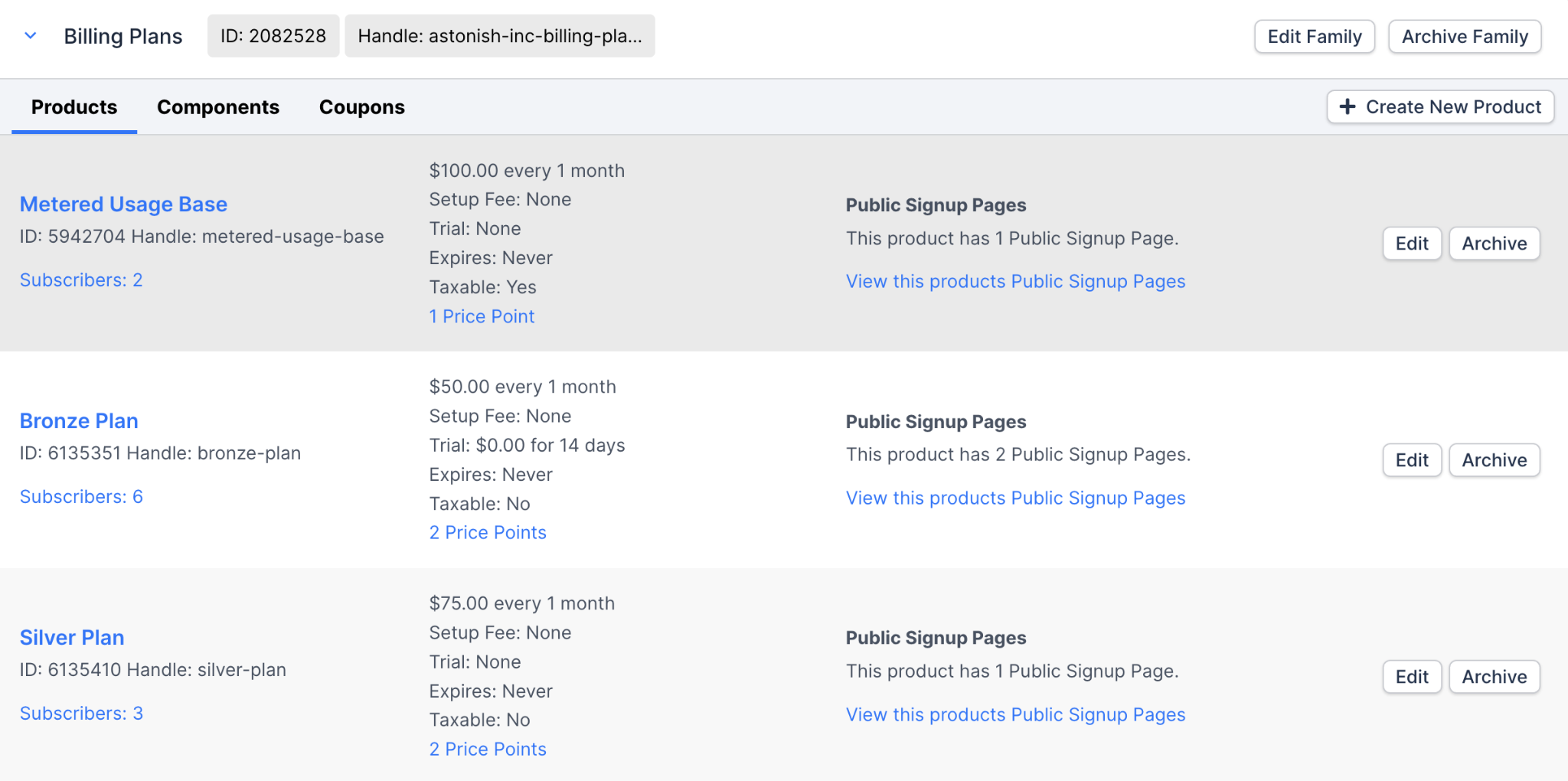
What it does: Maxio handles the full billing and revenue operations stack for B2B SaaS. Subscription management, usage-based billing, revenue recognition, and SaaS metrics like MRR and ARR all live in one system instead of being stitched across multiple tools.
Best for: Mid-market B2B SaaS companies with a CFO-led buying motion, where accurate MRR, ARR, and revenue recognition matter as much as the billing engine itself.
Orb meters well but stops at the invoice. Maxio is where you go when finance needs to be in the same room as engineering.
Revenue recognition and SaaS metrics live in the same system as invoicing, complex contract schedules get handled cleanly, and grandfathered pricing doesn't become a maintenance nightmare as the customer base grows.
The learning curve is real, especially for admins configuring advanced billing scenarios, and some reviewers report percentage-based fees creeping up as billing volume grows.
The bigger issue for AI-native teams: pricing iteration here runs closer to Chargebee's cadence than to a developer-first platform built for weekly experiments, so it's less flexible if your product runs on fast-moving, credit-based usage.

Pro: “I use Maxio for keeping track of all my clients' invoices and subscription details. What I like most about Maxio is the ease of being able to look up an invoice or subscription task really easily while I'm on a call with a client. I can review an invoice quickly, within about two minutes, and access contact information easily.” [Yessie Z., G2 Review (February 27, 2026)]

Con: “I think the amount of bolt-on and add-ons that you need to use all of the functions is frustrating. Right now, we have to bring in Maxio advanced billing and pull from multiple different accounts to get into the system.” [Shane H., G2 Review (March 9, 2026)]
Maxio’s Grow plan runs $599/month for up to $100K in monthly billings. Once you're past that, Scale is quote-only and steps up to advanced revenue recognition, A/R management, and expense amortization.
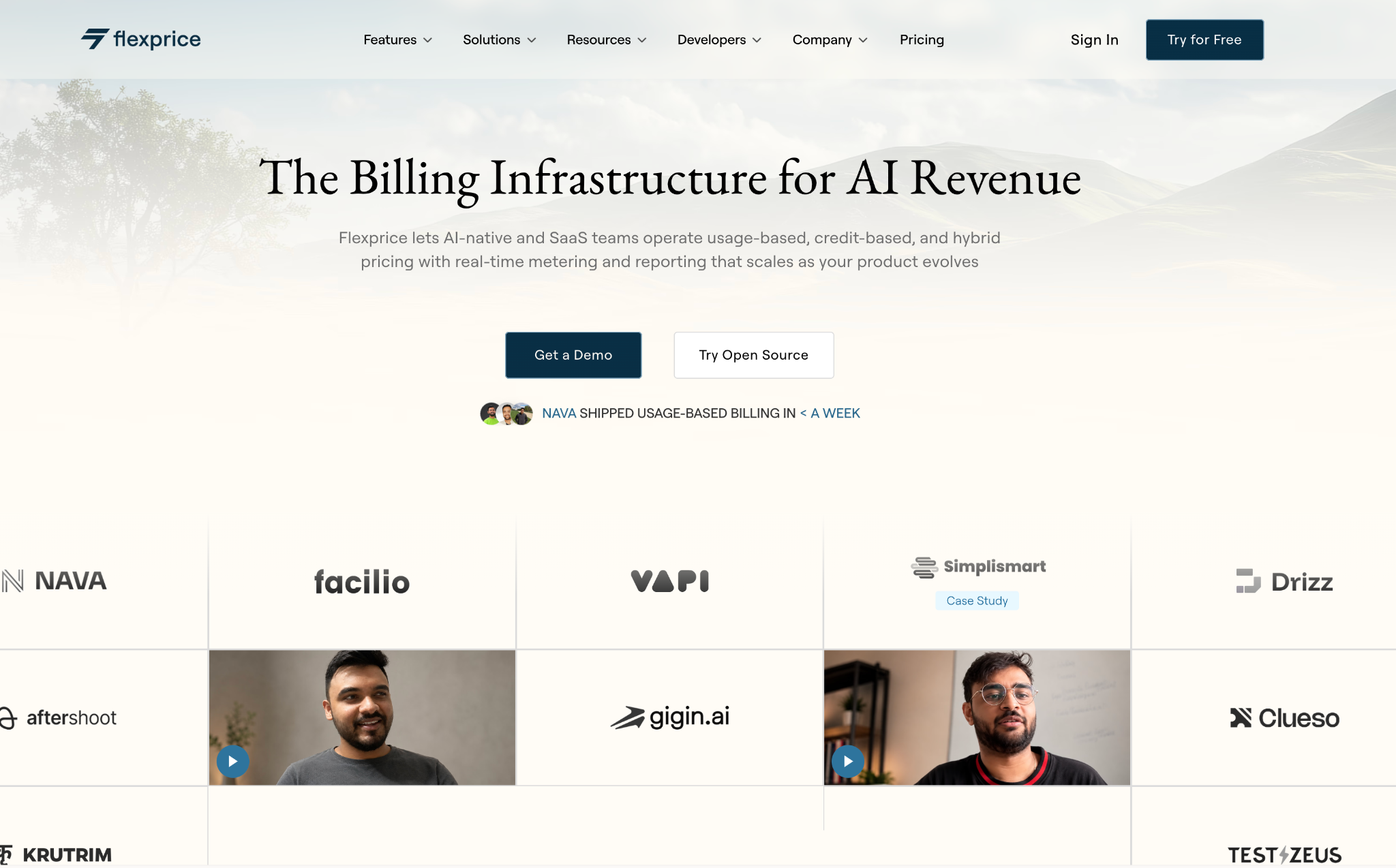
What it does: Flexprice is an open-source billing platform built specifically for AI, agentic, and API products, with programmable credit wallets, real-time metering, and a pricing engine that supports pricing changes in minutes.
Best for: AI-native companies iterating on pricing weekly who want the depth of Orb's usage billing without vendor lock-in or a restriction to a single payment gateway.
Orb is closed-source and cloud-only, and that's where Flexprice pulls ahead for some teams. The open-source core means you can inspect the billing logic directly, extend it to handle edge cases, and self-host it entirely without waiting on a vendor roadmap.
With Orb now part of Adyen, teams that want a fully independent billing layer have a more concrete reason to look elsewhere.
The trade-off is infrastructure ownership. Self-hosting means running Postgres, Redis, and the supporting application services yourself via Docker, so the zero-cost promise assumes your team has the capacity to keep it running in production.
It's also a younger platform with a smaller install base than Chargebee or Metronome, so there are fewer big-name reference customers to point to.
You'll still need a payment gateway like Stripe underneath it, since Flexprice handles pricing and metering, not payment processing itself.

Pro: “I appreciate how Flexprice speeds up getting things going, ensuring that monetization always justifies the offering. As a product leader, I'm fascinated by the time my engineering team saves to ensure everything runs seamlessly. The initial setup with Flexprice was very quick and seamless.” [Aradhya S., G2 Review (July 7, 2026)]
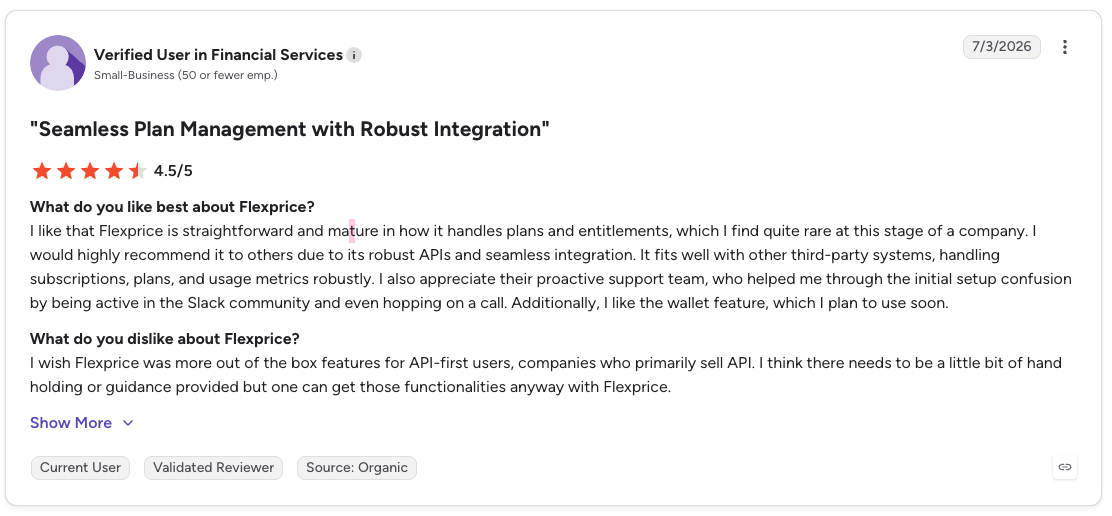
Con: “I wish Flexprice had more out-of-the-box features for API-first users, companies who primarily sell API. I think there needs to be a little bit of hand-holding or guidance provided, but one can get those functionalities anyway with Flexprice.” [Verified User in Financial Services, G2 Review (July 3, 2026)]
Basic is free up to 100K events/month, Build runs $500/month for up to 1M events, and Scale is $1,000/month for up to 5M events. Mission Critical is custom pricing with VPC or on-premise deployment options.
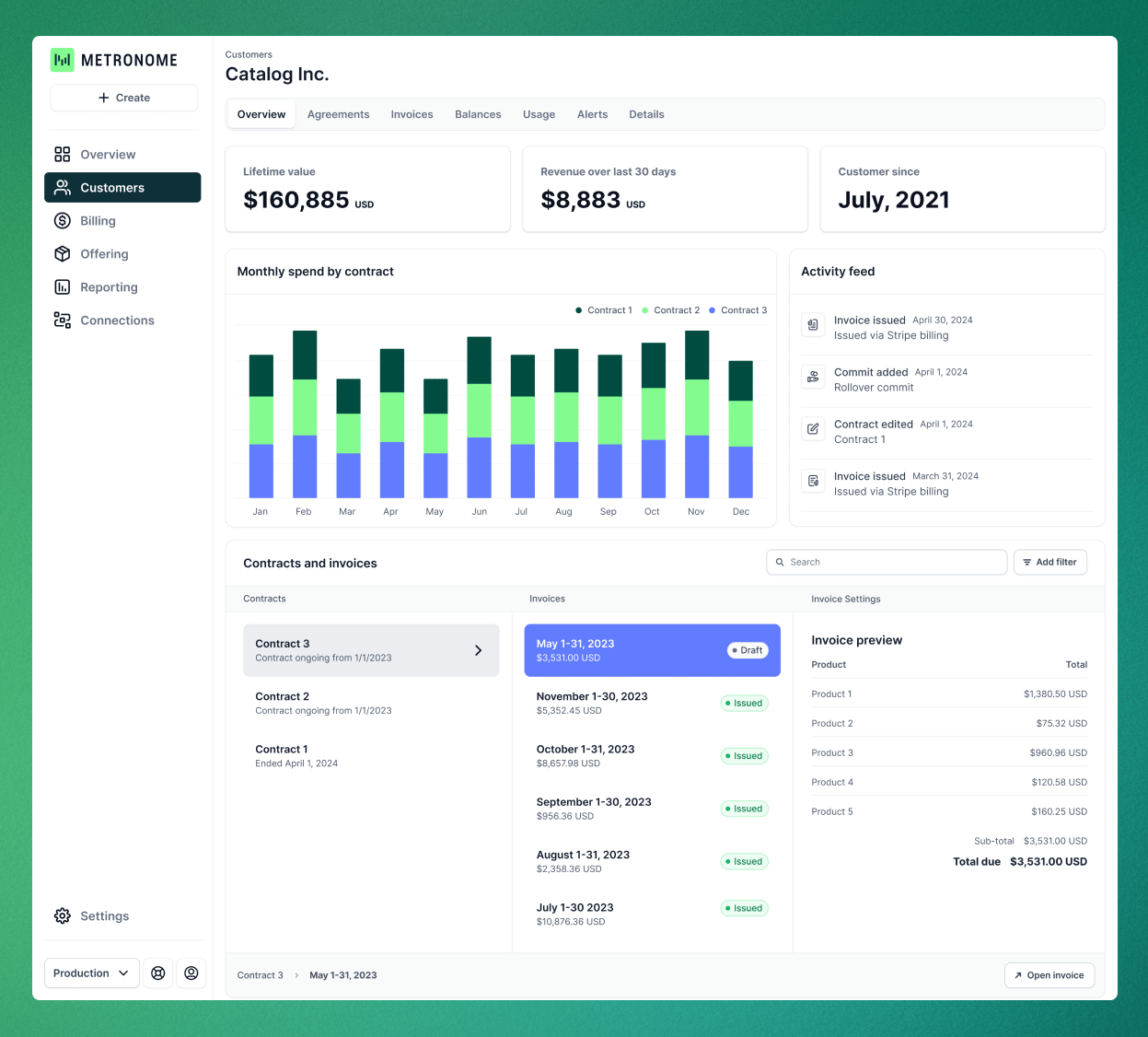
What it does: Metronome is a usage-based billing platform known for SQL-defined billable metrics, high-throughput event ingestion, and enterprise contract management, used by companies like OpenAI, Anthropic, and Nvidia before Stripe completed its acquisition of the company in January 2026.
Best for: High-volume, contract-heavy enterprises that need deep pricing simulation and multi-year deal machinery, and who are comfortable with Metronome's roadmap now living inside Stripe.
Metronome and Orb both store raw event history, but Metronome goes deeper on rate cards and contract tooling once your GTM motion gets complex.
Enterprise contracts, ramps, commitments, amendments, and true-ups are handled natively, with real-time metering that keeps prepaid credits and rate cards responsive at high event volume.
It's still post-usage invoicing only, so runaway spend isn't blocked before it hits the bill, and pricing isn't public. Every deal needs a sales conversation with no starting figure to anchor against.
The bigger question mark is the acquisition itself: if you're not already in the Stripe ecosystem, running Adyen or GoCardless, for example, you're carrying real consolidation risk, and the roadmap for a standalone, gateway-agnostic version of Metronome doesn't really exist anymore.
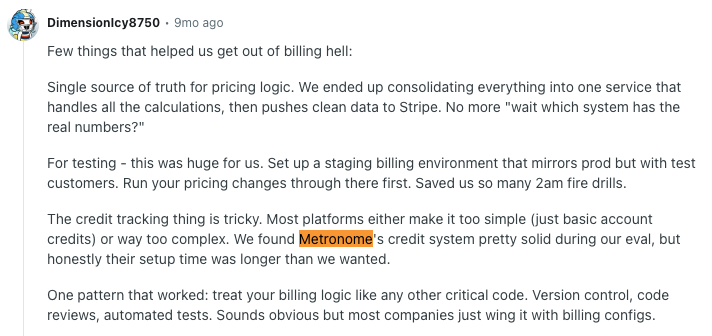
Pro: “The credit tracking thing is tricky. Most platforms either make it too simple (just basic account credits) or way too complex. We found Metronome's credit system pretty solid during our eval.” [Reddit User (July 21, 2025)]

Con: “Metronome is very expensive and is the only rating and metering solution you listed that works for enterprise level usage volumes.” [Reddit User (July 09, 2024)]
Metronome does not publish pricing. Every plan requires a sales conversation, and public estimates suggest enterprise contracts start well above what self-serve platforms on this list charge.
Read our Metronome alternatives guide if contract complexity isn't your actual problem.

What it does: Lago is an open-source billing platform for usage-based, subscription, and hybrid pricing, self-hostable under an AGPLv3 license with no per-transaction fee, plus a managed cloud option for companies that want less operational overhead.
Best for: Engineering-led teams that want full visibility into their billing logic and are willing to run the infrastructure themselves to avoid vendor lock-in.
Lago's appeal is ownership. There's no per-event or revenue-share fee on the self-hosted core, which starts to matter a lot once you're processing serious volume. Real-time event ingestion is built into the core itself, so you're not stitching in a separate data pipeline tool.
You also get full visibility into the billing logic, backed by an active open-source community, frequent releases, and SOC 2 Type II certification.
The free core isn't the whole product. Features you'd expect "in the box," like the customer portal, credit notes, and tax connectors, are paid add-ons even on the managed cloud plans.
Self-hosting also assumes you have the DevOps capacity to maintain the infrastructure and keep up with ongoing upgrades, and neither paid tier publishes pricing, so budgeting means a sales conversation either way.

Pro: “Lago gives us full control over our billing stack while staying developer-friendly. The fact that it’s open-source and self-hostable was a game-changer for our team, especially with GDPR constraints and growing infra complexity.”
Con: “There’s a slight learning curve if you’re moving from Stripe Billing or Chargebee. Lago is flexible, but it requires thoughtful integration. That said, it’s worth it if you want control.” [Antoine P., G2 Review (September 16, 2025)]
Paid plans require contacting sales directly, and pricing is not published on the site.
There's no single right answer here. The right Orb alternative depends on which problem you're trying to solve.
Choose Chargebee or Maxio if you:
Choose Flexprice or Lago if you:
Choose Metronome if you:
Skip switching entirely if your current setup on Orb still fits. None of these five alternatives solves a problem worth the migration effort if simple event-based metering is all your pricing model needs.
If we had to pick one starting point for most AI-native companies outgrowing Orb, it would be Flexprice or Lago, depending on how much self-hosting your team wants to own. Chargebee and Maxio remain the safer bet if your business is subscription-first with usage as a secondary layer.
Metronome remains the strongest option for enterprise contract complexity, though its future within Stripe is worth watching over the next year.
The five platforms above all handle the invoice side of the equation well. However, none of them enforce what a customer is allowed to do before the bill runs.
Stigg sits in the request path alongside whichever billing platform you choose, enforcing entitlements, credits, usage limits, and spend governance in real time before the request completes. Billing stays aligned with access decisions from the start.
A few things it handles at that layer:
Most Orb alternatives solve the invoice. If that's not where you're breaking, start with the Stigg docs.
Flexprice and Lago are the strongest fits for AI companies, since both treat credits, tokens, and hybrid usage as first-class primitives rather than a subscription plan with usage bolted on. Flexprice leans further into the speed of pricing experimentation, while Lago leans further into self-hosted control.
No, Stripe completed its acquisition of Metronome on January 14, 2026. Metronome now operates as a product within Stripe's suite, which is worth factoring in if vendor independence or multi-processor flexibility matters to your billing strategy.
Metronome and Maxio both handle enterprise contract complexity well, including ramps, commitments, and multi-year terms. Flexprice also supports ramped contracts and account hierarchies, though its enterprise reference base is smaller than Metronome's.
Lago and Flexprice both ship an open-source core under permissive self-hosting terms, though Lago gates several features, such as the customer portal and tax integrations, behind paid tiers, even on the managed cloud. Chargebee, Maxio, and Metronome are all closed-source, proprietary platforms.
Not every problem requires a full billing migration. If your actual problem is entitlement enforcement, credit limits, or usage governance inside your product rather than how invoices get generated, that's a different layer than the ones covered here.
.jpg)