%20(1).png)
Guides
Software Billing Models: 8 Types and How to Choose
Software billing models decide how you charge and what you must build. Compare subscription, usage, credits, and hybrid models, and how to choose.

Generative AI usage-based billing software compared across 8 platforms. Includes pricing, engineering complexity, AI metric support, and pros and cons.


Every AI product eventually runs into the same question. How do you turn token consumption into something you can reliably price, control, and bill?
After mapping the AI billing stack across 8 platforms, from developer-first rating engines to enterprise order-to-cash suites, here's what actually separates generative AI usage-based billing software when you're pricing token consumption at scale.
No two AI billing platforms solve the same problem. Some focus on usage metering and real-time enforcement, while others are built for invoicing, revenue operations, or enterprise finance teams.
To keep the comparison practical, we evaluated each platform against four criteria that matter most when billing for generative AI consumption:
We also looked beyond feature lists. A platform might support usage-based billing on paper, but still require significant engineering effort to make it work for AI workloads.
Our rankings reflect how these platforms perform in production AI environments, where scalability, flexibility, and day-to-day challenges matter as much as the feature set itself.
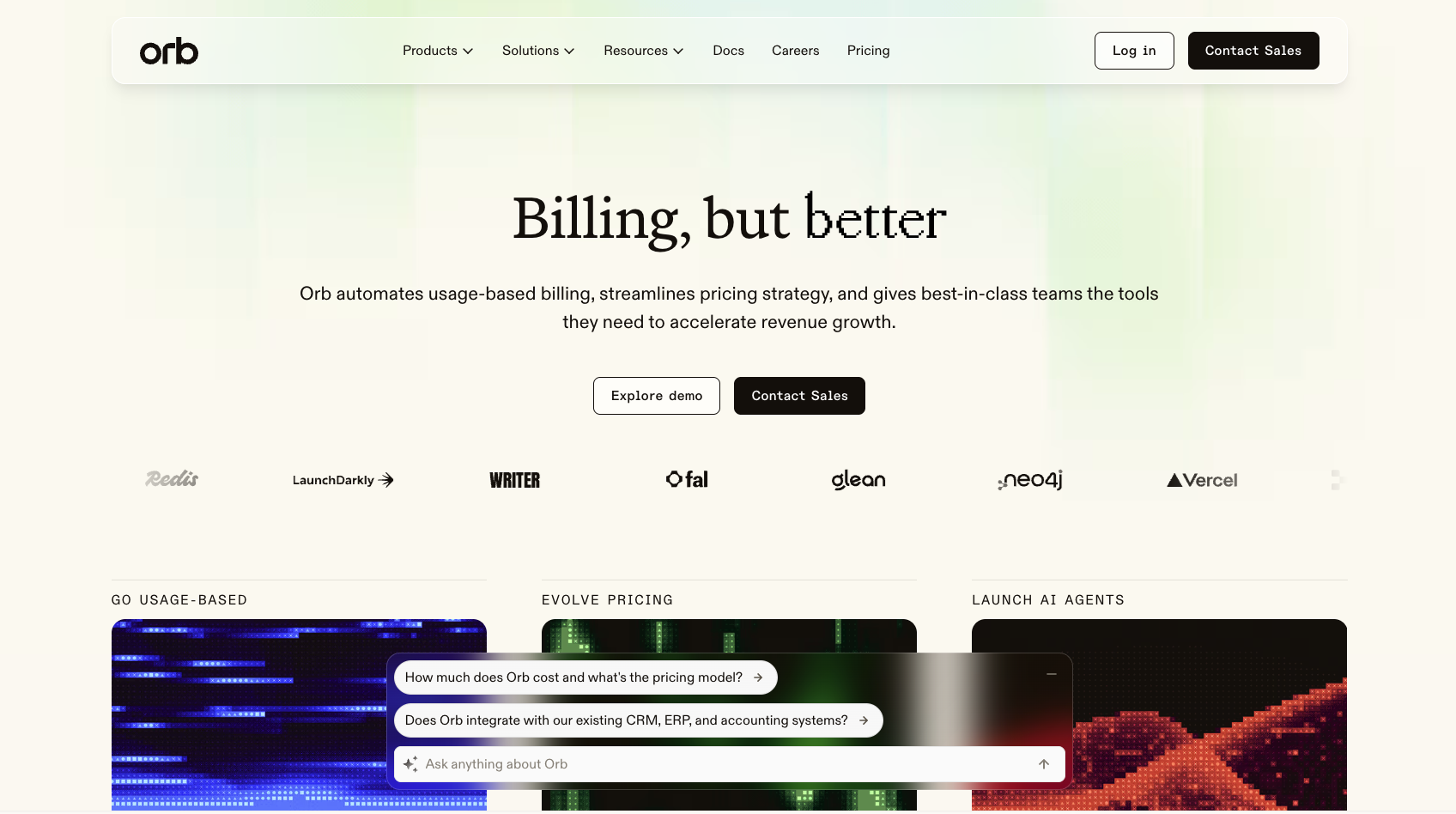
What it does: Orb is a developer-focused billing engine built for complex, multi-dimensional pricing models. It handles usage-based and hybrid billing through a strong API and a real-time rating engine.
Best for: AI and API companies with pricing logic that varies by model, endpoint, volume tier, or customer contract.
Orb was designed for teams whose pricing looks more like a formula than a price list. It accepts high-volume event streams, applies pricing rules in real time, and generates granular invoices that show exactly what drove each charge.
The platform is API-first. You’ll get the most out of it if you have dedicated billing engineering resources. Product or RevOps teams expecting a no-code interface will need engineering support to configure and maintain pricing logic.
Orb does not process payments natively. It integrates with payment providers rather than replacing them.
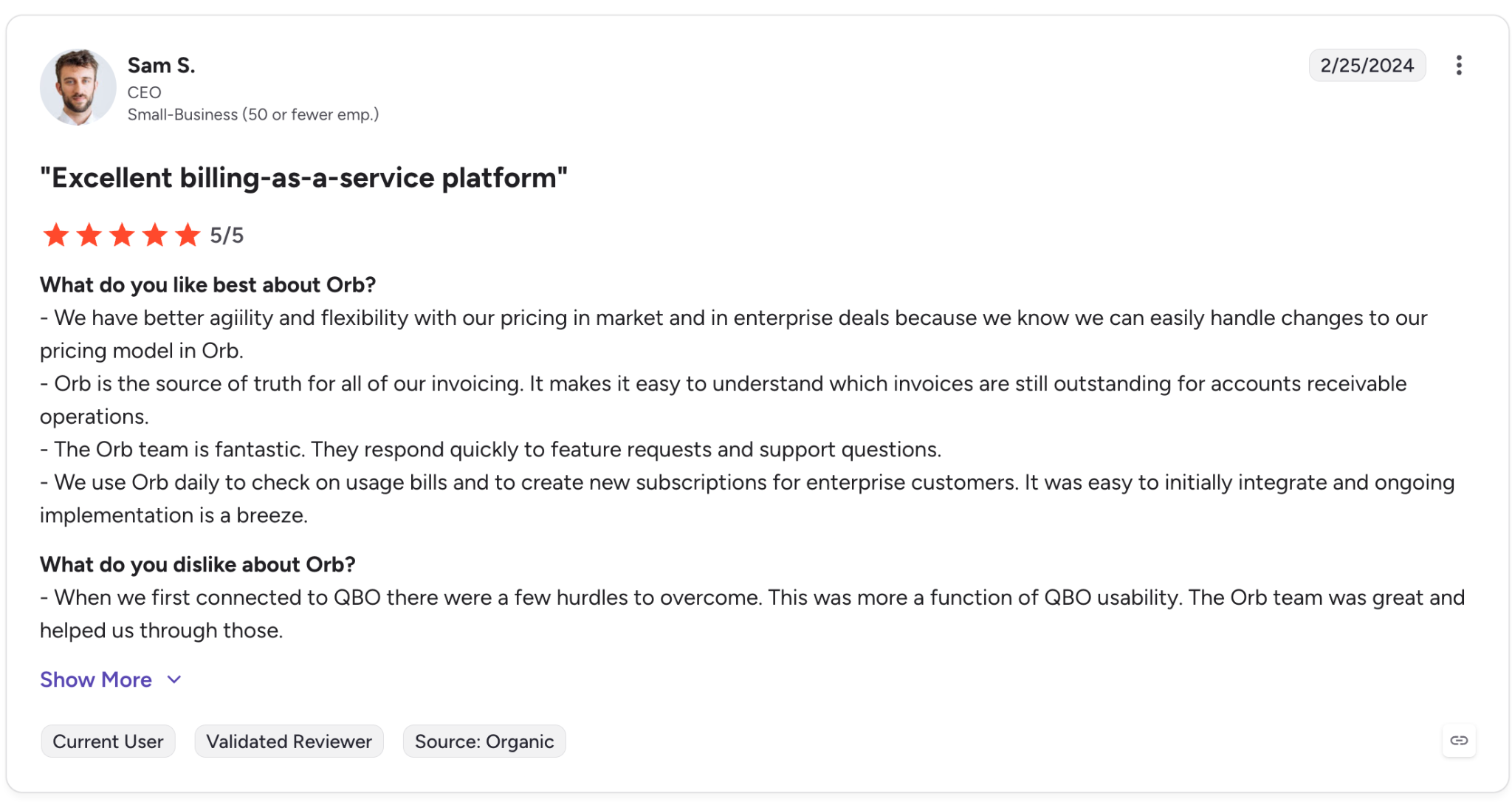
Pro: "We have better agility and flexibility with our pricing in market and in enterprise deals because we know we can easily handle changes to our pricing model in Orb." (Sam S., G2 Review, Feb 25, 2024)
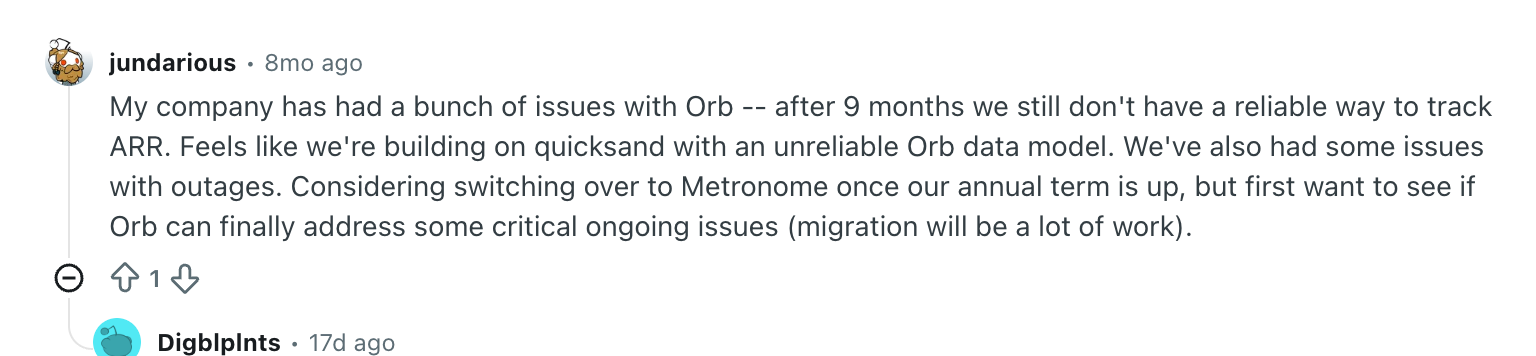
Con: "After 9 months, we still don't have a reliable way to track ARR. Feels like we're building on quicksand with an unreliable Orb data model." (u/jundarious, Reddit, Oct 2, 2025)
Orb uses custom pricing across all plans (Core, Advanced, and Enterprise), with costs dependent on usage, integrations, support, and scale requirements.
If you’re expecting a plug-and-play setup, you should make sure you have the resources to get full value from Orb. It’s the right call for AI companies that need serious pricing flexibility and have the engineering capacity to build on top of it.
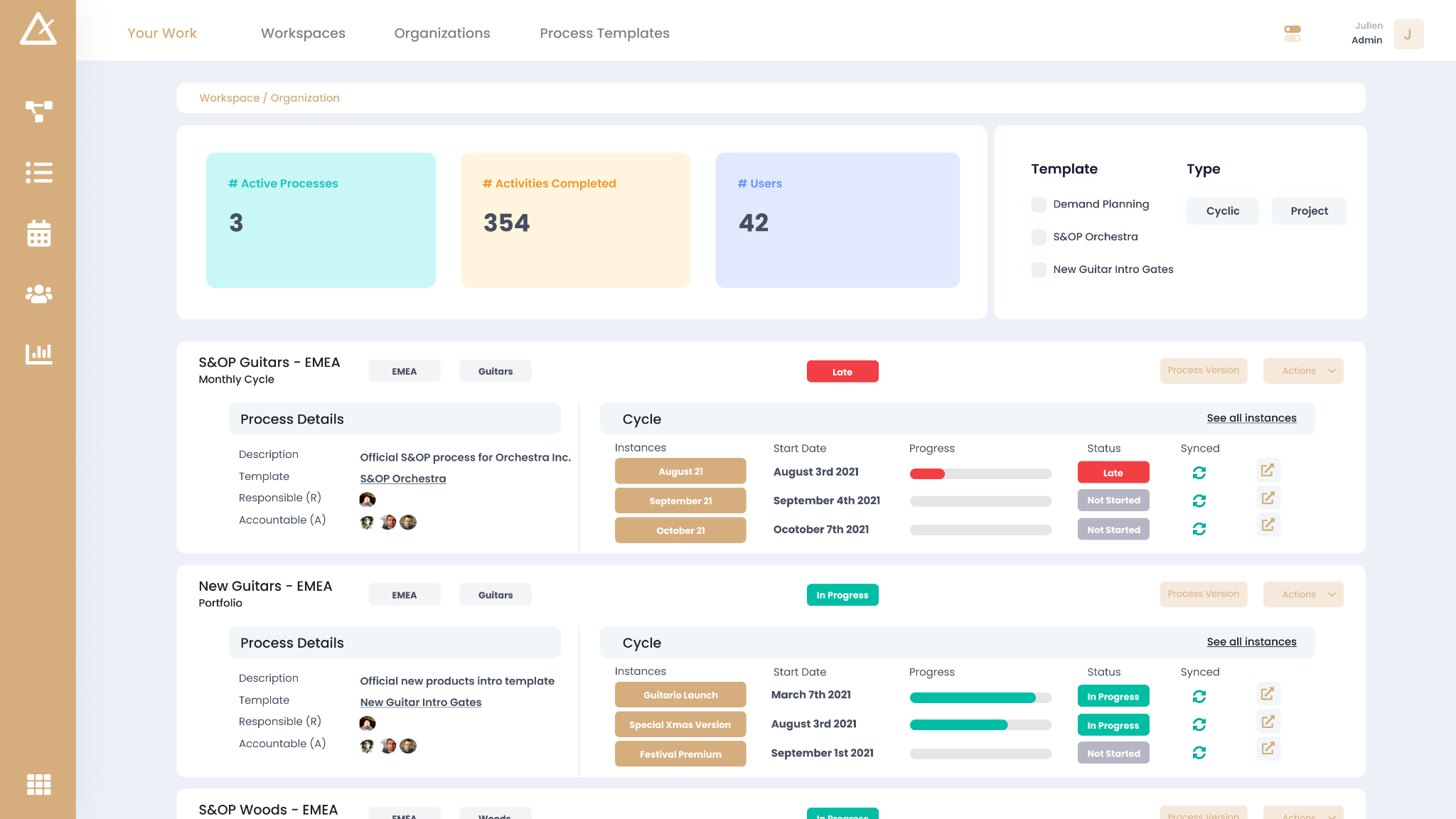
What it does: Metronome is a usage-based billing infrastructure built to handle high-volume event ingestion and complex enterprise pricing models. Stripe acquired Metronome in 2026 and integrated it into the Stripe ecosystem.
Best for: High-volume AI platforms with complex enterprise pricing, high event volumes, and existing Stripe infrastructure.
Metronome was built for technical teams managing billing at high volume. It ingests event streams, transforms them into billable metrics, and supports complex pricing configurations, including commitments, overages, and multi-dimensional pricing.
The Stripe acquisition changes the competitive context. Metronome is now positioned within Stripe's ecosystem, which means tighter integration for teams already on Stripe, but also means the product roadmap is tied to Stripe's direction.
Enterprise-grade procurement and pricing apply. This is not a tool for early-stage teams.
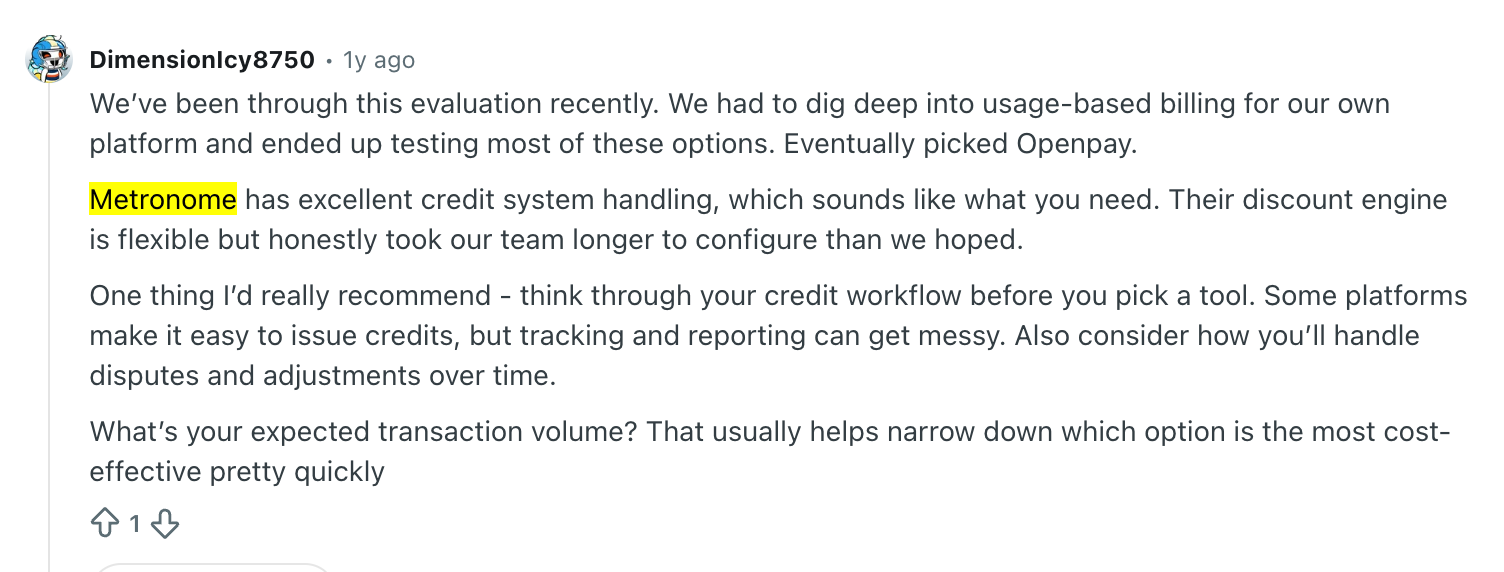
Pro: "Metronome has excellent credit system handling... Their discount engine is flexible." (u/DimensionIcy8750, Reddit, Jul 3, 2025)

Con: "Metronome is very expensive and is the only rating and metering solution you listed that works for enterprise-level usage volumes." (u/javabuddha1, Reddit, Jul 9, 2024)
Metronome offers a free Starter plan for launching usage-based billing, with custom pricing for high-growth companies that need advanced integrations, dedicated support, and tailored pricing at scale.
Metronome suits large AI platforms with complex enterprise billing volumes. The Stripe acquisition makes it a stronger fit for teams already in that ecosystem and a weaker fit for teams that want provider independence.
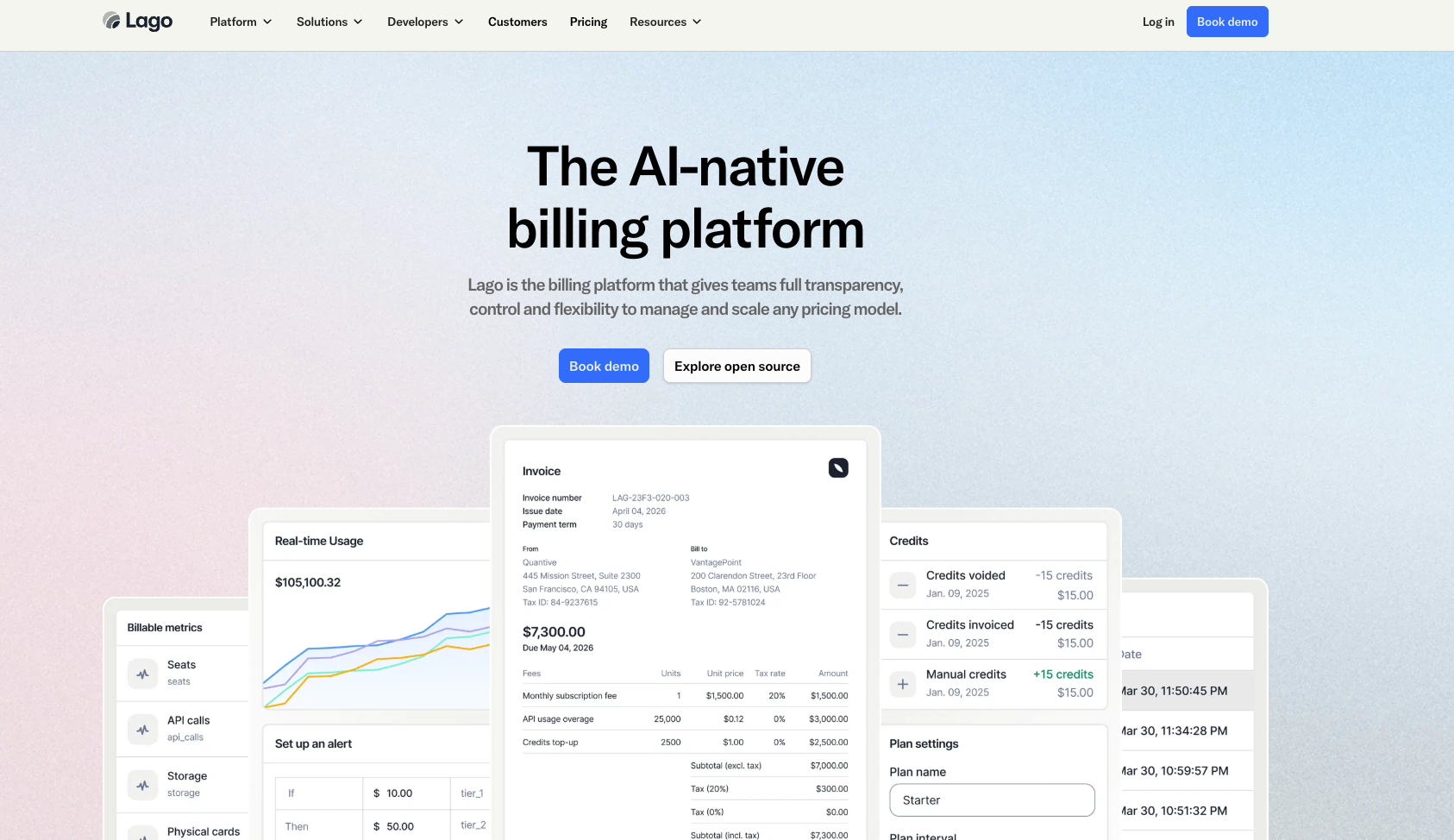
What it does: Lago is an open-source billing engine that teams can self-host or use as a managed cloud service. It handles event-based metering, flexible pricing model configuration, and invoice generation.
Best for: AI teams with strict data residency requirements, teams that want to avoid vendor lock-in, or engineering-led organizations that want to own the billing stack.
Lago's open-source core is free. Teams can deploy it inside their own infrastructure, modify the code, and retain complete ownership of billing data and logic.
The tradeoff for that ownership is extra work around implementation. Self-hosting Lago requires DevOps resources, and features like the hosted portal, real-time balance management, and credit notes are either premium or require custom development work.
Lago does not include native payment processing. Payment collection requires a separate integration.
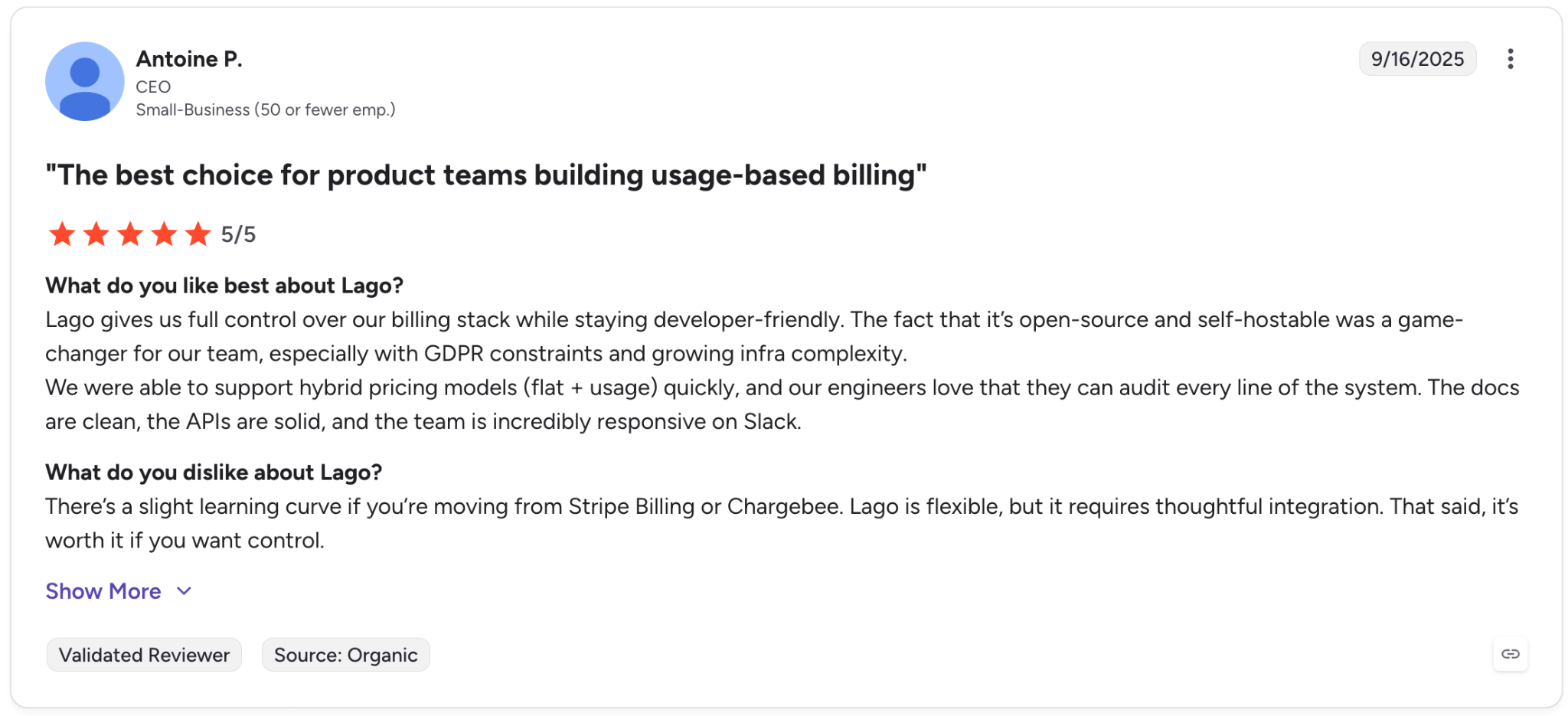
Pro: "Lago gives us full control over our billing stack while staying developer-friendly. The fact that it’s open-source and self-hostable was a game-changer for our team." (Antoine P., G2 Review, Sep 16, 2025)
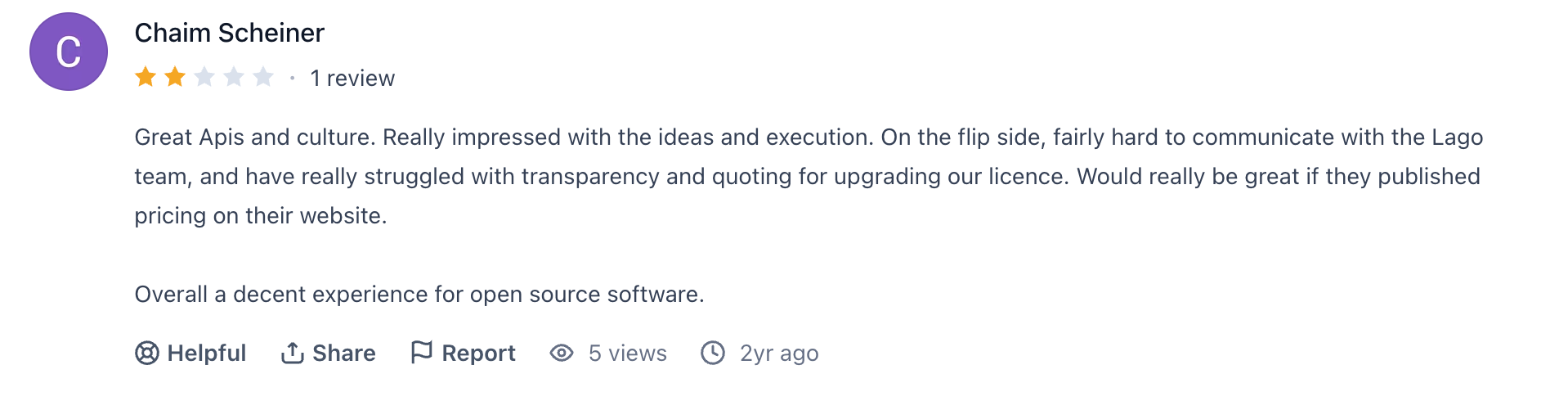
Con: "Really struggled with transparency and quoting for upgrading our licence. Would really be great if they published pricing on their website." (Chaim Scheiner, Product Hunt Review, Jan 24, 2024)
Lago offers custom Business and Enterprise pricing, with plans built around usage volume, support needs, and implementation requirements.
Lago is the right fit for teams that treat billing as a core product component and want to own the entire stack. If you don’t have strong DevOps and engineering resources you’ll find the maintenance overhead significant.
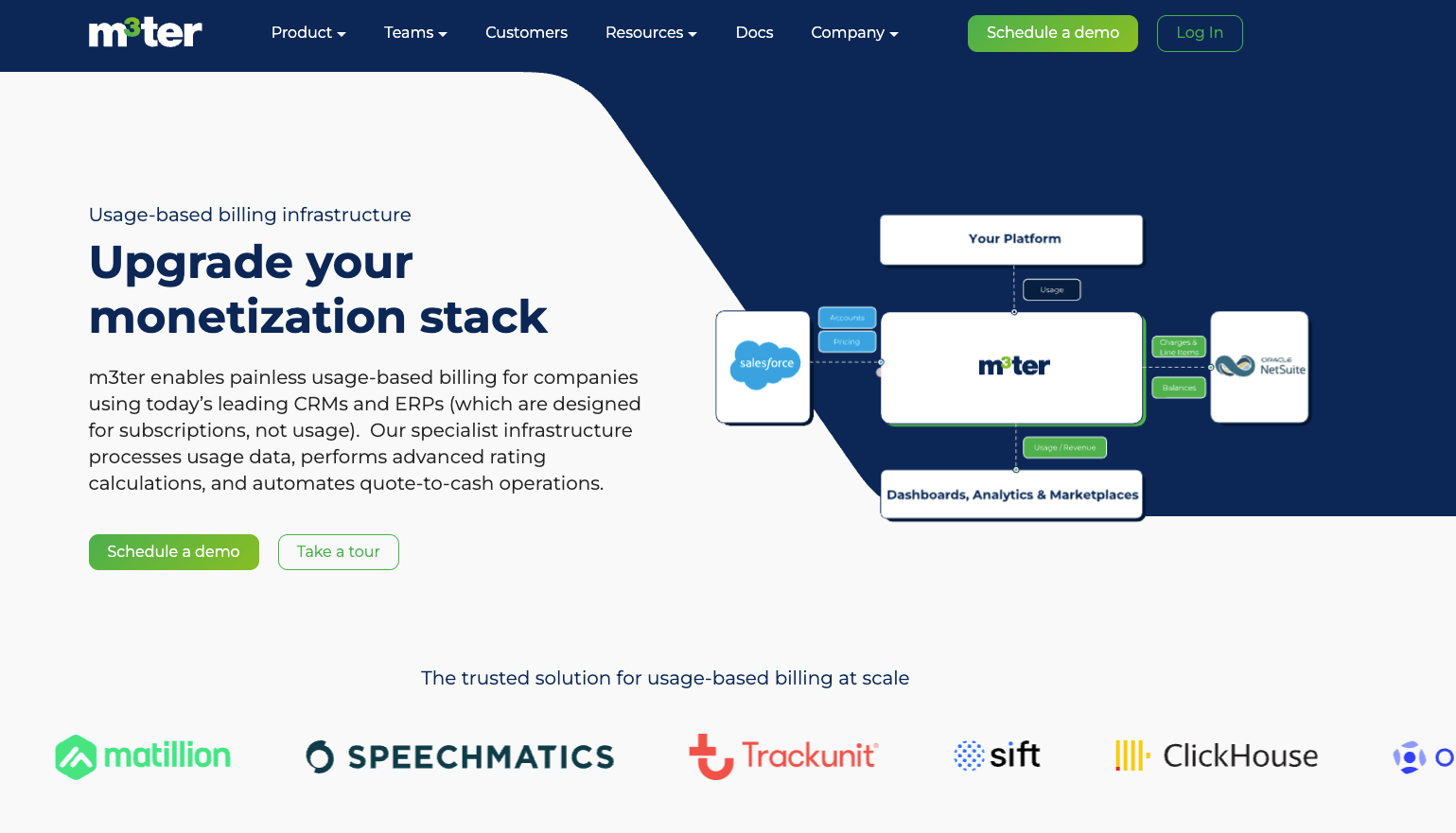
What it does: m3ter is a usage data platform as opposed to a full billing suite. It sits between the product and the billing or finance system, where it ingests raw usage events, normalizes them, and outputs clean billable metrics.
Best for: AI companies with complex, multi-source usage data that needs to be aggregated and attributed accurately before it reaches a billing system.
m3ter solves a specific problem, where raw usage data from AI products is often messy, multi-dimensional, and inconsistent across sources. m3ter normalizes this data into reliable billable metrics that downstream billing systems can use.
It does not process payments, generate invoices, or handle subscriptions independently. If you’re using m3ter, you need a separate billing platform downstream.
This makes it a metering layer in a larger architecture rather than a standalone billing solution.
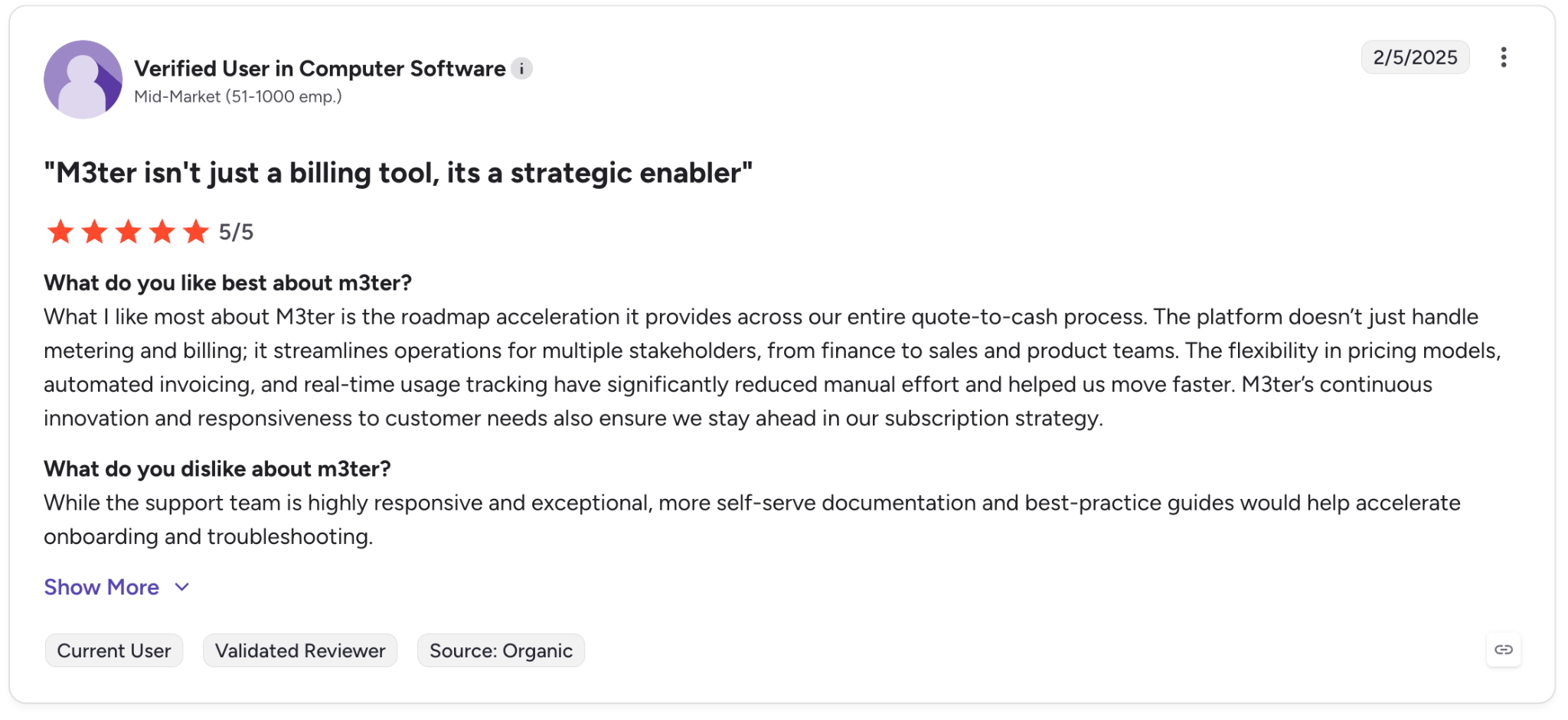
Pro: "The flexibility in pricing models, automated invoicing, and real-time usage tracking have significantly reduced manual effort and helped us move faster." (Verified User in Computer Software, G2 Review, Feb 5, 2025)
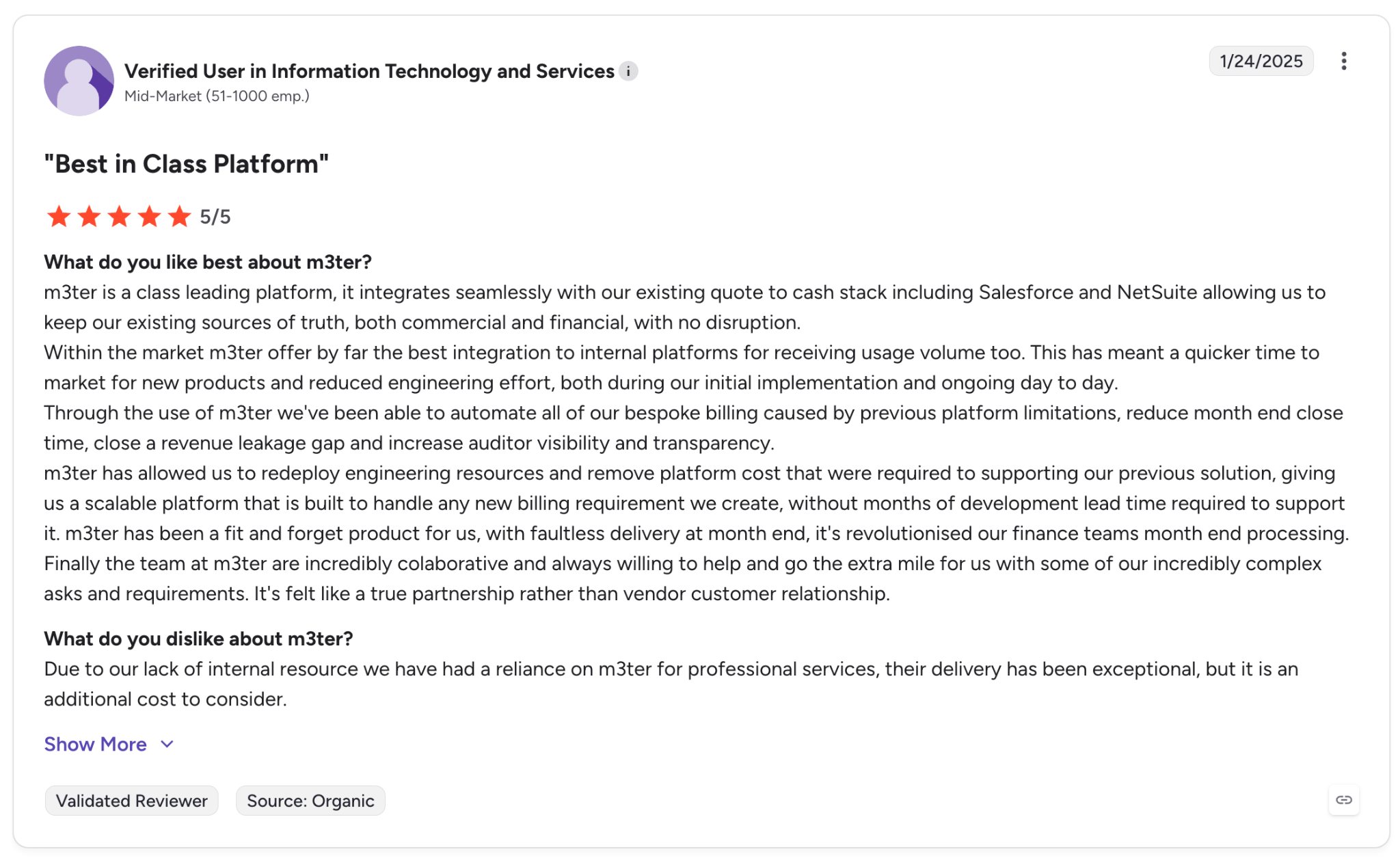
Con: "Due to our lack of internal resources, we have had a reliance on m3ter for professional services... it is an additional cost to consider." (Verified User in Information Technology and Services, G2 Review, Jan 24, 2025)
m3ter uses custom pricing. Contact sales for a personalized quote and demo.
m3ter is a strong choice for AI companies whose metering requirements are complex enough to justify a dedicated data layer.
If you’re looking for an all-in-one billing solution, you should look elsewhere, since m3ter is infrastructure for building a multi-component billing architecture.
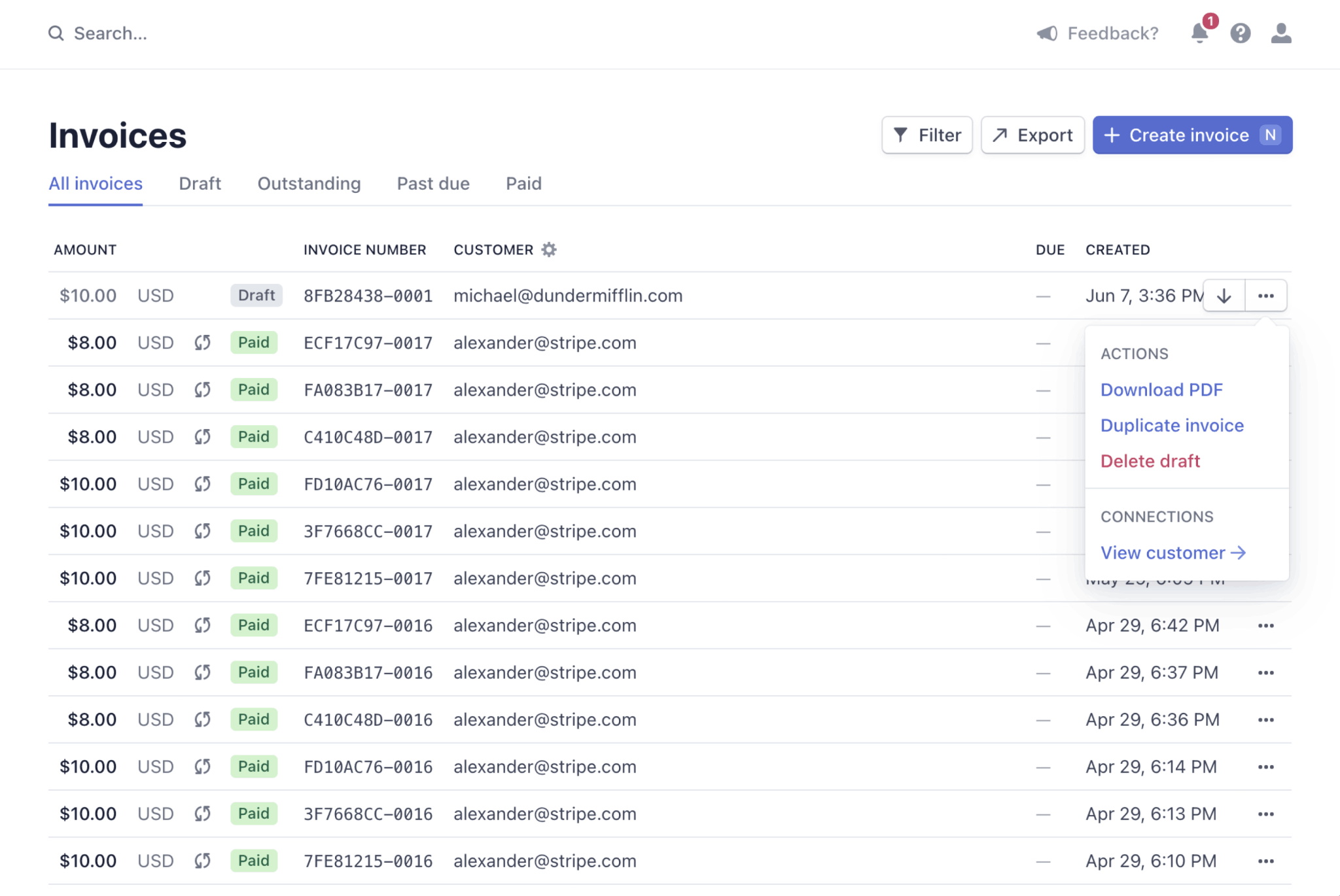
What it does: Stripe Billing is the subscription and usage-based billing layer within the Stripe payments ecosystem. It handles metered billing, subscriptions, invoicing, and payment collection through a unified platform.
Best for: AI startups that already use Stripe for payments and want usage-based billing without adopting a separate platform.
Stripe Billing's main advantage is its tight integration with Stripe Payments. Teams that already process payments through Stripe can add usage-based billing without introducing a new vendor relationship or a separate data pipeline.
The tradeoff is that Stripe Billing is a set of building blocks instead of an opinionated billing product. Teams with complex, multi-dimensional pricing logic will need to build significant custom logic on top of it.
Stripe's metered billing aggregates usage for end-of-cycle invoicing. It was not designed to enforce limits in real time before compute runs.
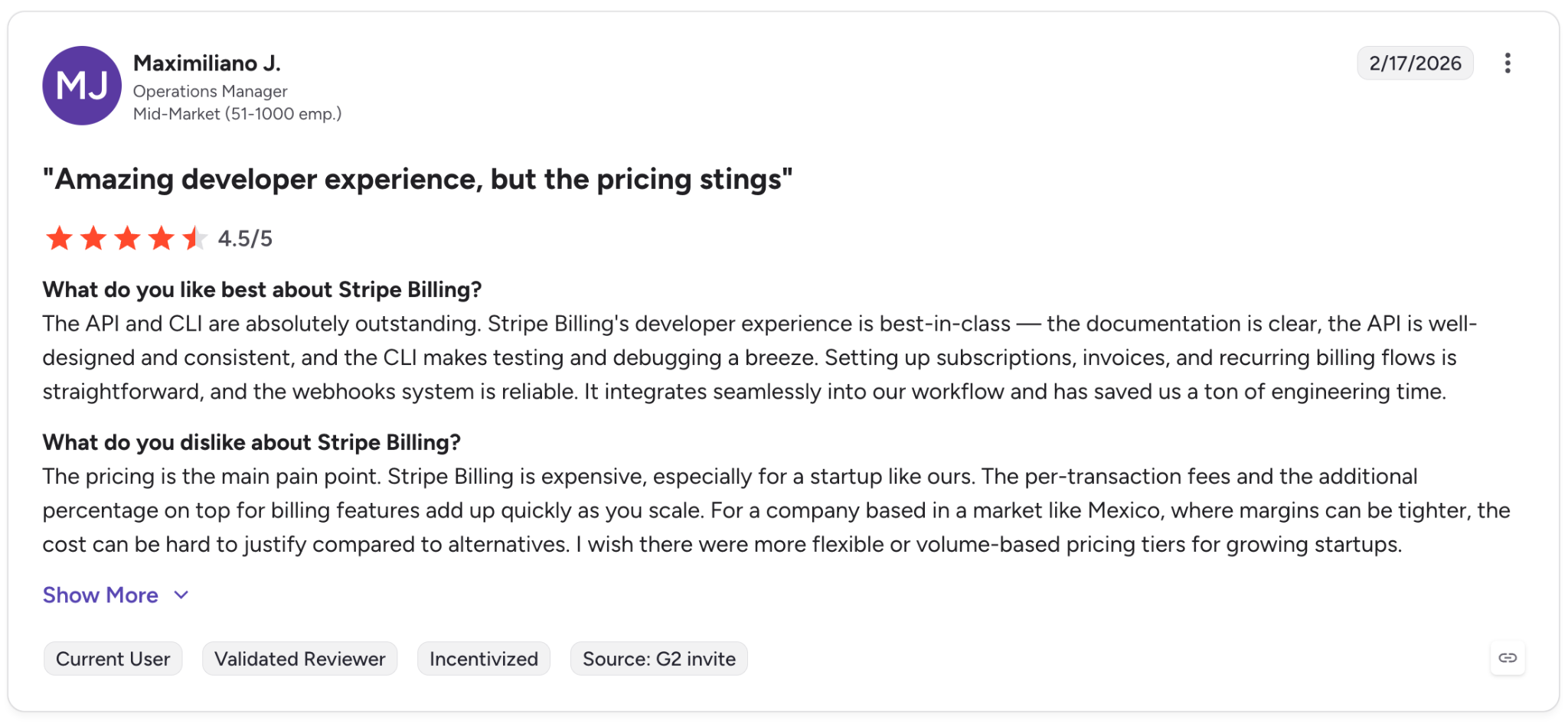
Pro: "Stripe Billing's developer experience is best-in-class. The documentation is clear, the API is well-designed and consistent, and the CLI makes testing and debugging a breeze." (Maximiliano J., G2 Review, Feb 17, 2026)
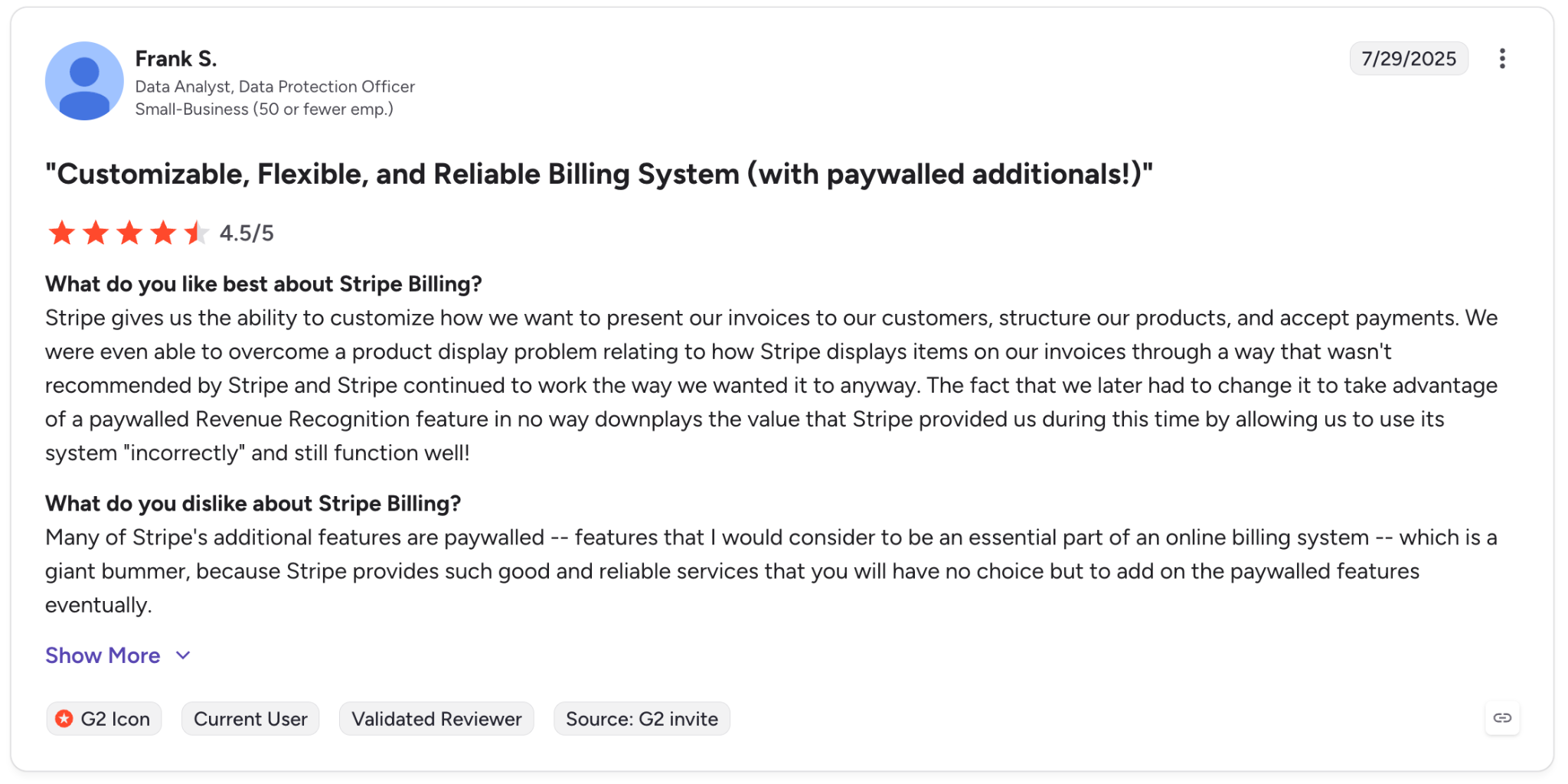
Con: "Many of Stripe's additional features are paywalled — features that I would consider to be an essential part of an online billing system." (Frank S., G2 Review, Jul 29, 2025)
Stripe Billing offers two pricing options: A subscription plan starting at $620/month on a 1-year contract, or a pay-as-you-go model at 0.7% of billing volume.
This gives you the flexibility to choose between predictable monthly pricing and usage-based billing.
Stripe Billing is the natural starting point if you are already in the Stripe ecosystem. It covers the billing basics well and reduces integration overhead. If you have complex AI pricing models or real-time enforcement requirements, you’ll need additional tooling on top of it.
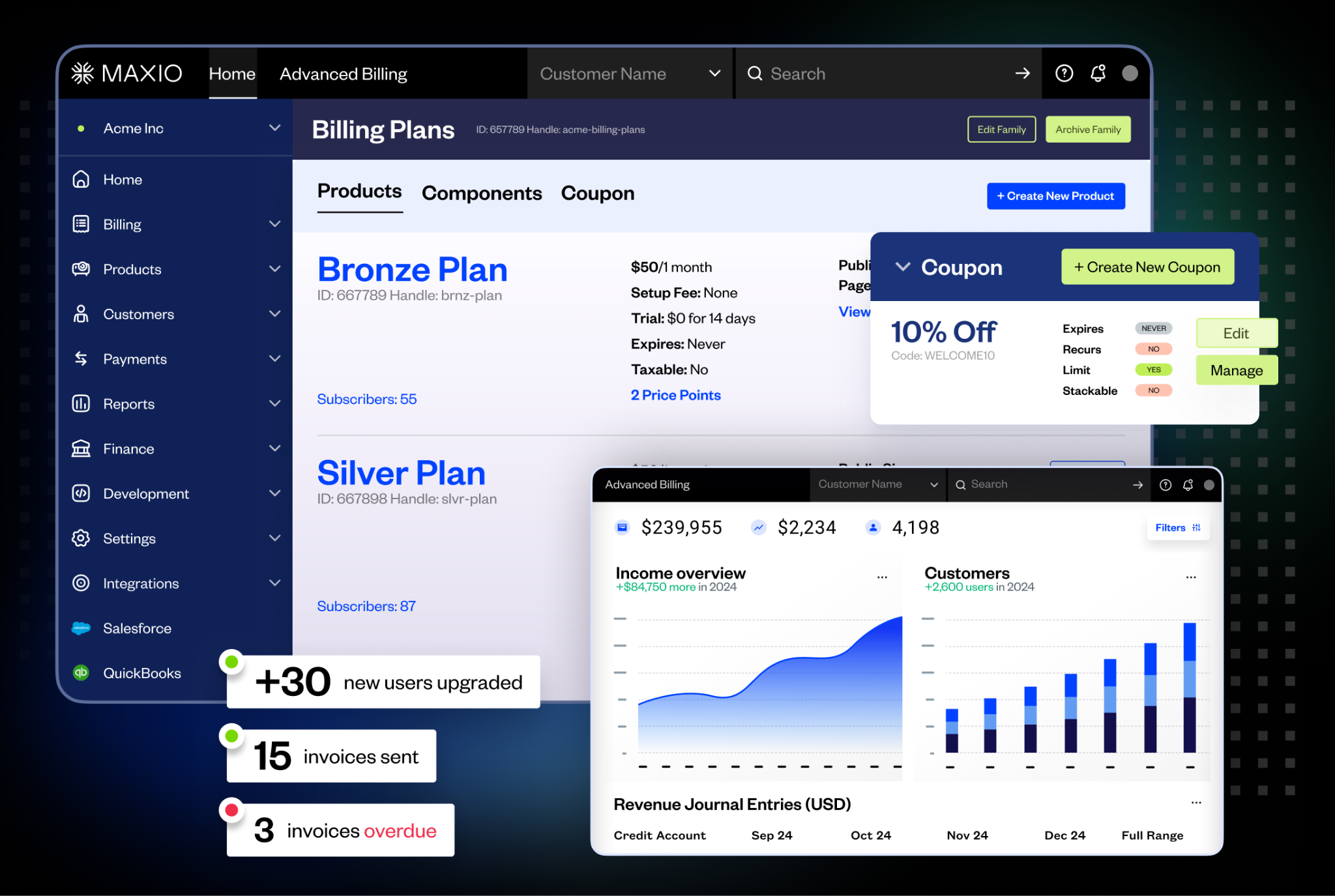
What it does: Maxio is a unified platform combining subscription and usage-based billing, SaaS metrics, and automated revenue recognition. It was formed through the merger of Chargify and SaaSOptics.
Best for: B2B SaaS companies with recurring and usage-based revenue that need billing and finance reporting in one system, with ASC 606 compliance.
Maxio targets the intersection of billing and financial operations. Finance teams get automated revenue recognition, SaaS metrics like MRR and churn, and reconciliation tools alongside the billing engine.
Engineering teams building complex real-time AI pricing models will find Maxio better suited to subscription-led products with a usage component than to pure consumption-based AI pricing.
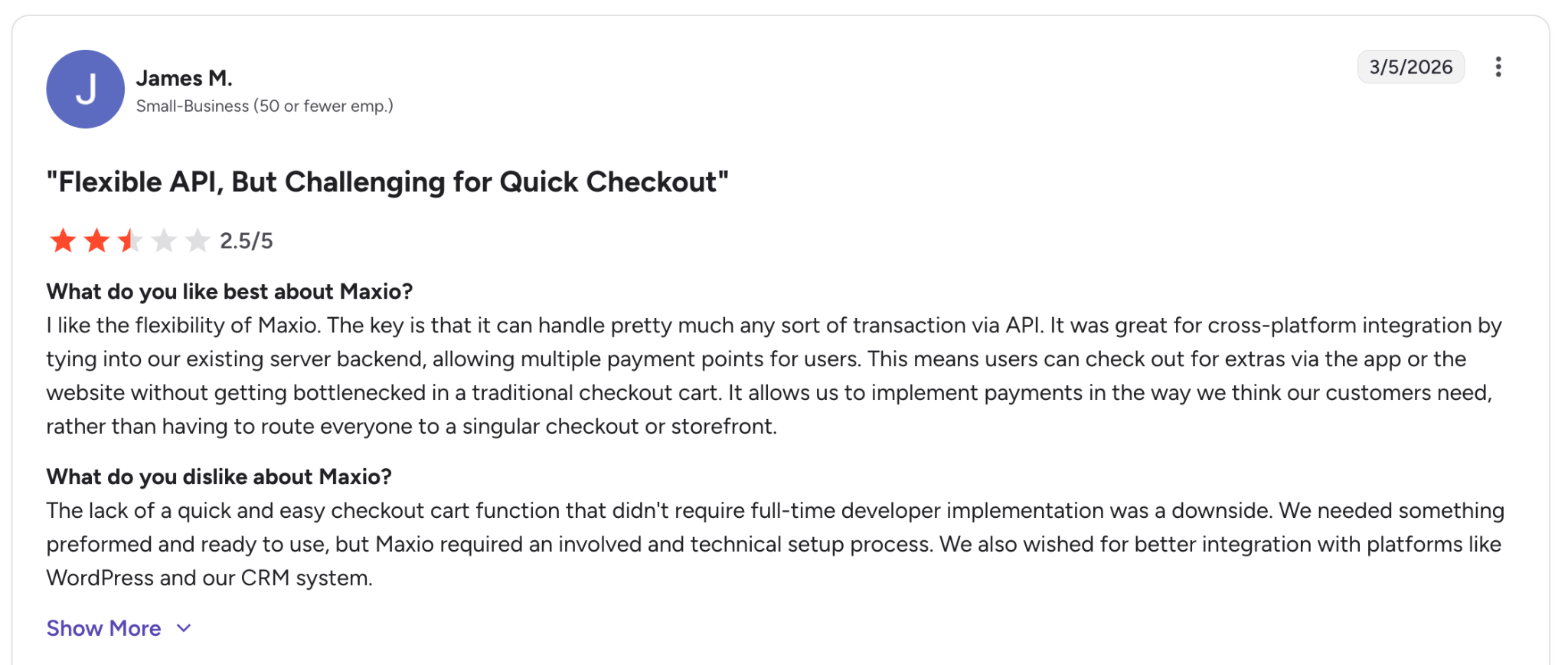
Pro: "Maxio can handle pretty much any sort of transaction via API. It allows us to implement payments the way we think our customers need, rather than routing everyone through a singular checkout." (James M., G2 Review, Mar 5, 2026)
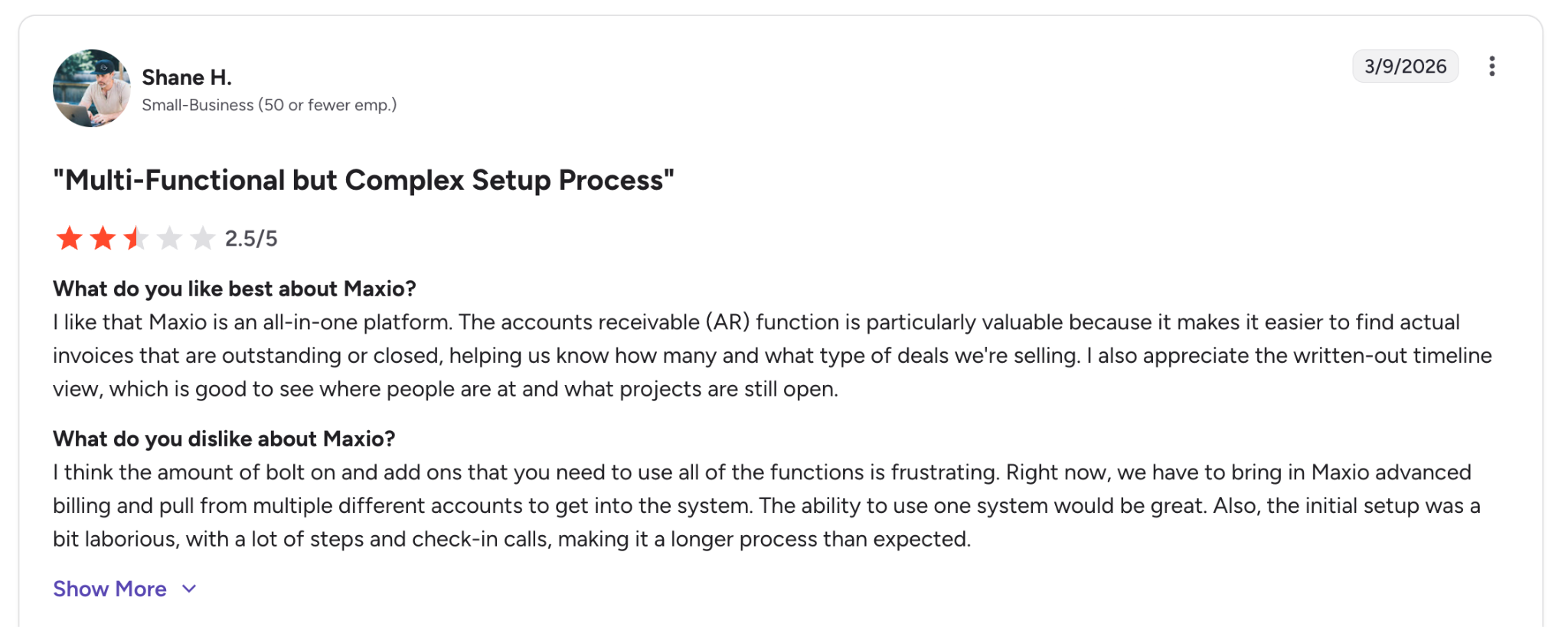
Con: "The amount of bolt-on add-ons needed to use all the functions is frustrating. The initial setup was a bit laborious." (Shane H., G2 Review, Mar 9, 2026)
Maxio offers a Grow plan at $599/month for businesses with up to $100K in monthly billings, while larger businesses can access the Scale plan with custom pricing based on their billing volume and requirements.
Maxio is a good fit for established B2B SaaS companies that have moved into usage-based pricing and need billing and revenue recognition handled together.
Pure AI-native companies with token-based pricing and high event volume should consider whether Maxio's architecture fits their metering requirements.
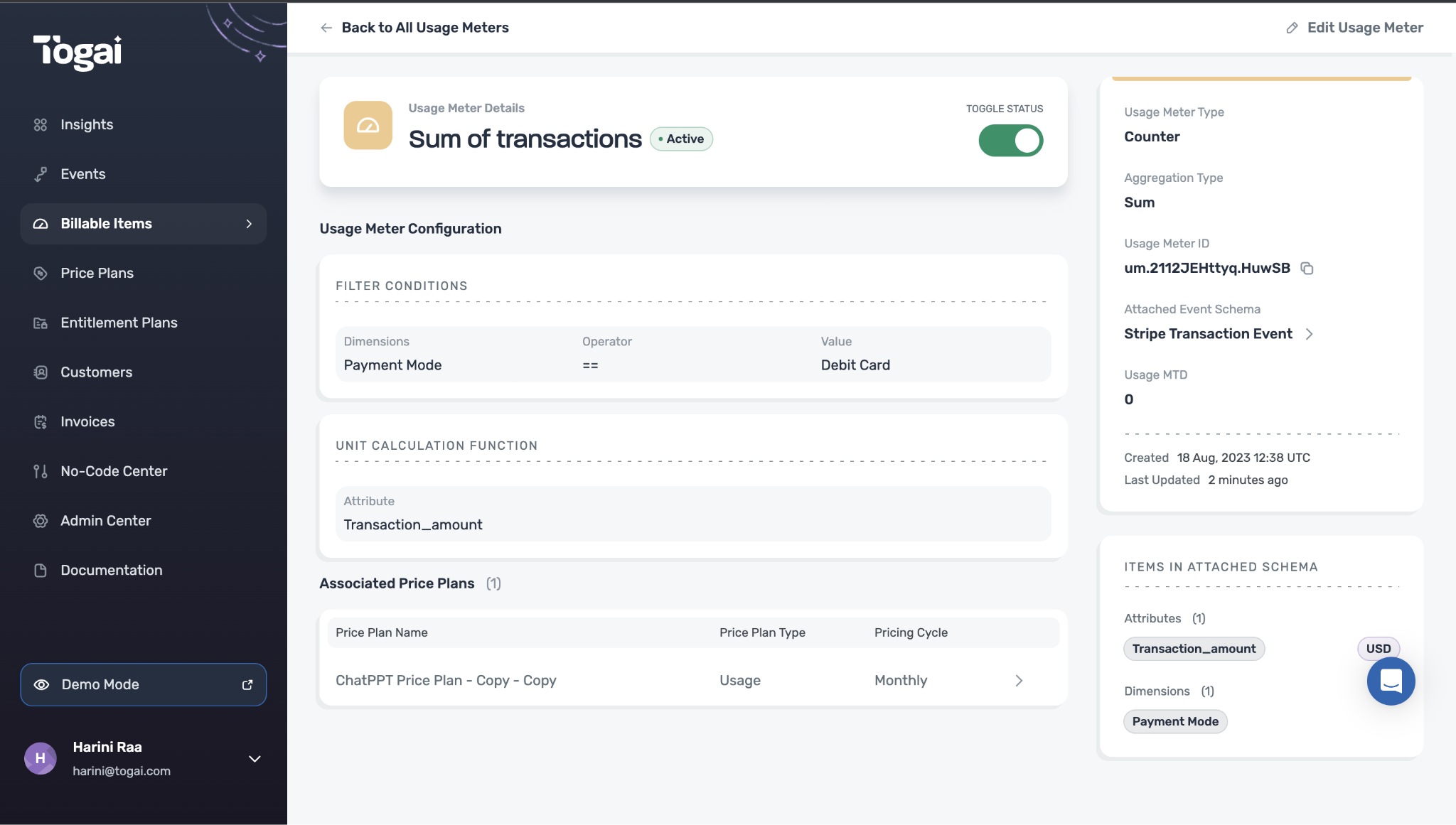
What it does: Togai is a usage-based billing platform that covers event ingestion, metering, price configuration, rating, and invoicing in a single system. It supports a wide range of pricing models and is designed to handle complex billing without the need for significant ongoing engineering effort.
Best for: Product and RevOps teams that need to configure and iterate on pricing models quickly, and engineering teams that want to decouple billing logic from the product codebase.
Note: Togai has now been acquired by Zuora.
Togai's core proposition is that billing configuration should not require code changes. Pricing models are set up through the platform rather than hardcoded into the product. You can add or modify pricing without a deployment.
The ingestion pipeline supports high-throughput, high-cardinality event streams with idempotency guarantees. It also includes a synchronous pipeline for real-time metered entitlements, which is relevant for AI products that need enforcement alongside metering.
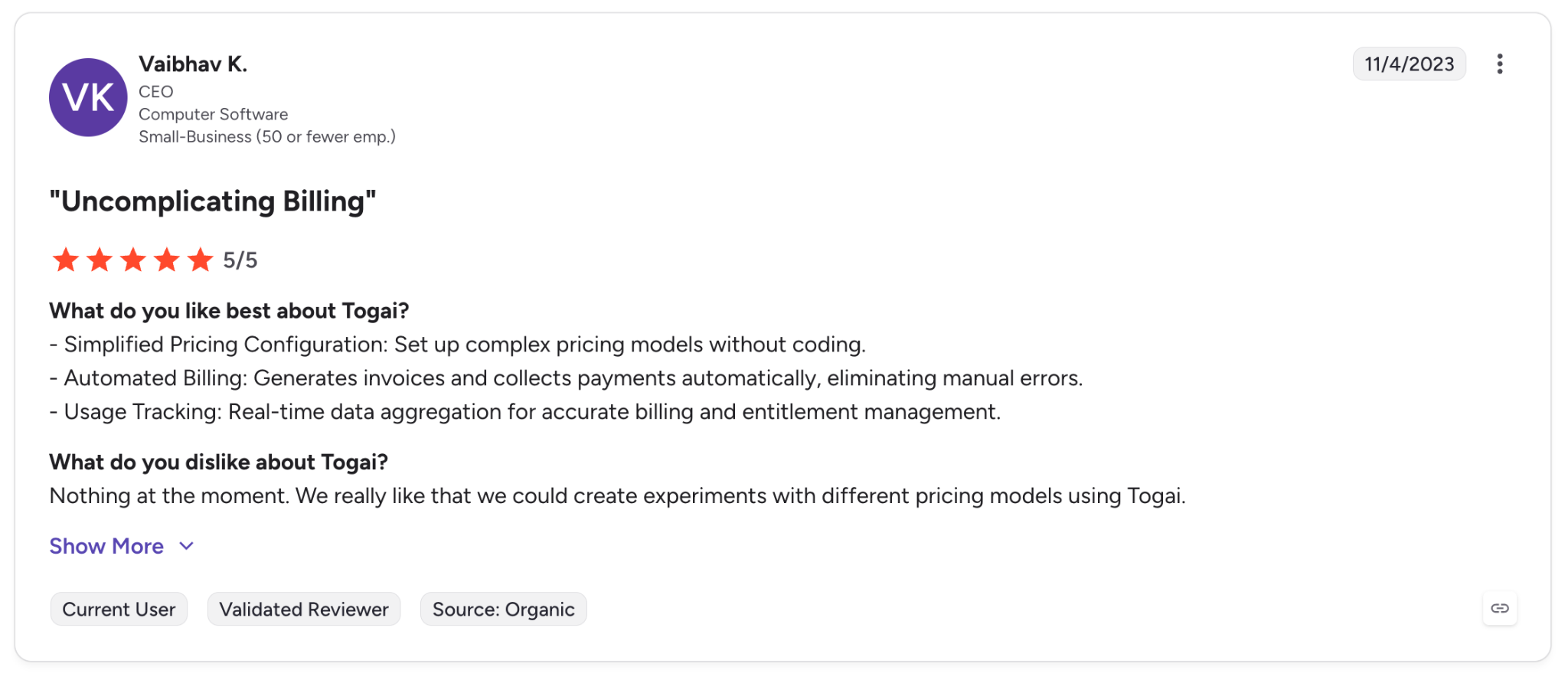
Pro: "Set up complex pricing models without coding. Generates invoices and collects payments automatically." (Vaibhav K., G2 Review, Nov 4, 2023)
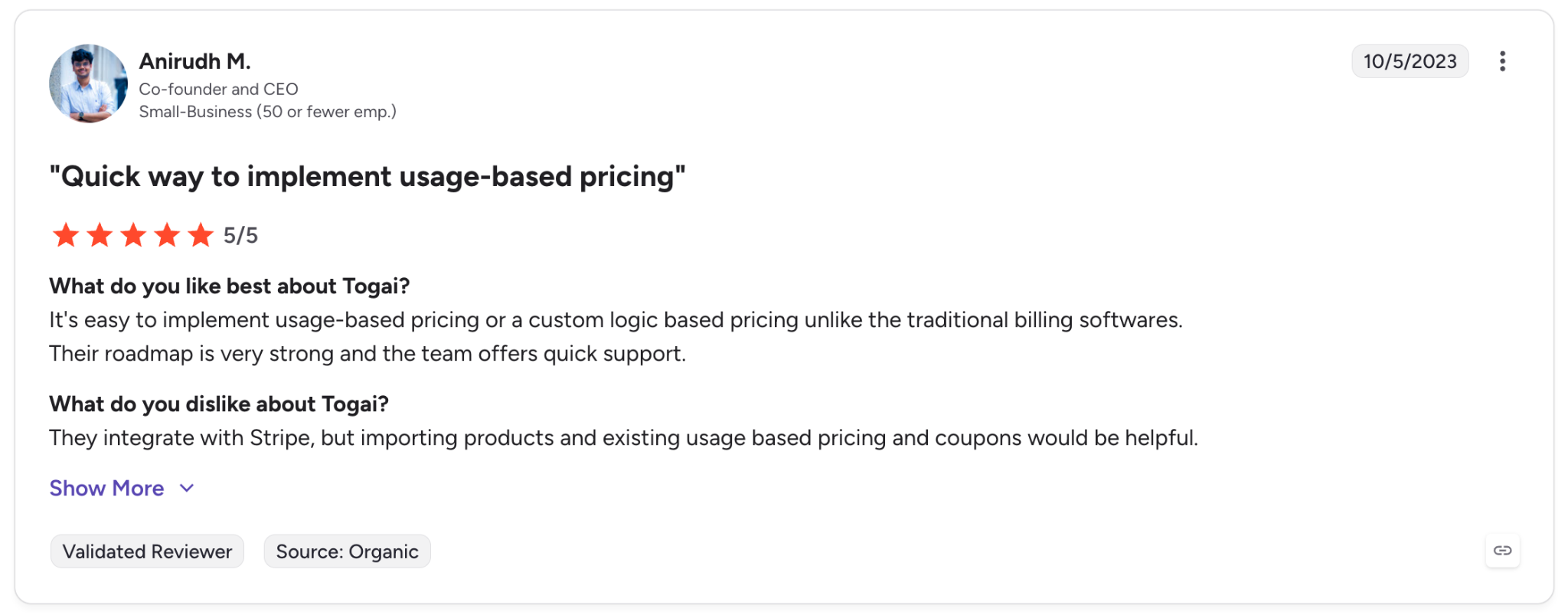
Con: "Importing existing products, usage-based pricing, and coupons from Stripe would be helpful." (Anirudh M., G2 Review, Oct 5, 2023)
Togai does not publicly disclose pricing. You’ll need to contact sales for a custom quote based on your usage, scale, and billing needs.
Togai is worth evaluating if your primary pain is the speed of pricing iteration rather than high-volume AI event processing.
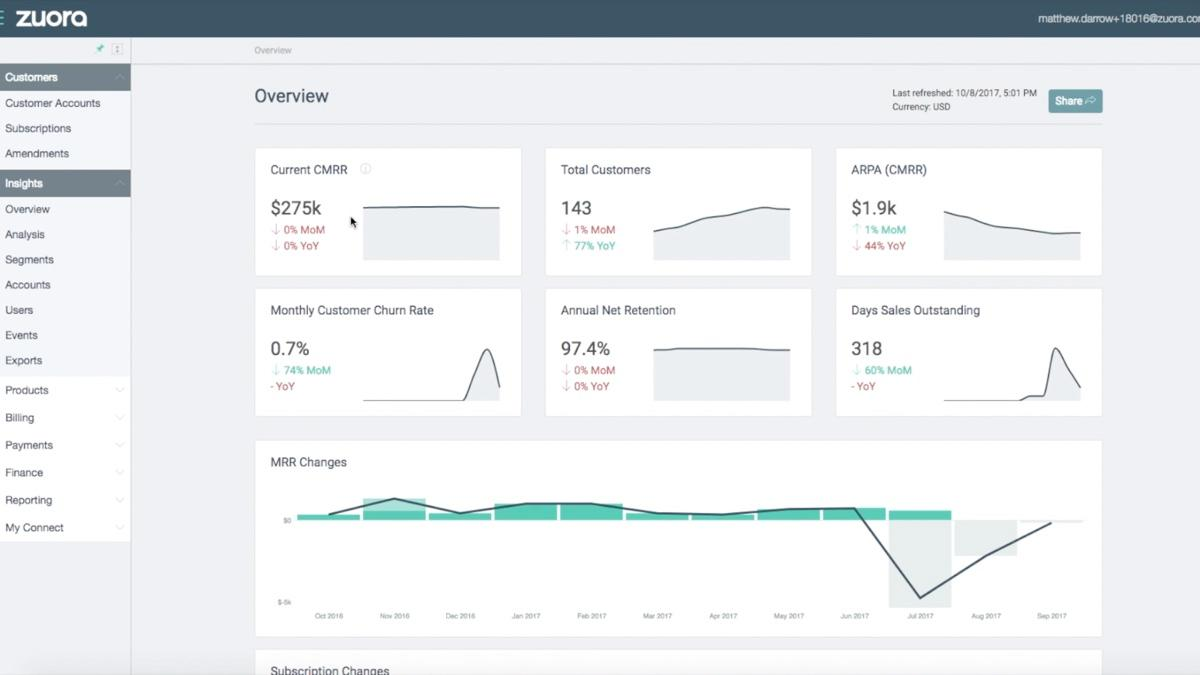
What it does: Zuora is an enterprise subscription and usage-based order-to-cash platform. It handles the full cycle from quote generation through billing, invoicing, revenue recognition, and compliance for large organizations.
Best for: Large enterprises selling AI services through complex, negotiated contracts with multi-entity, multi-currency, and compliance requirements.
Zuora went private in a $1.7 billion deal, which signaled a repositioning away from competing directly with newer, more developer-focused billing tools. It remains a strong choice for enterprises where billing is a regulated, finance-owned process rather than a product-team concern.
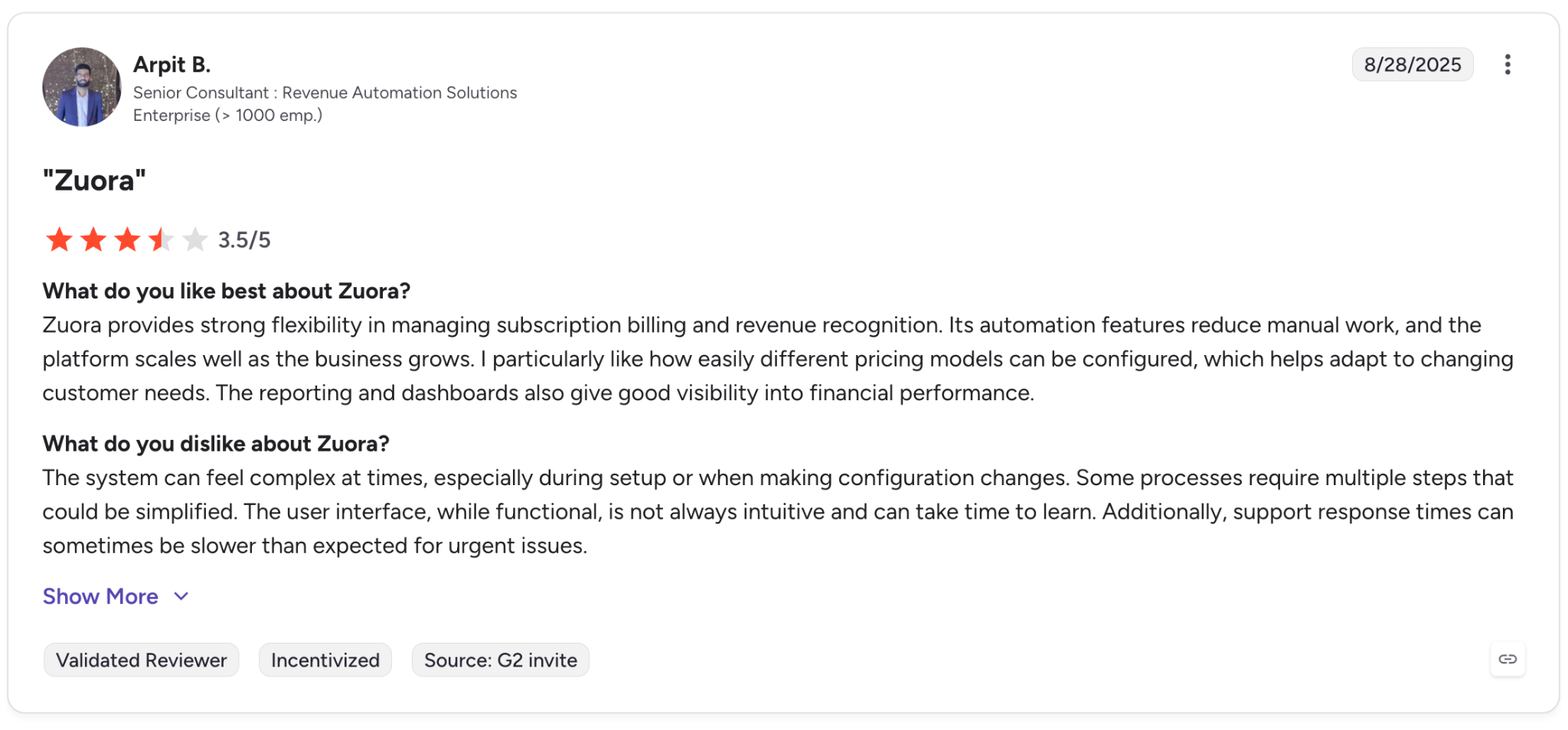
Pro: "Zuora provides strong flexibility in managing subscription billing and revenue recognition. Its automation features reduce manual work, and the platform scales well as the business grows." (Arpit B., G2 Review, Aug 28, 2025)
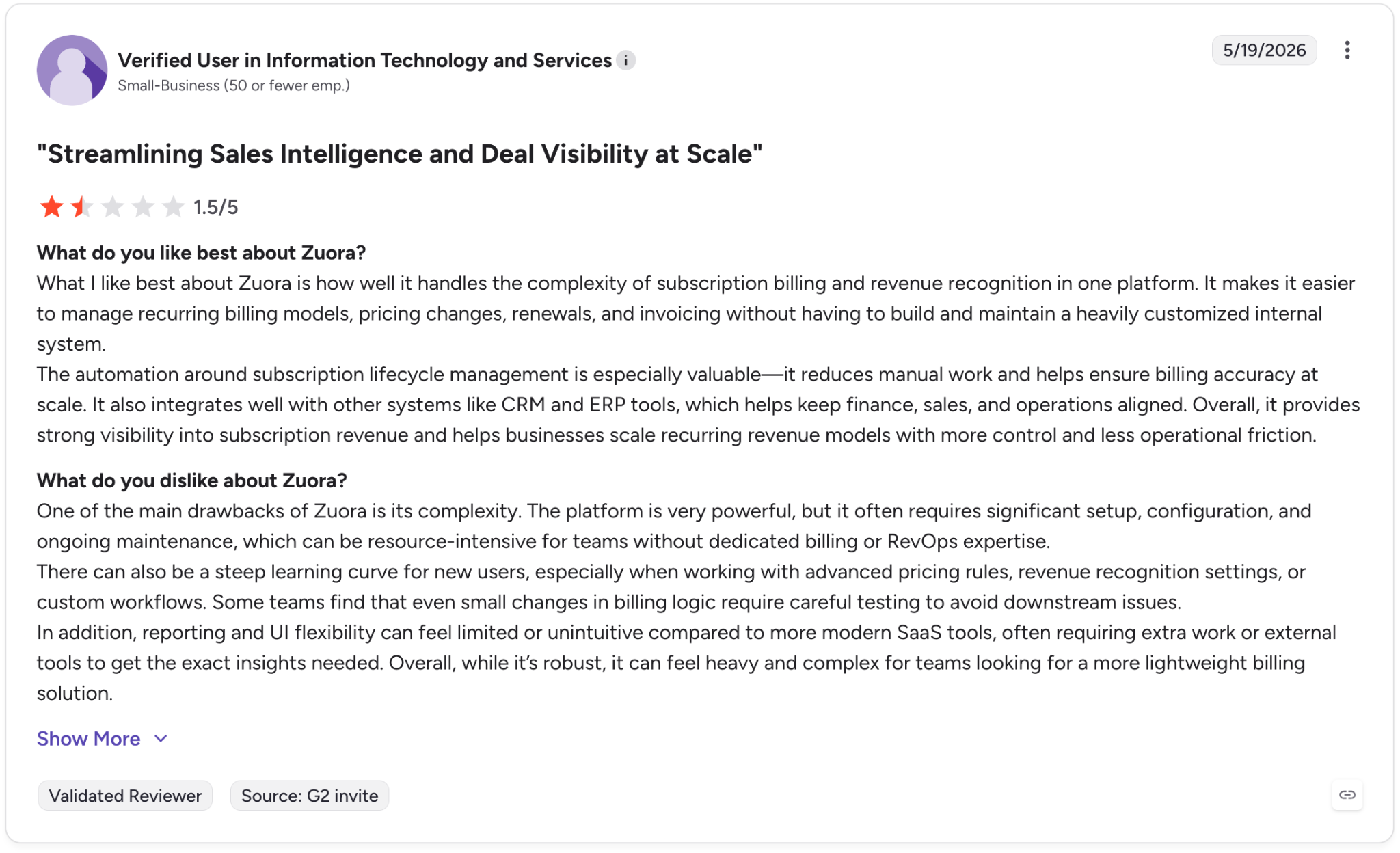
Con: "The platform is very powerful, but it often requires significant setup, configuration, and ongoing maintenance. There can also be a steep learning curve for new users." (Verified User in Information Technology and Services, G2 Review, May 19, 2026)
Zuora does not publish pricing publicly. You need to contact Zuora for a custom quote based on their billing, subscription, and monetization requirements.
Zuora is for large enterprises where billing is a compliance and finance function rather than a product function. AI teams at the enterprise level that need to combine Zuora with a real-time metering and enforcement layer should plan for that integration cost upfront.
The right tool depends on where billing sits in your architecture and what your primary constraint is.
Choose Orb if you:
Choose Metronome if you:
Choose Lago if you:
Choose m3ter if you:
Choose Stripe Billing if you:
Choose Maxio if you:
Choose Togai if you:
Choose Zuora if you:
Skip this category entirely if:
For most AI teams, the decision comes down to engineering resources and pricing demands.
Orb is the strongest choice for developer-first teams with complex pricing logic and the engineering capacity to build on it. Lago is the right call for teams that need data ownership and are comfortable with the implementation overhead.
Stripe Billing handles the straightforward use case well for teams already in the Stripe ecosystem. Metronome is the enterprise option for teams with high event volume and Stripe alignment.
This generative AI usage-based billing software was not designed to enforce usage limits before compute runs.
Instead, they measure what happened and invoice for it. For real-time enforcement of credit limits, entitlements, and session budgets before each model call, a dedicated runtime layer is needed above whichever billing tool you choose.
Every tool in this list answers the same question: What did this customer use, and what do we charge for it?
A different question sits earlier in the lifecycle: Should this request be allowed to run at all?
That decision has to happen before compute is consumed. Checking balances at billing time might explain an overage, but it does not prevent one.
Stigg is the usage runtime for AI products, enforcing entitlements, credits, usage limits, and spend governance synchronously during execution.
Engineering teams use it to:
Running alongside the application, the Sidecar resolves most checks locally and uses Stigg’s Edge API only when needed. This keeps latency low and enforcement available during upstream degradation.
The billing systems in this guide remain the right choice for metering, invoicing, and revenue recognition. The runtime layer handles what happens before those systems ever see an event.
If pricing logic is spreading across services or limits depend on custom enforcement code, the architecture is usually missing a dedicated control layer. See how Stigg fits into modern AI infrastructure.
Generative AI usage-based billing software tracks consumption at the event level, such as tokens, API calls, or agent actions, applies pricing rules, and generates invoices based on actual usage. It aligns billing with compute costs rather than charging a fixed fee, which makes it the standard model for AI products where usage varies significantly between customers.
The main difference between metering and billing is that metering tracks what was consumed, while billing applies pricing rules to that data and generates invoices. m3ter is a metering platform that feeds a billing system downstream, while Orb and Stripe Billing handle both. AI products often need a third layer, enforcement, which decides whether a request should proceed before compute runs.
Lago is the lowest-cost entry point since the open-source core is free. Stripe Billing is the fastest to implement for teams already on Stripe. Zuora and Metronome are enterprise tools and are not appropriate for early-stage products.
No, the tools on this list were designed for post-usage settlement, not real-time access control. Enforcing a credit limit before each model call requires a dedicated enforcement layer running in the request path, separate from the billing system.
The main differences between Orb and Metronome are their target market and ownership. Orb is an independent, developer-first billing engine suited to AI teams with complex pricing logic. Metronome was acquired by Stripe in 2026 and is now positioned within the Stripe ecosystem, which ties its roadmap to Stripe's direction.
%20(1).png)
%20(1).png)