Product Updates
Stigg Now Supports 24 Data Export Destinations
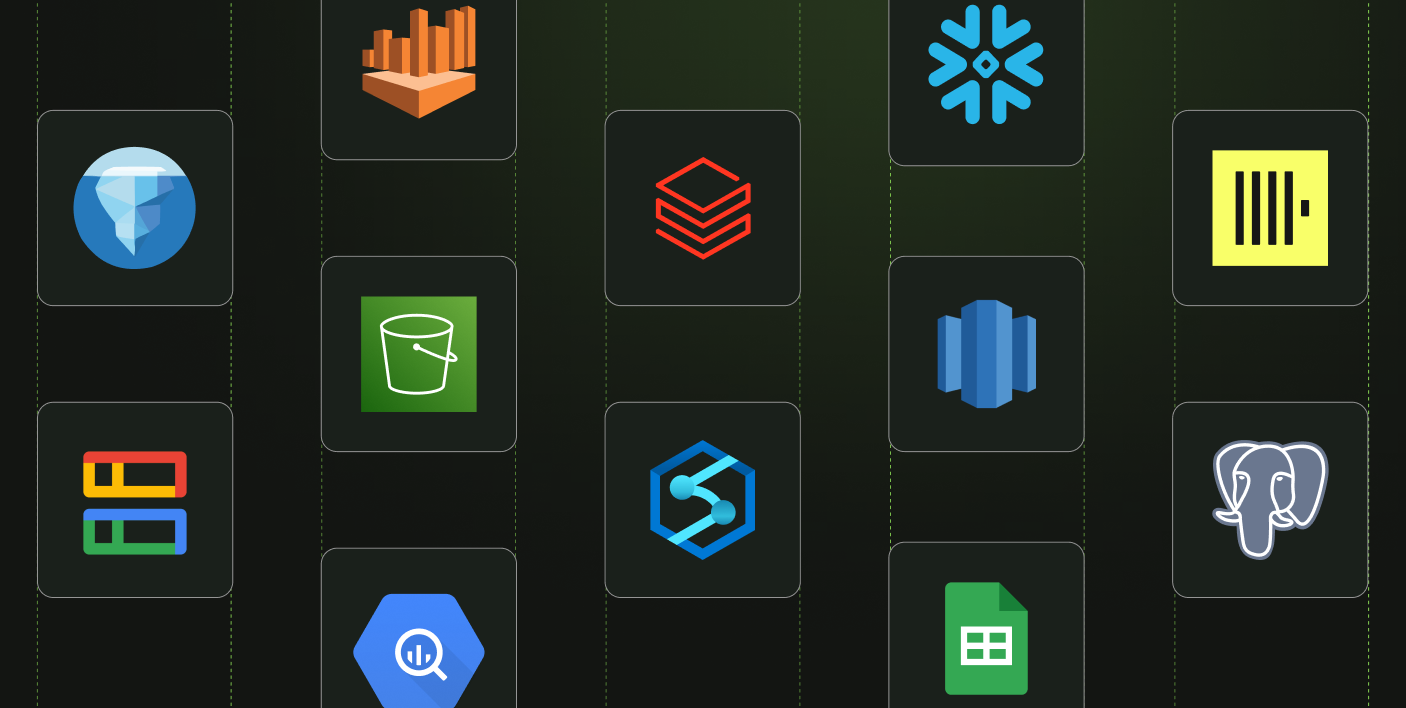
Stigg’s data can now be exported to 24 destinations, making it easier to connect your usage & monetization data with the rest of your stack.

Pricing for AI products is no longer linear, and now your credit model doesn’t have to be either. Meet Custom Credit Consumption Formulas: a precise, flexible way to translate real product usage into accurate credit burn.


A more precise way to translate real product usage into credit burn
Pricing in the AI era is no longer linear.
A single action in your product might use several different LLMs, hit internal services with different cost profiles, process batched inputs of varying sizes, or trigger a sequence of agents whose workloads change from request to request. The volume and shape of consumption are dynamic, and they vary widely based on the specifics of the event.
Yet most pricing infrastructure still assumes uniform usage, flat credit burn, and predictable cost curves. As a result, engineering teams build their own credit-calculation logic in code, with error handling, outlier management, and enforcement spread across multiple services. Product and revenue teams can’t move fast: every packaging update or pricing adjustment requires new code paths and careful coordination, slowing teams down at a moment when rapid iteration is a must in the AI era.
This is one of the most common sources of friction we see in modern AI and usage-based products. And it is why we built Custom Credit Consumption Formulas.
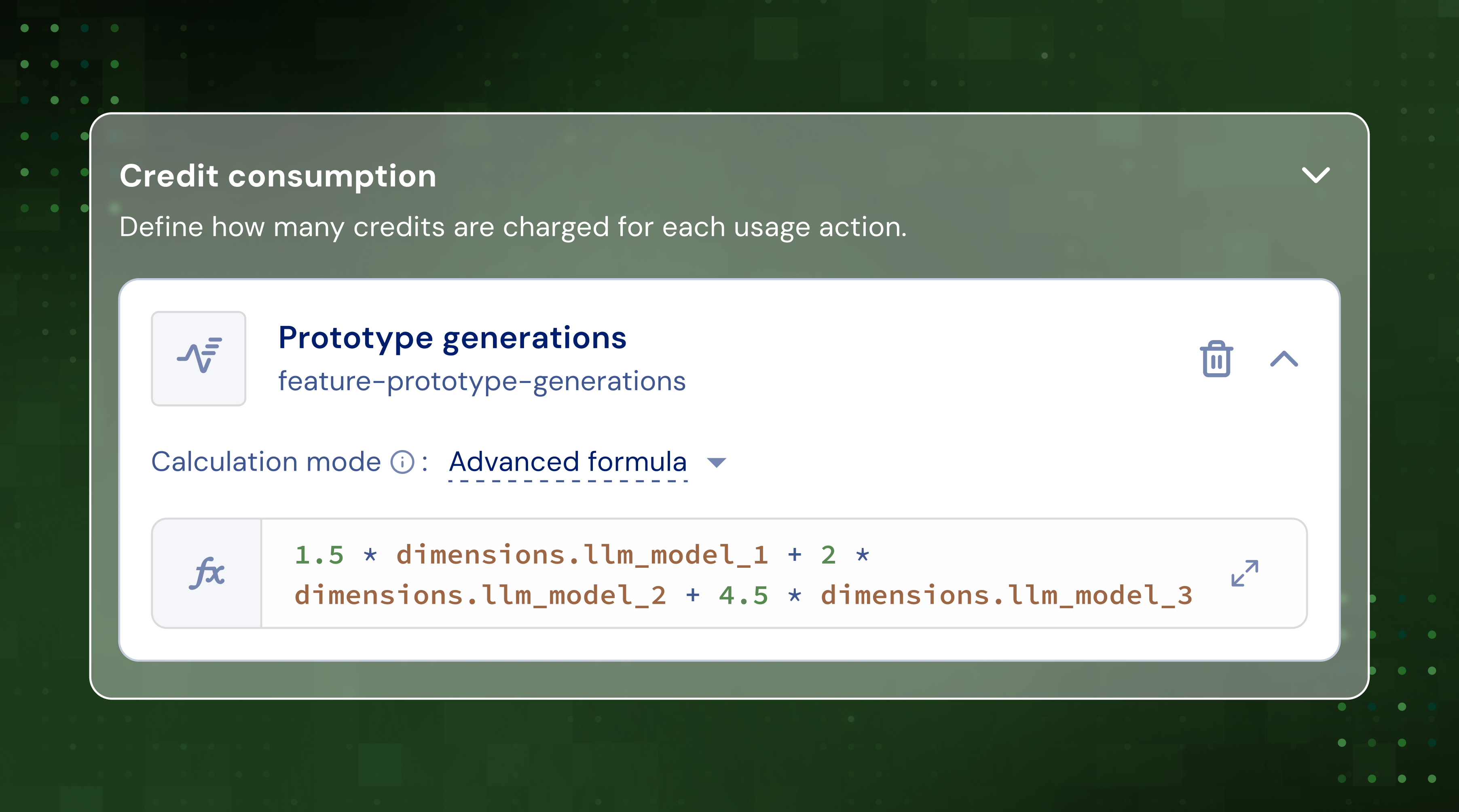
Custom Credit Consumption Formulas give you complete control over how usage of any metered feature translates into credit burn, so your pricing finally reflects the real value and cost of your product. Formulas can reference any event dimension your system emits, including token counts, batch sizes, file counts, duration, input types, or agent-level usage. Each feature can have its own formula, and the output is enforced in real time with full visibility in the credit ledger.
You specify how usage should map to consumption. Stigg takes care of metering, enforcement, auditability, and propagation across your stack.
This flexibility matters because modern workloads rarely resemble simple unit counts. A summary operation might combine multiple input types with different cost structures:
credits_used = (a * documents) + (b * emails) + (c * images)
An AI generation request may call several models—each with its own value and cost profile.
Here, the weights represent the premium the SaaS vendor chooses to charge for usage of each model:
credits_used = (1.1 * Model1_Tokens) + (1.5 * Model2_Tokens) + (5 * Model3_Tokens)
An agent-based system might want to expose combined usage across multiple agents without flattening everything into a single metric:
credits_used = Agent1_Tokens + Agent2_Tokens + Agent3_Tokens
These patterns are common across the teams we work with. They need the ability to express the cost and value of their product clearly without embedding logic across multiple repos or relying on billing systems that cannot represent real usage.
Custom formulas move pricing logic out of scattered backend code and into a centralized, versioned, and testable configuration. Engineering retains control and clarity. Product and revenue teams gain the ability to iterate on pricing models without pushing new code paths or touching entitlements. And because Stigg enforces deductions consistently across PLG and enterprise workflows, customers experience predictable behavior regardless of how they interact with your product.
This approach aligns pricing with actual consumption while keeping the implementation maintainable, auditable, and flexible as your product evolves.
To configure a formula, open the price configuration for the relevant plan and under the “Credit consumption” section, select the metered feature. Switch to Advanced calculation mode and describe your formula using mathematical operators and the event dimensions associated with that feature. You can validate the results using the credit ledger and usage reporting, then iterate as needed based on real-world data.
Credit-based pricing is becoming a standard for AI-native and usage-heavy products. The challenge is not the idea of credits but the complexity of mapping real usage to meaningful consumption. With Custom Credit Consumption Formulas, you can model how your system actually behaves without building and maintaining the infrastructure yourself.
If you want to explore these capabilities with your own workload patterns, you can try Stigg or request a walkthrough from our team.
.png)