Product Updates
Stigg Now Supports 24 Data Export Destinations
Stigg’s data can now be exported to 24 destinations, making it easier to connect your usage & monetization data with the rest of your stack.

Entitlements provisioned, usage metered, customers invoiced. Received.ai is now part of Stigg, and enterprise billing runs on one platform.


.png)
When we shipped Stigg 2.0 in June, we said the moment of truth in AI is the API call, not the invoice. That premise still holds. Stigg decides what a customer, user, or agent is allowed to do, in milliseconds, on every request. What it didn’t decide was what that usage should cost.
In a sales-led business, those two questions are closely connected but typically handled by different systems. Stigg governs access, limits, and usage in real time. Billing systems determine rates, commitments, credits, and ultimately what appears on the invoice. That separation gets harder to manage as contracts change. A customer adds credits mid-cycle. An overage rate is renegotiated. A commitment changes during an expansion. Each change needs to be reflected consistently in both product behavior and billing.
The Received.ai acquisition brings those two sides together: what the customer is allowed to consume and what they should pay for it, driven by the same commercial agreement. This post covers the architecture behind that integration and what you can use today.
In a sales-led business, the commercial agreement usually ends up implemented in multiple systems.
The product needs to know what the customer is entitled to: which features they can access, what limits apply, and what usage is allowed. The billing system needs to know how to charge for that same agreement: rates, tiers, commitments, credits, and billing schedules. For a simple deal, keeping the two aligned is manageable. Enterprise contracts rarely stay simple.
Customers expand, renew early, add products, negotiate custom limits, change commitments, or receive pricing exceptions. Each change has to be reflected consistently across the systems responsible for access and billing.
When those systems have separate configuration and ownership, they drift. A customer may have access to something that isn’t reflected in their contract. Usage can be billed using terms that no longer match the customer’s entitlements. An amendment can require coordinated changes across engineering, finance, and RevOps before it can actually go live.
The underlying problem is straightforward: there is one commercial agreement, but multiple independent implementations of it. Every additional copy creates another place that has to stay in sync as the deal changes.
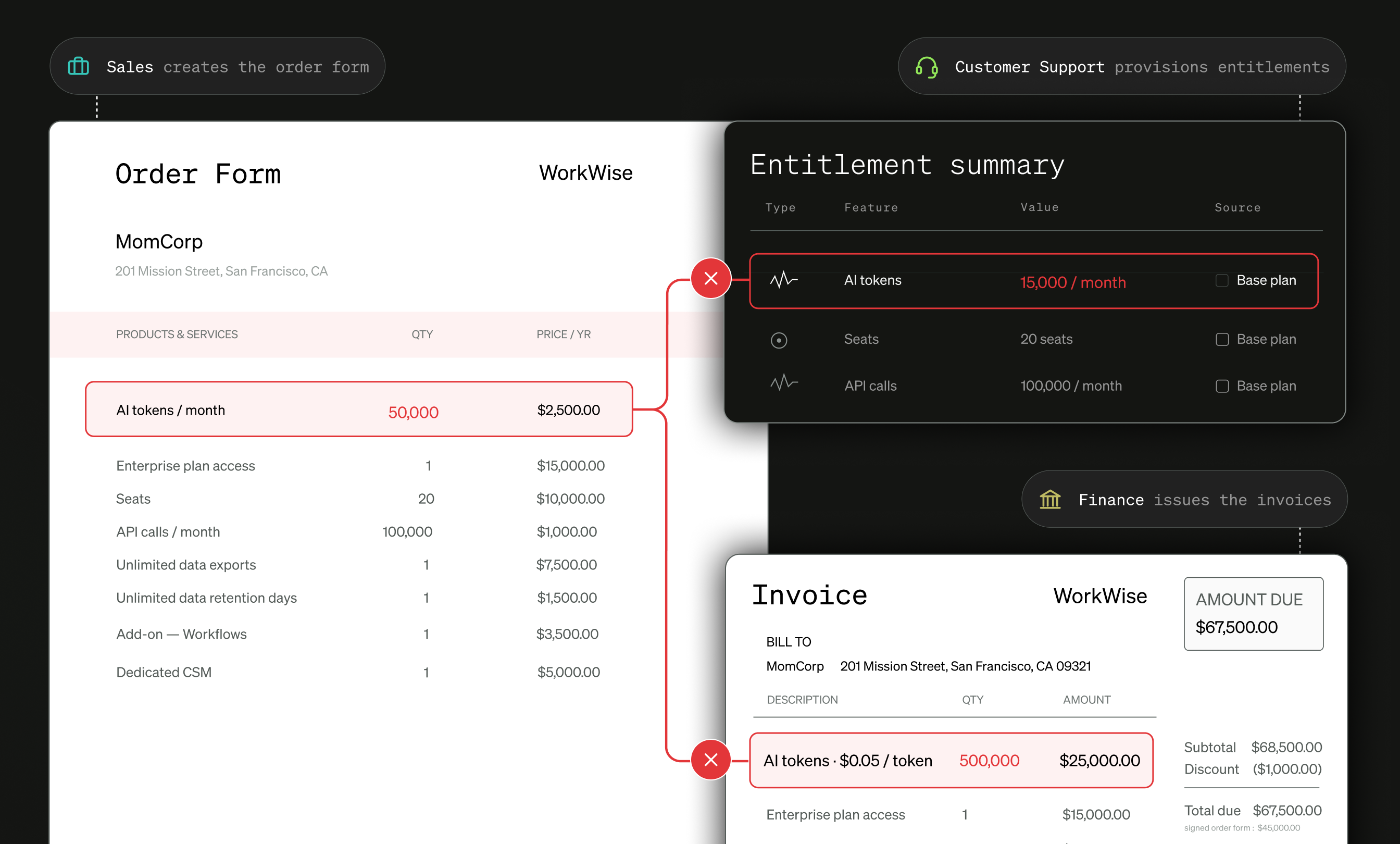
A signed quote becomes a contract object in Stigg that captures the commercial terms of the deal. Product entitlements and billing configuration are both derived from that contract. When the contract changes, amendments are recorded as part of its history rather than replacing the previous state. That gives you a complete record of how the agreement evolved and lets you reconstruct exactly which terms were in effect at any point in time. The enforcement layer uses the current contract state to determine what the customer can access and consume. The billing layer uses the same state to determine how that usage should be charged. One contract, two outcomes: what the customer can use and what they pay for it. No separate representations of the deal to keep in sync.
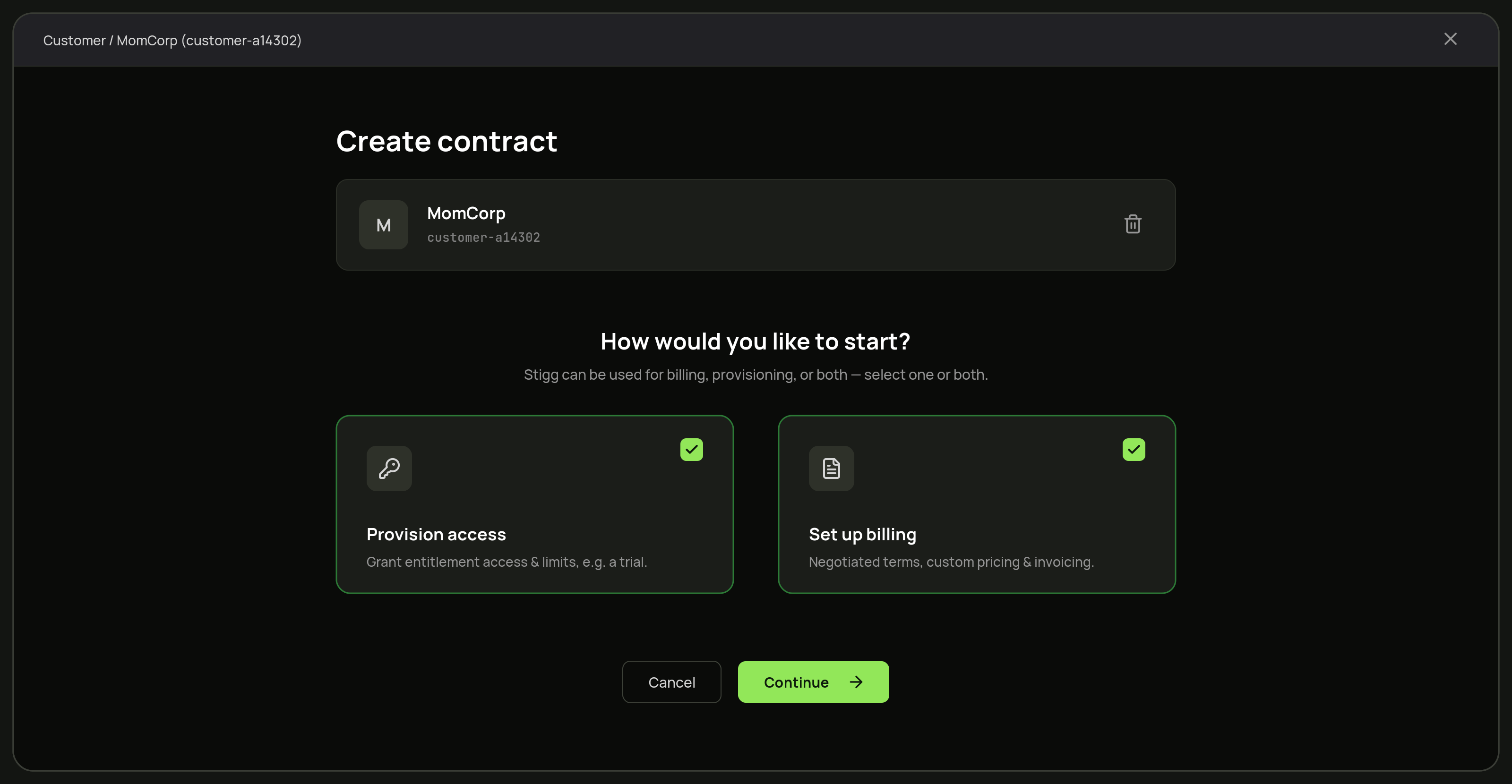
Contract management for sales-led deals. A closed deal becomes an active contract in Stigg, with its plans, entitlements, limits, and customer-specific terms reflected in the product. Sales and RevOps can manage negotiated overrides directly from Salesforce, without turning every contract change into an engineering task.
Invoicing that follows the contract. Billing follows the actual terms of the agreement: contract dates, mid-term changes, prorations, credits, debits, and renewals. Multiple products and usage charges can roll into a single customer invoice rather than being managed as separate billing flows.
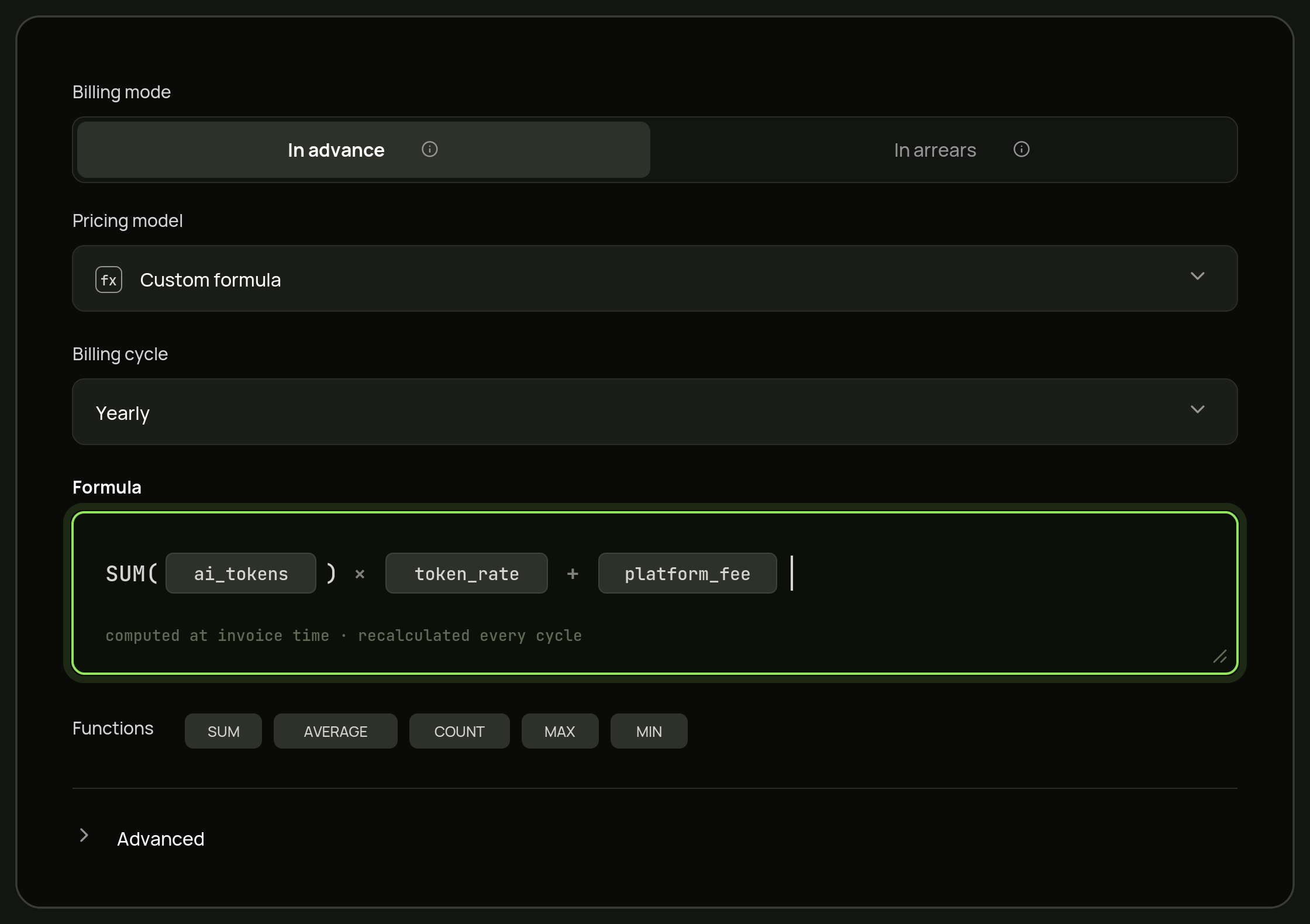
Formula-based pricing. Enterprise pricing doesn’t always fit neatly into flat, per-unit, volume, or tiered models. Stigg supports formulas that calculate charges from the terms of the contract and the usage recorded during the billing period.
That means pricing can incorporate commitments, actual consumption, volume adjustments, and prorations without reducing the deal to a collection of hardcoded rates. A term like “the greater of $X or Y% of committed spend” can be represented directly as pricing logic and evaluated when the billing period closes.
Finance-ready output. Invoice line items can be traced back to the contract terms and metered usage that produced them, including billing across parent-child account and subsidiary structures. Finance gets the detail needed to understand how each charge was calculated and where it came from.
Adding contract management and invoicing to Stigg doesn’t mean you need to replace the billing stack you already have.
If you invoice through Stripe, keep invoicing through Stripe. The same goes for NetSuite, Airwallex, Checkout.com, or your own invoicing system. Stigg sits alongside these systems and handles the parts of the commercial agreement that need to translate into product behavior: provisioning entitlements from contract terms, applying amendments, updating plans and limits, and calculating what should be invoiced.
Your product-led motion doesn’t change either. A customer can still sign up, choose a plan, and pay through Stripe exactly as they do today.
For companies that don’t already have a billing stack, Stigg can now cover the full path from contract to product to invoice. This is particularly useful for AI companies closing enterprise deals early, where credits, usage metering, entitlements, and custom commercial terms quickly become interconnected.
Credits, metering, governance, contract management, and invoicing can all live in one platform, without requiring another billing system just to get an enterprise deal into production.
.png)
Here is what Stigg covers as of today, across both product-led and sales-led motions:
Entitlements and access control. Define what each customer, user, team, or agent can access and consume, and enforce those decisions in the request path with sub-10ms latency.
Credits. Manage credit wallets, balances, expiration, rollovers, and consumption rules with a ledger that updates in real time and prevents overspending.
Usage metering. Ingest, attribute, and aggregate usage at scale, including BYOC deployments processing more than one million events per second.
Governance. Apply budgets, spend caps, and consumption limits across customers, users, teams, departments, or agents, and enforce them at the point of consumption.
Contract management. New. Model sales-led agreements including multi-year terms, custom pricing, commitments, ramps, and amendments. Contract terms flow directly into the entitlements the product enforces.
Invoicing. New. Generate billing schedules from contract terms, handle prorations and adjustments, calculate custom pricing, and consolidate charges into invoices that can sync with Stripe, Airwallex, or your existing billing stack.
AI companies shouldn’t need to stitch together separate systems for entitlements, credits, metering, governance, contracts, and invoicing just to turn a pricing model into something they can sell and operate. Stigg provides one infrastructure layer connecting the commercial agreement to what the product enforces and, ultimately, what the customer is charged.
AI makes the connection between product usage and commercial terms much tighter. Usage happens continuously, credits are consumed in real time, and enterprise customers negotiate commitments, limits, and pricing that can change throughout the contract.
The infrastructure behind that model needs to change with the contract. When entitlements, metering, credits, and billing all work from the same commercial terms, a pricing change can remain a configuration change instead of becoming a coordination project across multiple systems and teams.
Usage-based enterprise billing was already difficult. AI makes getting it right increasingly important.
Contract management and invoicing are in public beta today, following a private beta with existing and new Stigg customers.
Received.ai founder Shai Betito has joined Stigg as VP of Engineering and is leading the integration. He built Received.ai around many of the same problems we’re solving here: complex contracts, usage-based pricing, and the operational path from commercial terms to invoicing. Bringing that expertise into Stigg lets us build contract management and invoicing as part of the same infrastructure that already handles entitlements, credits, metering, and governance, rather than bolting another system onto the side.
Broader general availability will roll out through 2026.

.png)