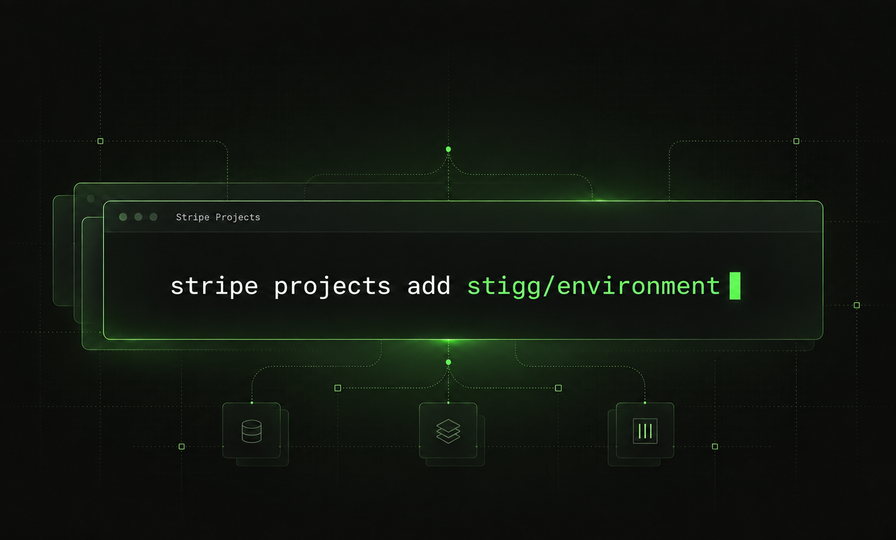
Stigg is now available on the Stripe App Marketplace: entitlements enforced in real time, usage-based metering, and pricing control layer that runs alongside Stripe billing - keeping product access and billing in audit-level sync.
Teams like Webflow and Miro have been running Stigg alongside Stripe in production for years. Today, that same integration is available to any team on Stripe, directly from the Stripe App Marketplace.
At Stripe Sessions last year, Webflow's VP of Engineering opened with something that landed for everyone in the room: "We'd hear, please don't touch the billing code." The entitlement logic lived everywhere. Every pricing change was a multi-week engineering project. Every support question about why a customer didn't have access required digging through multiple systems. It is a story most engineering teams recognize.
The gap is not in payments. It is in the layer above it: the logic that decides what every customer is actually allowed to do, on every request, in real time. Which features are they entitled to? What are their limits? Have they hit them? That layer needs to be fast, auditable, and decoupled from billing. For most teams, it does not exist in a clean form. Stigg is that layer, and it is now one install away inside Stripe.
Entitlement visibility, right inside your Stripe Dashboard
Once the app has been installed, every customer's entitlement state becomes readable directly from the Stripe Dashboard. The features they have access to, what their limits are, how much they have consumed this period. The people who most often need this - support teams, account management, RevOps - are already living in Stripe. Now they do not have to leave it or ask an engineer to find out what a customer can do.
Getting started is equally fast. The app fetches your products, prices, subscriptions, and customers automatically. The sync is bidirectional. Changes in Stigg propagate to Stripe instantly, and subscription changes in Stripe reflect back in real time. Checkout and the Stripe Billing Portal work out of the box.
A platform built for how AI companies charge today
Stigg layers natively into your existing stack, working alongside Stripe and integrating with your CRM, CPQ, data warehouse, and downstream systems, keeping entitlements, subscriptions, and usage data in sync across everything automatically. No reconciliation scripts. No drift between what a customer paid for and what they can do.
And once it is running, the range of what it supports is significant. Miro came to Stigg needing to launch an AI credit model for their Innovation Workspace. Three months before going live, they did not have AI credits. After launch, they had a fully functioning hybrid seat and usage-based model with real-time enforcement, monthly resets, and visibility across the stack. Susan van de Ven, their Head of Growth Engineering, takes the stage at Stripe Sessions today to share that story.
Real-time entitlement enforcement, usage-based metering, AI usage controls that cap token and compute consumption before costs spiral, agent provisioning so AI agents are granted and revoked access automatically as subscriptions change, and any pricing model from credits to hybrid to usage-based, all configurable without a code deploy. This is what teams are building on.

.png)