%20(1).png)
Guides
Platform Pricing Strategy for AI Products in 2026
Build a platform pricing strategy that connects customer value, usage, credits, margins, packaging, entitlements, and product architecture.

Billing system software tested across 6 platforms for AI and usage-based products, with honest pricing, reviews, and where each one breaks down.

Picture a voice agent misrouting outbound calls through a partner integration overnight. There's no way to see the cost until the invoice lands weeks later.
Most billing system software runs on a monthly invoicing cycle, well behind the moment a request fires.
For engineering teams shipping usage-based AI products, that's where real cost slips through unnoticed, long before anyone downstream sees a number.
Billing tools are good at telling you what they do, but they’re a lot quieter about where that breaks down once usage gets complicated. I built the research around finding that breaking point for each one.
From there, I evaluated each tool against five things:
The pattern that stuck out fast was simple. There's no single best billing system software. It comes down to how complicated your pricing and your contracts already are, and most of these tools are honest about which end of that spectrum they're built for.
Disclaimer: Prices are subject to change without notice. Always visit the official company websites for the most up-to-date pricing information.
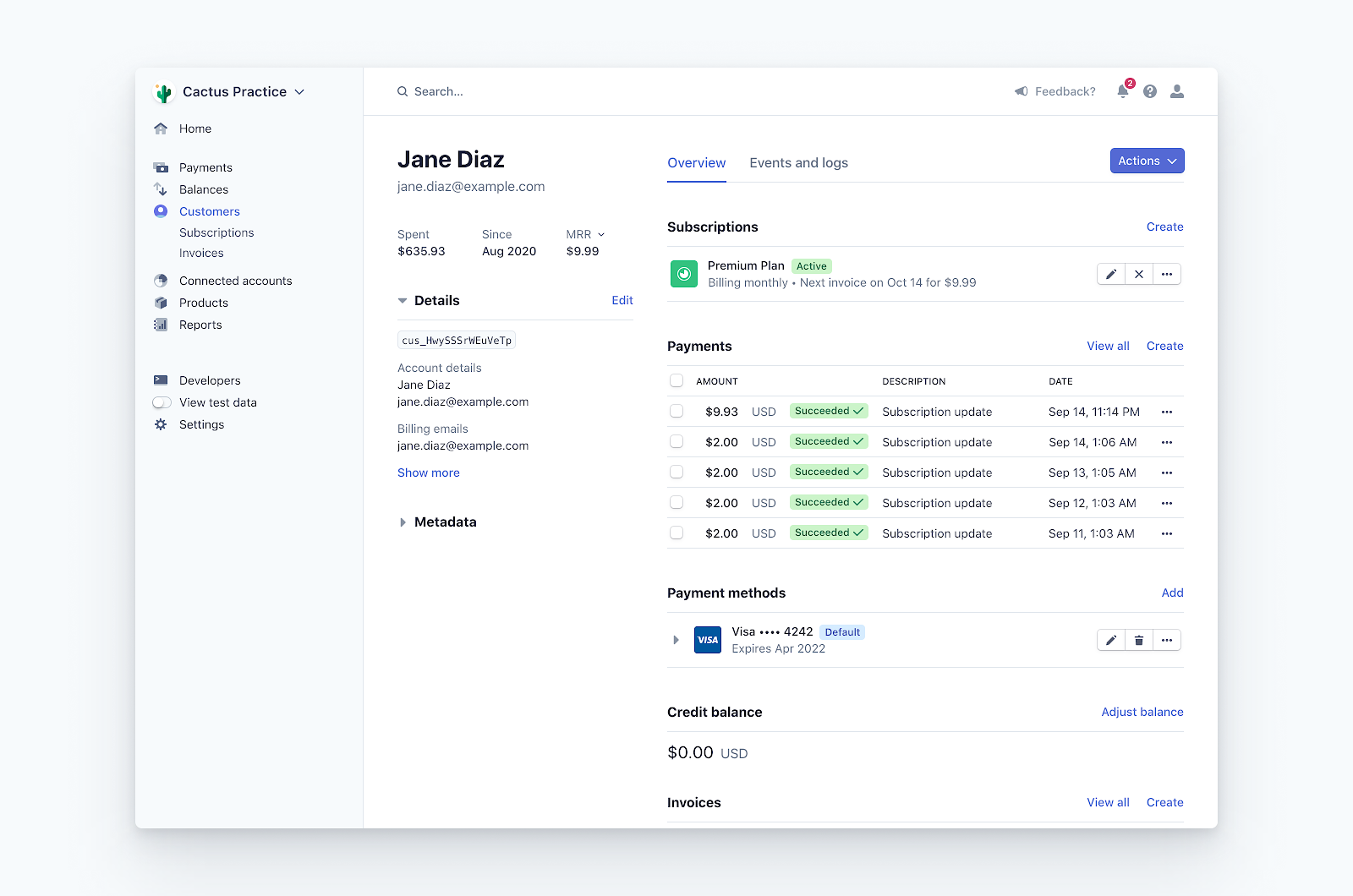
What it does: Stripe Billing manages subscriptions, invoicing, and usage-based charges on the same infrastructure as Stripe's payment processing.
Best for: Companies already running payments through Stripe that want a billing layer without standing up separate infrastructure.
If you're already processing payments through Stripe, Billing is the path of least resistance. It sits on the same rails, and getting a metered or tiered plan running doesn't require new infrastructure. Pricing moved to a flat 0.7% of billing volume in 2024, consolidated from separate Starter and Scale tiers.
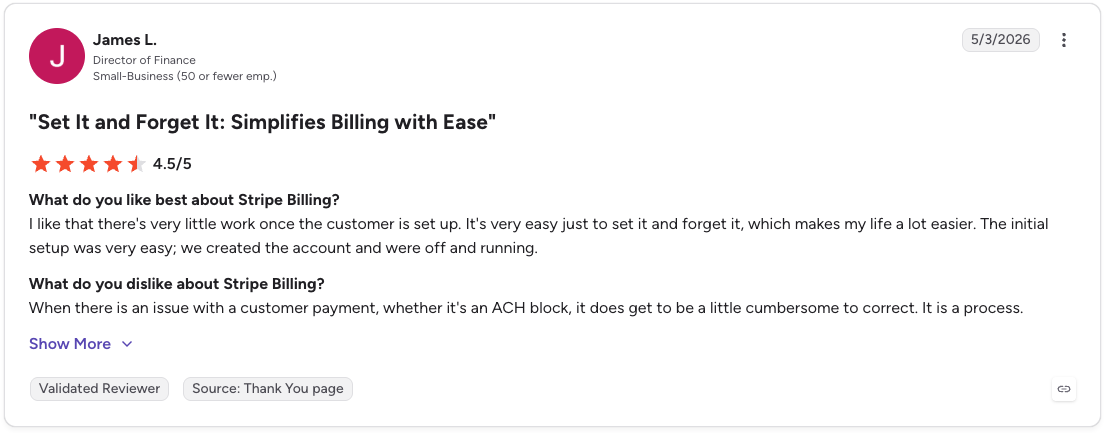
Pro: “I like that there's very little work once the customer is set up. It's very easy just to set it and forget it, which makes my life a lot easier. The initial setup was very easy; we created the account and were off and running.” [James L., G2 Review, May 3, 2026]
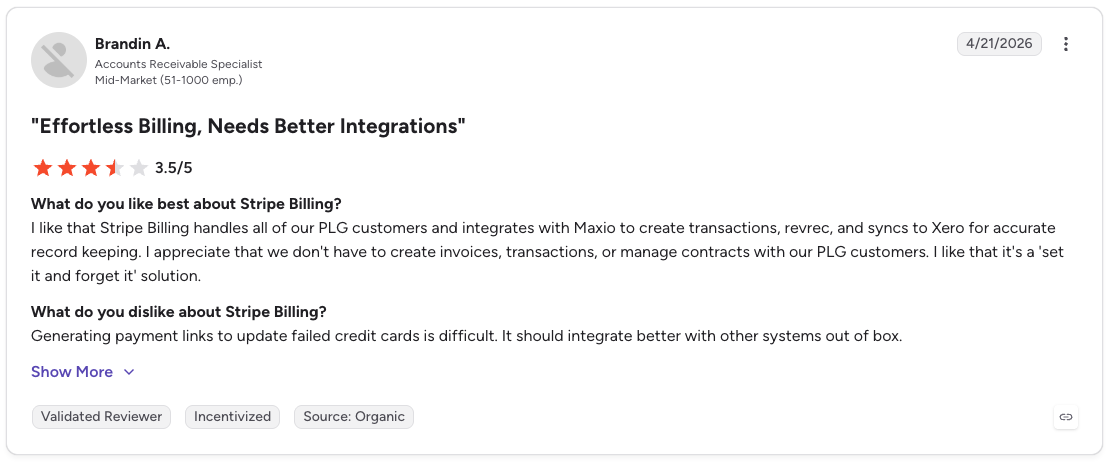
Con: “Generating payment links to update failed credit cards is difficult. It should integrate better with other systems out of box.” [Brandin A., G2 Review, April 21, 2026]
Stripe Billing charges 0.7% of billing volume on its pay-as-you-go plan. The monthly plan starts at $620/month on a one-year contract for up to $100,000 in monthly billing volume, with custom pricing available for larger or more complex businesses.
I'd start here if speed matters more than sophistication right now. Stripe Billing gets a simple usage or subscription model live faster than anything else on this list.
Several features I'd consider essential to a real billing system are behind a paywall, so plan for that cost once you're past the early stage.
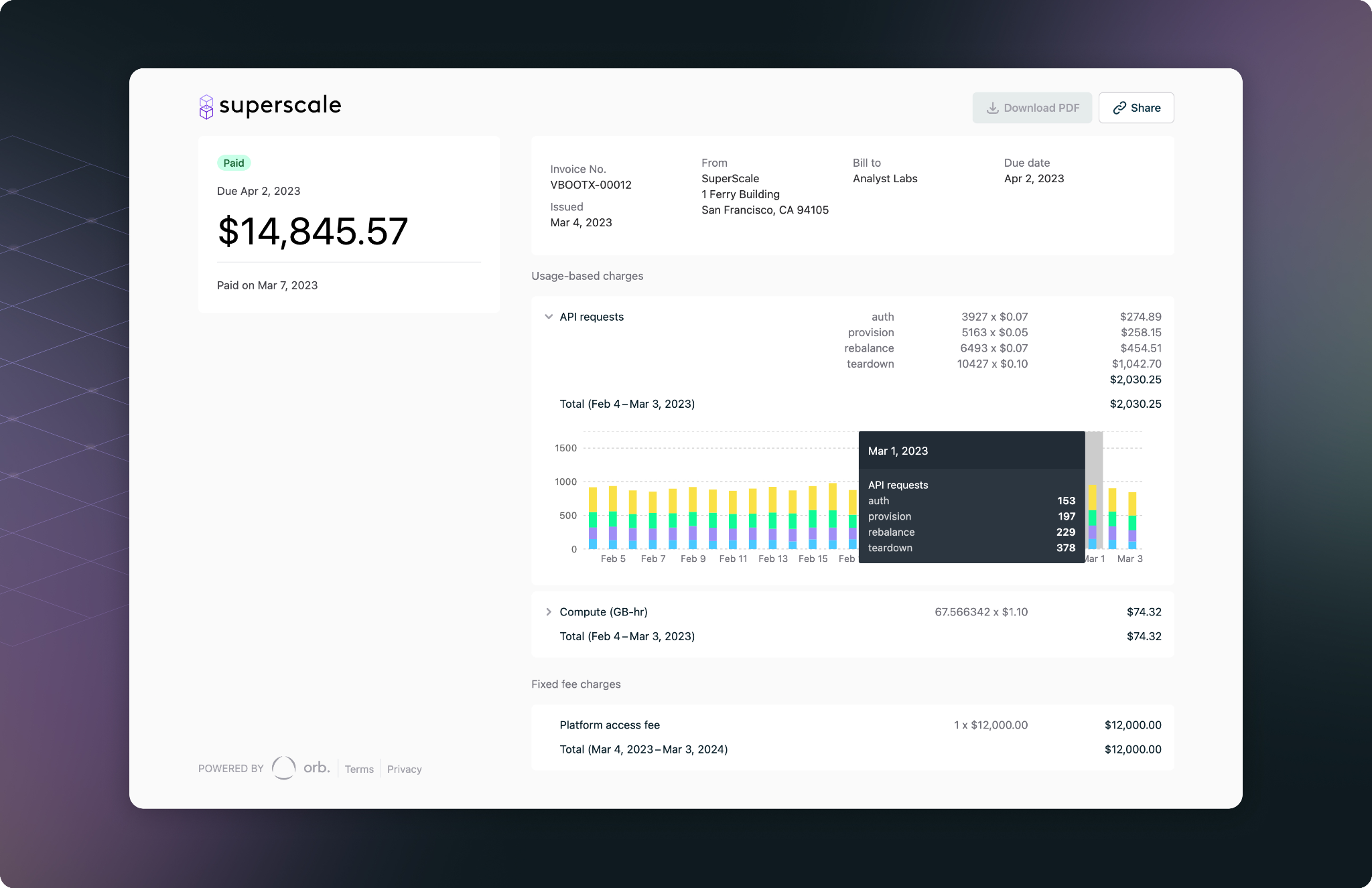
What it does: Orb is a billing system built around usage-based and hybrid pricing as the foundation, with subscription and seat-based billing handled inside the same engine.
Best for: AI-native and API companies that need a billing system designed for consumption pricing from the ground up, rather than a subscription-first billing system with usage metering added on top.
Orb's billing system separates how a product works from how it's priced, so a pricing change updates a configuration rather than triggering an engineering rebuild.
Adyen acquired Orb for $335 million in a deal that closed July 1, 2026, making it a wholly owned subsidiary run under an incubator model rather than an independent platform.
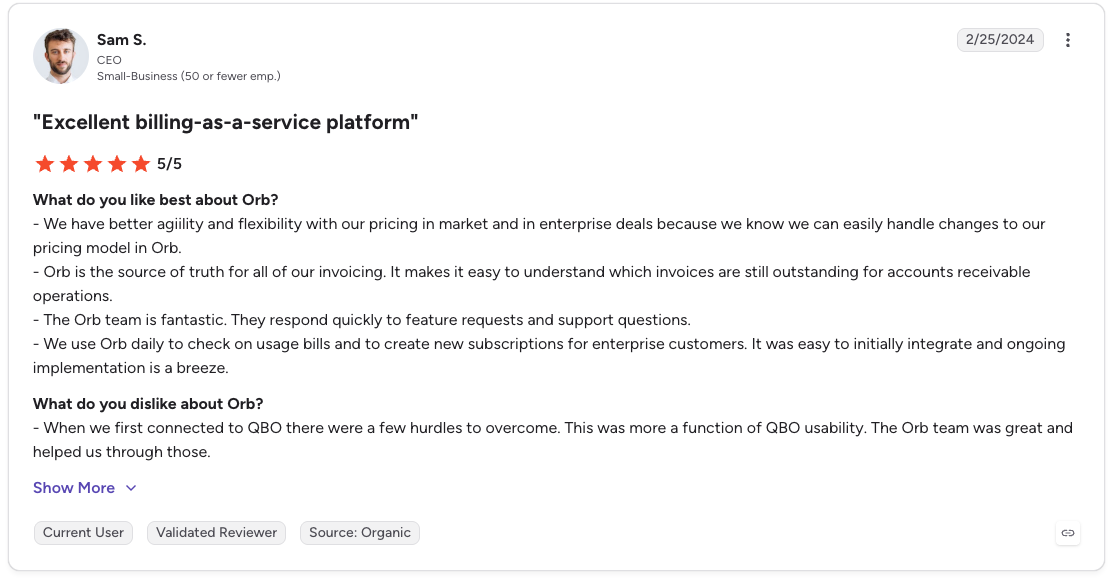
Pro: “We use Orb daily to check on usage bills and to create new subscriptions for enterprise customers. It was easy to initially integrate and ongoing implementation is a breeze.”
Con: “When we first connected to QBO there were a few hurdles to overcome. This was more a function of QBO usability.” [Sam S., G2 Review, February 25, 2024]
Orb does not publish fixed pricing. All plans use custom pricing, with Core, Advanced, and Enterprise tiers that add progressively more integrations, support, and enterprise capabilities.
I'd recommend Orb's billing system if your pricing model is genuinely usage-first and you don't want to fight a subscription-first data model to get there. If you need a large volume of independently verified reviews before committing, the review base here is still catching up to the product.
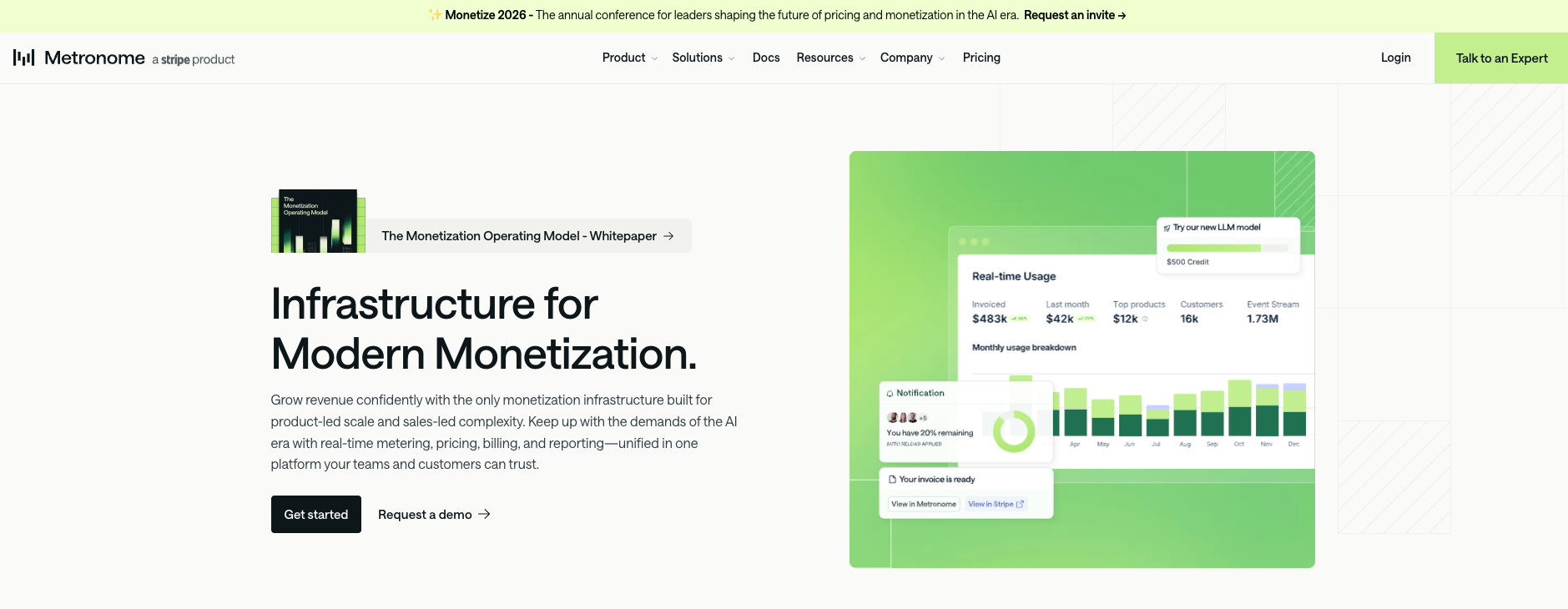
What it does: Metronome is a billing system built for usage-based invoicing with particular depth in complex, negotiated enterprise contracts, committed-use deals, and ramped pricing.
Best for: Companies with a growing book of custom enterprise contracts that a generic billing system can't represent cleanly.
Stripe acquired Metronome in January 2026, specifically because Stripe's own native billing system couldn't handle high-volume AI usage pricing on its own. If you're evaluating Metronome as a billing system now, you're evaluating what's becoming Stripe's answer to complex usage billing.
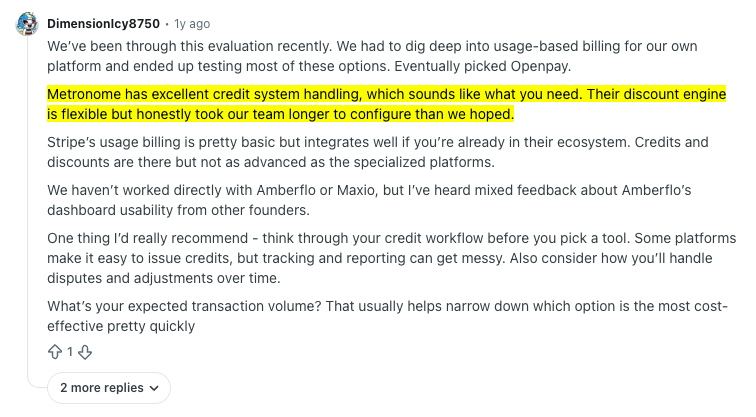
Pro: “Metronome has excellent credit system handling”
Con: “Their discount engine is flexible but honestly took our team longer to configure than we hoped.” [u/DimensionIcy8750, Reddit User Review, July 4, 2025]
Metronome does not publish standard plan pricing. It offers a Starter plan with usage-based pricing and a Custom plan for larger businesses, with pricing available by contacting sales.
Metronome earns its place once custom enterprise contracts start eating real engineering time to maintain elsewhere. Go in expecting a genuine configuration runway, not a quick setup. If your pricing is still simple, I'd save this one for later and start lighter.
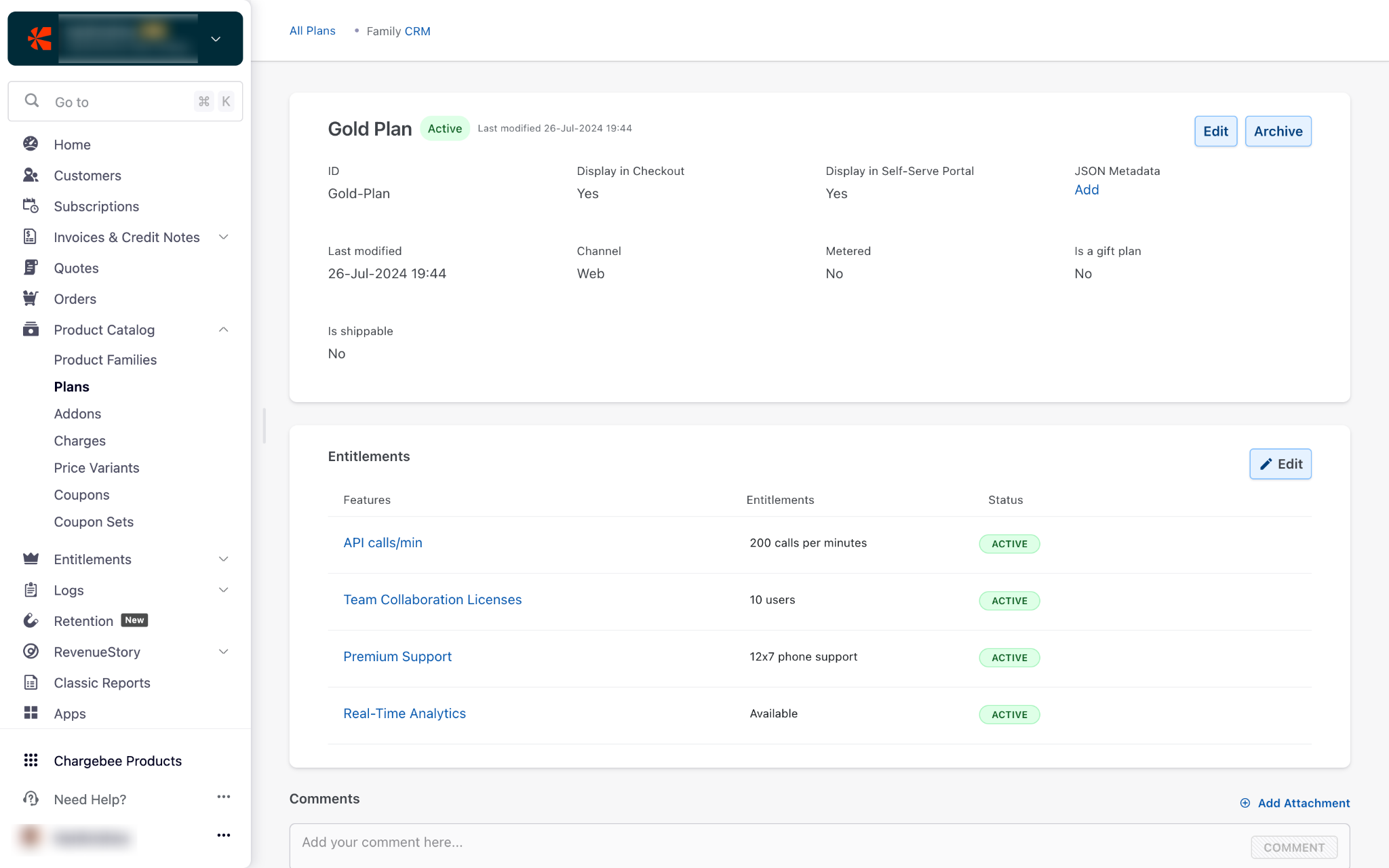
What it does: Chargebee runs subscription billing as its core engine, handling recurring invoicing, dunning, and revenue recognition, then layers metered usage on top so a flat platform fee and consumption-based overages can live in the same plan without stitching two systems together.
Best for: Products charging a flat platform fee with usage-based overages stacked on it.
Chargebee's core strength is still subscription billing, and it shows in how well it's rated. G2 reviewers report Chargebee excelling in overall user satisfaction, and reviewers specifically call out how smoothly it integrates with payment gateways during setup.
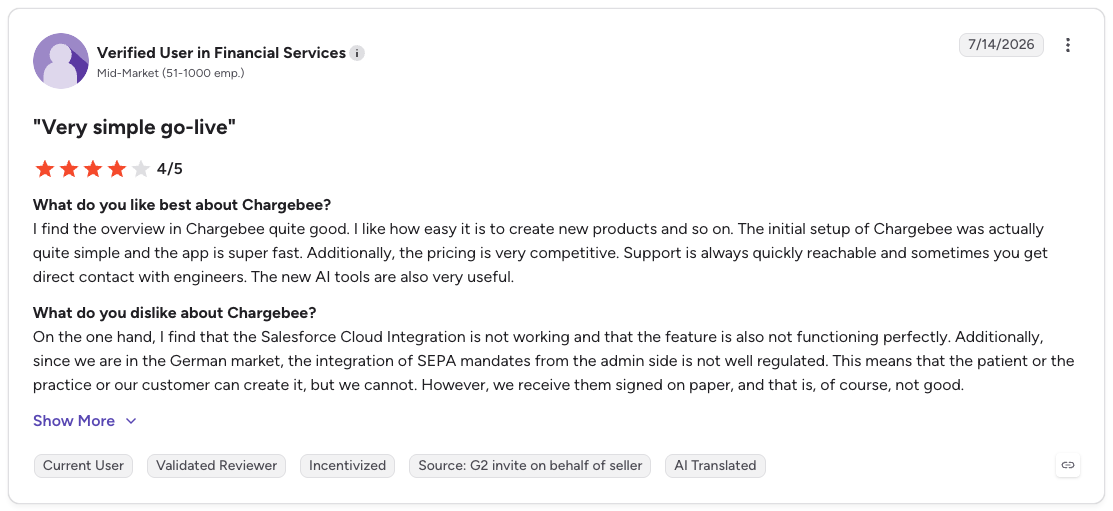
Pro: “I find the overview in Chargebee quite good. I like how easy it is to create new products and so on. The initial setup of Chargebee was actually quite simple and the app is super fast. Additionally, the pricing is very competitive.” [Verified User in Financial Services, G2 Review, July 14, 2026]
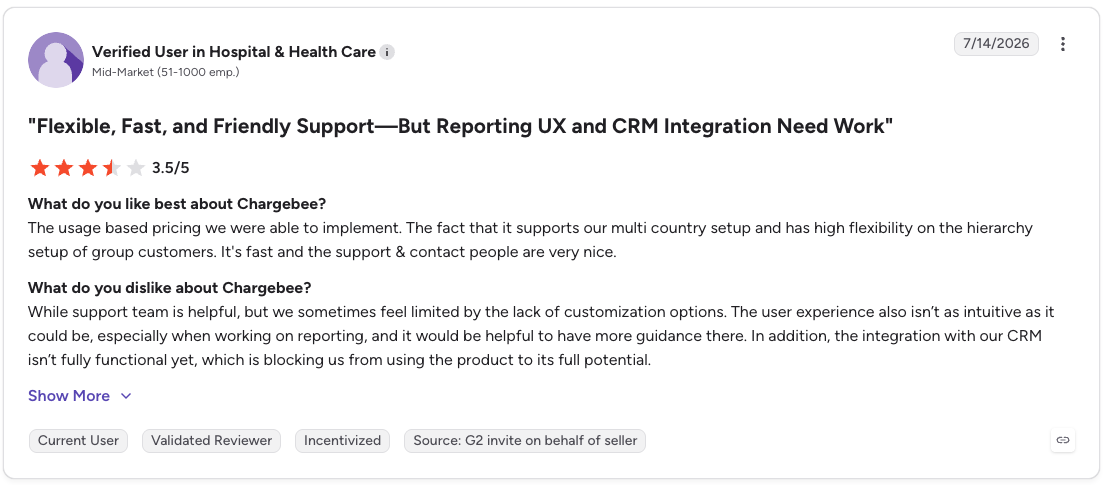
Con: “While support team is helpful, but we sometimes feel limited by the lack of customization options. The user experience also isn’t as intuitive as it could be, especially when working on reporting, and it would be helpful to have more guidance there. In addition, the integration with our CRM isn’t fully functional yet, which is blocking us from using the product to its full potential.” [Verified User in Hospital & Health Care, G2 Review, July 14, 2026]
Chargebee’s Starter plan is free for the first $250K in billing, then costs 0.75% of billing volume. Performance costs $7,188/year, while Enterprise uses custom pricing.
I'd go with Chargebee if you're running a subscription with usage add-ons. Cost stayed predictable, support answered fast, and day-to-day navigation felt easy.
Migration is a common pain point in reviews, running longer than expected, and several reviewers mention support slowing down once you're past the Starter tier and into Performance-level usage.
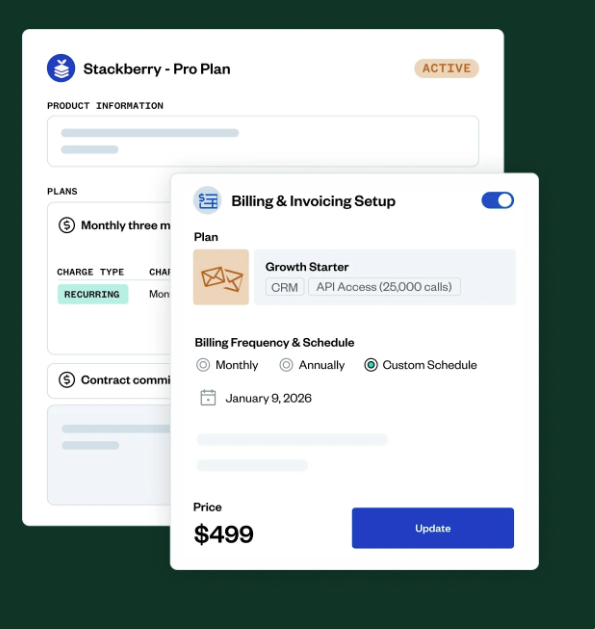
What it does: Zuora is a billing system built for enterprise subscription and usage billing, with deep configurability for regulated revenue recognition across large, complex catalogs.
Best for: Large enterprises that need billing catalog complexity and audit-ready revenue recognition in one system.
Zuora's strength as a billing system shows up clearly in reviews. Automation around subscription lifecycle management reduces manual work and helps ensure billing accuracy as volume grows, and it integrates well with CRM and ERP tools to keep finance, sales, and operations aligned.
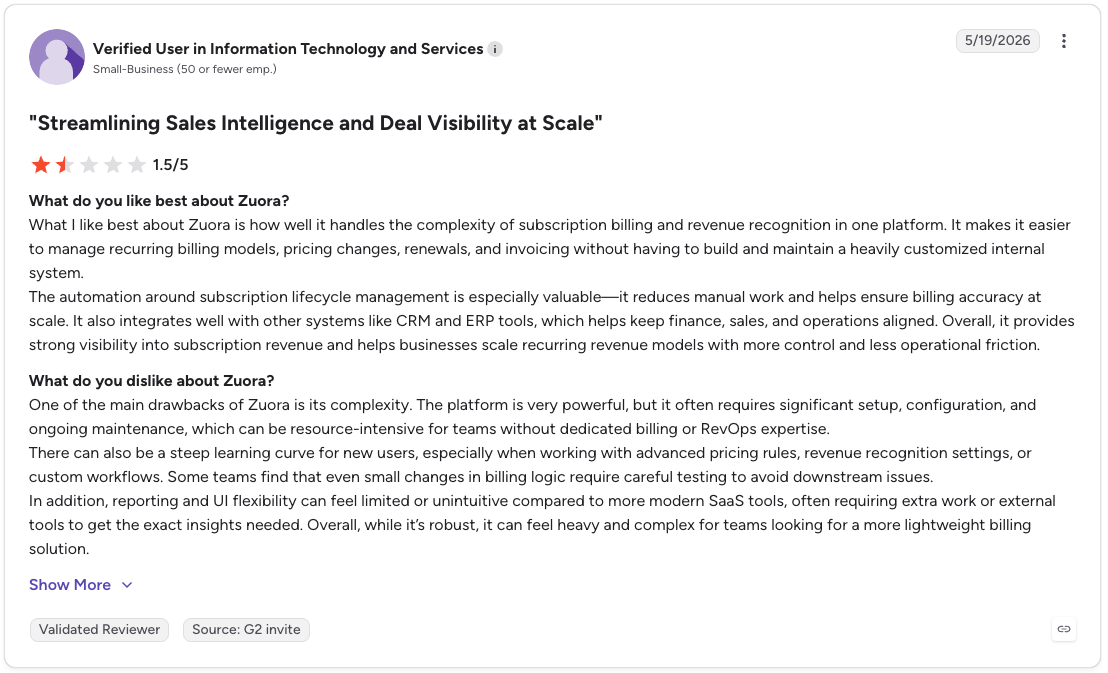
Pro: “What I like best about Zuora is how well it handles the complexity of subscription billing and revenue recognition in one platform. It makes it easier to manage recurring billing models, pricing changes, renewals, and invoicing without having to build and maintain a heavily customized internal system.” [Verified User in Information Technology and Services, G2 Review, May 19, 2026]
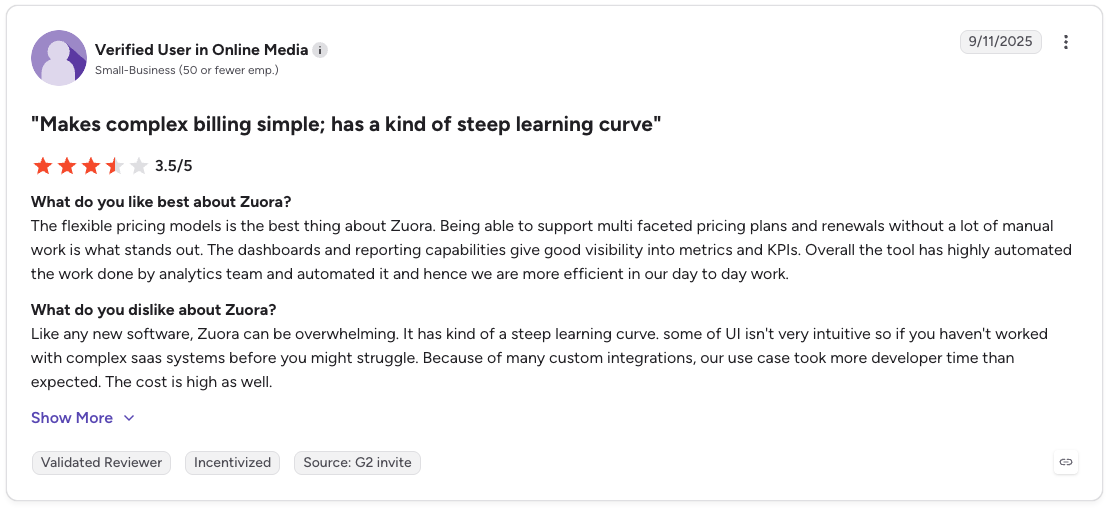
Con: “Like any new software, Zuora can be overwhelming. It has kind of a steep learning curve. some of UI isn't very intuitive so if you haven't worked with complex saas systems before you might struggle. Because of many custom integrations, our use case took more developer time than expected. The cost is high as well.” [Verified User in Online Media, G2 Review, September 11, 2025]
Zuora does not publish fixed pricing. All plans use custom pricing, with quotes available by contacting sales based on your billing, monetization, and enterprise requirements.
Zuora fits a large enterprise that needs deep catalog configurability and audit-ready revenue recognition in one billing system.
Reviewers consistently flag both the implementation weight and a steep learning curve once you're past initial setup. Advanced pricing rules and revenue recognition settings aren't something a new user picks up quickly.
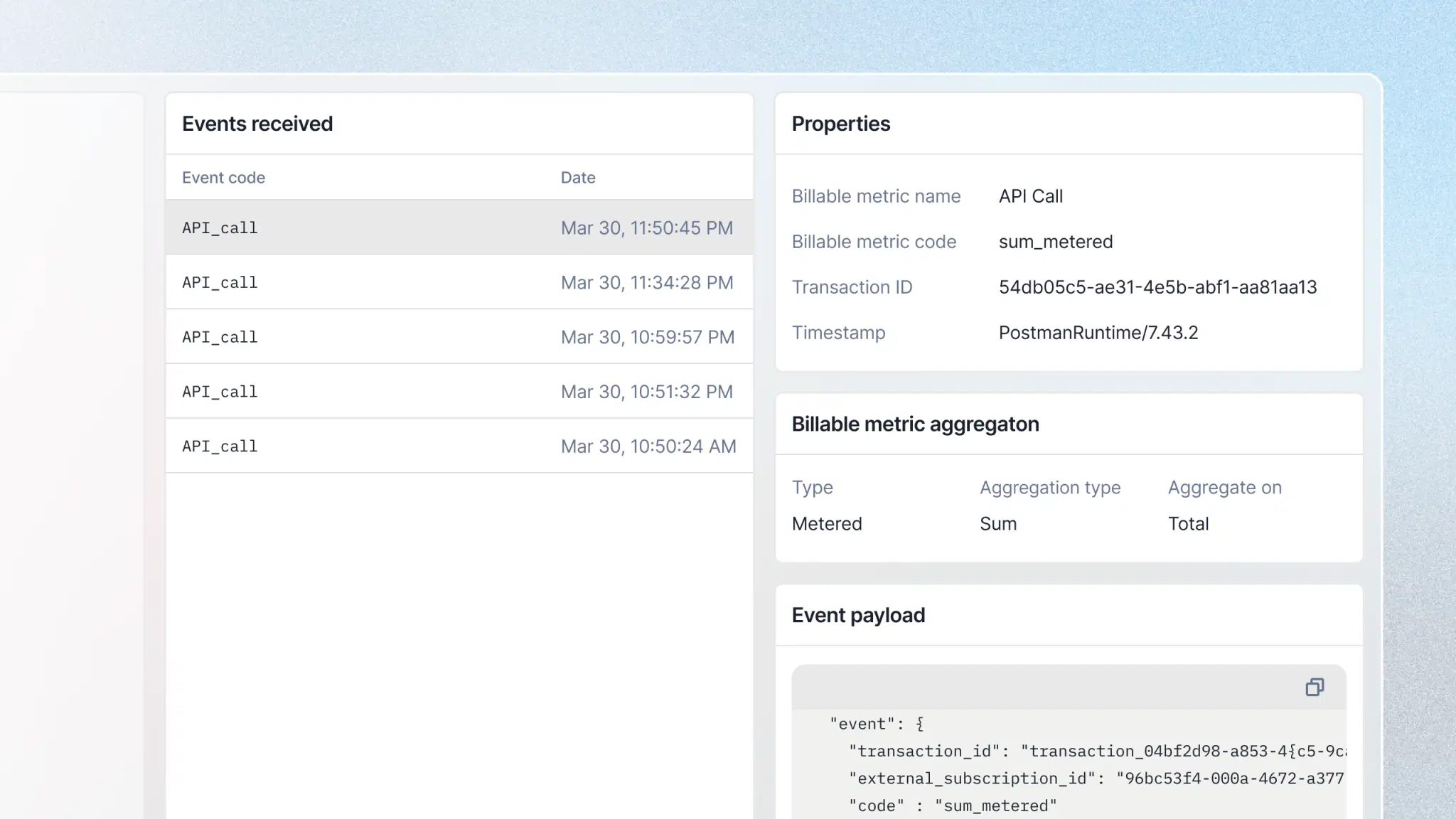
What it does: Lago is an open-source billing and metering engine covering usage-based, subscription, and hybrid pricing, built to deploy on your own infrastructure rather than run as a hosted black box.
Best for: Engineering-led teams that want the billing code itself living in their own repo instead of depending on a closed platform.
Lago's core appeal is straightforward. The full billing engine ships under AGPLv3, self-hostable via Docker, with no vendor lock-in on financial infrastructure you'd otherwise be building on top of Stripe or Chargebee. Event ingestion handles up to 15,000 billing events per second, enough for most API-driven products.
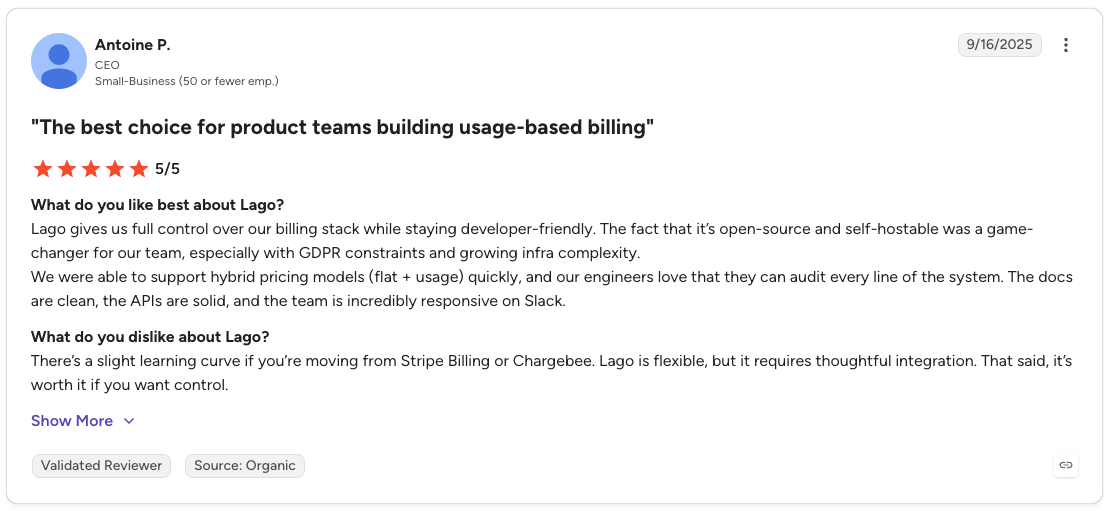
Pro: “We were able to support hybrid pricing models (flat + usage) quickly, and our engineers love that they can audit every line of the system. The docs are clean, the APIs are solid, and the team is incredibly responsive on Slack.”
Con: “There’s a slight learning curve if you’re moving from Stripe Billing or Chargebee. Lago is flexible, but it requires thoughtful integration. That said, it’s worth it if you want control.” [Antoine P., July 16, 2026]
Lago offers custom Business and Enterprise pricing, with plans tailored to usage volume, support needs, and implementation requirements.
I'd go with Lago if your team has the bandwidth to self-host and genuinely wants full control over billing data, down to the infrastructure it runs on. Skip it if you need a hosted portal, dunning, and tax handling out of the box, since that's either a paid-tier budget line or a build project of its own.
Every tool here is honest about what it's built for. It comes down to how complex your pricing already is and how much of the implementation you want to own yourself.
Choose Stripe Billing if you:
Choose Orb or Metronome if you:
Choose Chargebee if you:
Choose Zuora if you:
Choose Lago if you:
Skip this category entirely if your product charges flat per-seat subscriptions with no usage component at all. None of these six are built to solve a problem you don't have yet.
For most AI products, the decision comes down to Orb if your pricing is usage-first from day one, Chargebee if you're layering usage on top of a subscription, and Lago if you want that engine living in your own infrastructure.
Stripe Billing remains the fastest way to get something live this week, and Metronome is worth a look once your enterprise contracts get complicated enough to need it.
An invoice won’t tell you, in the moment a request fires, whether that request should have been allowed to run up the bill at all. That challenge is what none of the six platforms above are built to solve.
Stigg solves it. It's the usage runtime for AI products, checking entitlements, credits, usage limits, and spend governance synchronously, in the request path, before a call ever reaches Stripe, Zuora, Chargebee, Metronome, Orb, or Lago downstream.
What that looks like in practice:
None of this requires ripping out your existing billing system software. Start with just credits or just entitlements as a layer on top of whatever billing system software you're already running.
The Stigg docs are the fastest way in, SDKs, API references, and everything you need to get the Sidecar running.
Orb and Lago are the strongest fits for AI products specifically, since both were built around usage-based pricing rather than adapting a subscription engine after the fact.
Orb suits teams that want a fully managed platform, while Lago suits teams that want the billing code self-hosted in their own infrastructure.
For simple usage-based models, yes. Stripe Billing supports metered pricing through its usage records API. Once contracts involve ramped pricing, pooled credits, or high-cardinality metering across many agents or products, it tends to strain, which is part of why Stripe acquired Metronome to cover that gap.
The difference between billing software and an entitlement layer is that billing software calculates what a customer owes and generates the invoice after usage has already happened.
An entitlement layer checks whether a request is allowed to happen in the first place, before it fires, which none of the six tools above are built to do on their own.
Billing system software is a platform that manages what a customer owes and how that gets collected, covering usage tracking, charge calculation, invoicing, and payment collection in one system.
For AI products specifically, this usually means metering tokens, API calls, or agent actions, then converting that consumption into an invoice once the billing period closes.
.jpg)