%20(1).png)
Guides
Best Metered Billing Software: 9 Tools Ranked (2026)
I tested 9 metered billing software platforms for metering accuracy, pricing, and real-time enforcement, with honest pros, cons, and prices for 2026.

I tested 6 billing platforms for AI companies on real usage-metering scenarios. Compare pricing, deployment, and where each one breaks down.


Your AI product charges per token, per agent action, or per outcome, and most billing software for AI companies still assumes usage looks the same every month.
These six billing platforms handle that variance at very different levels of maturity:
Here's what each one handles well, where it falls short, and who it's actually built for.
I built a working credit-metering setup on the free or sandbox tier where one existed (Stripe, Lago, Chargebee, Recurly), and evaluated Metronome and Orb through their docs, demos, and published architecture, since both are sales-gated.
I also ran a synthetic load test simulating 50,000 usage events in a single hour to see how each platform's aggregation held up under a spike rather than steady traffic.
Two tools didn't make the final list: Paddle, because its usage-billing support is still limited to a beta waitlist as of this writing, and Chargify's standalone brand, since it's now fully absorbed into Maxio and no longer exists as a separate product to test.
This hands-on approach is what surfaced the real differences, like which platforms handle backdated corrections cleanly and which ones require rebuilding usage data by hand.
Disclaimer: Prices are subject to change without notice. Always visit the official company websites for the most up-to-date pricing information.
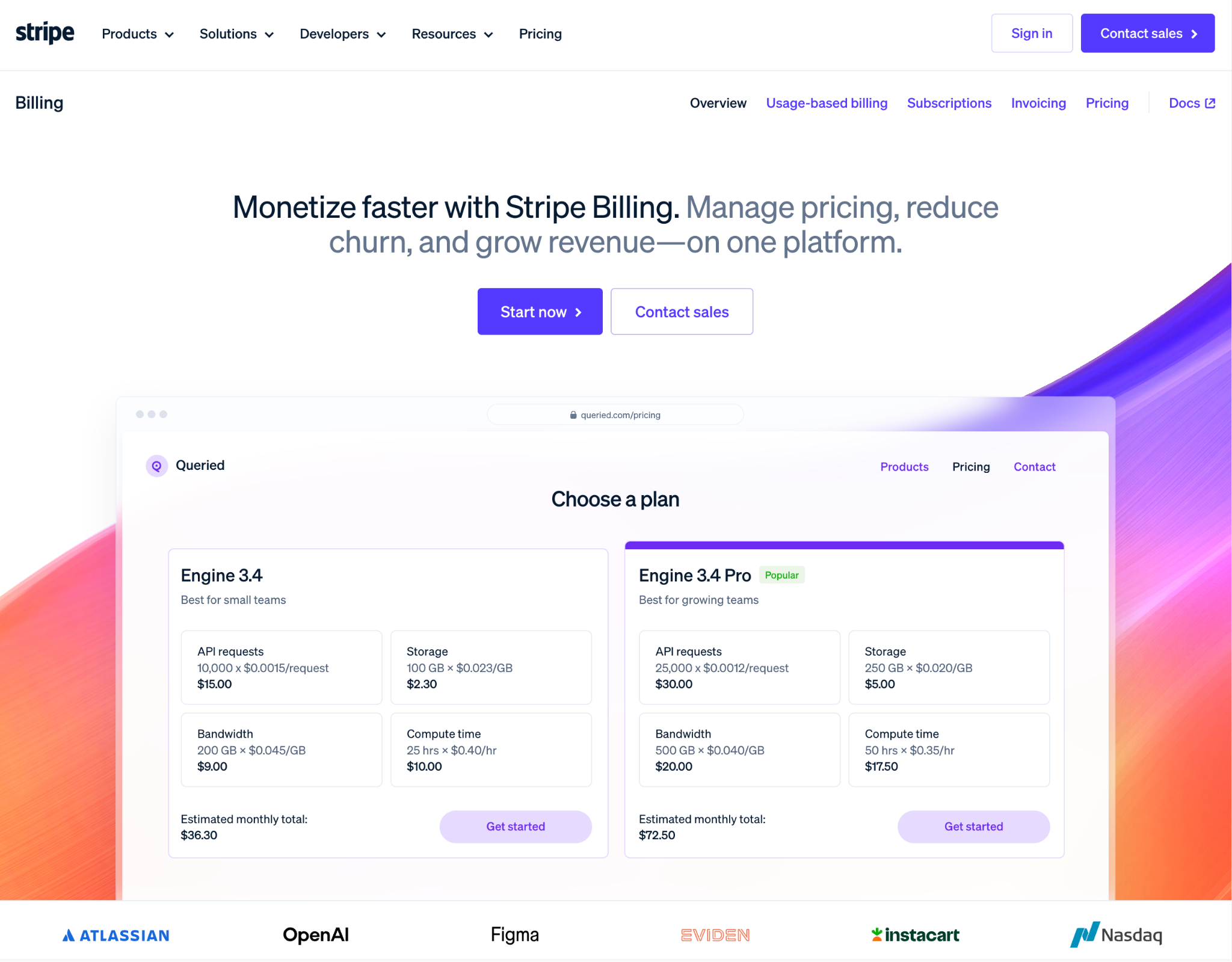
What it does: Stripe Billing handles subscriptions, invoicing, and usage-based charges natively inside Stripe, using metered billing to convert reported usage events into line items on a recurring invoice.
Best for: AI companies that already process payments through Stripe and want usage billing without standing up a separate metering platform on day one.
Stripe's metered billing model works off usage records your application reports against a subscription item, and it now sits alongside Stripe's own acquisition of Metronome, which gives Stripe two usage-billing paths under one roof depending on how much metering complexity you need.
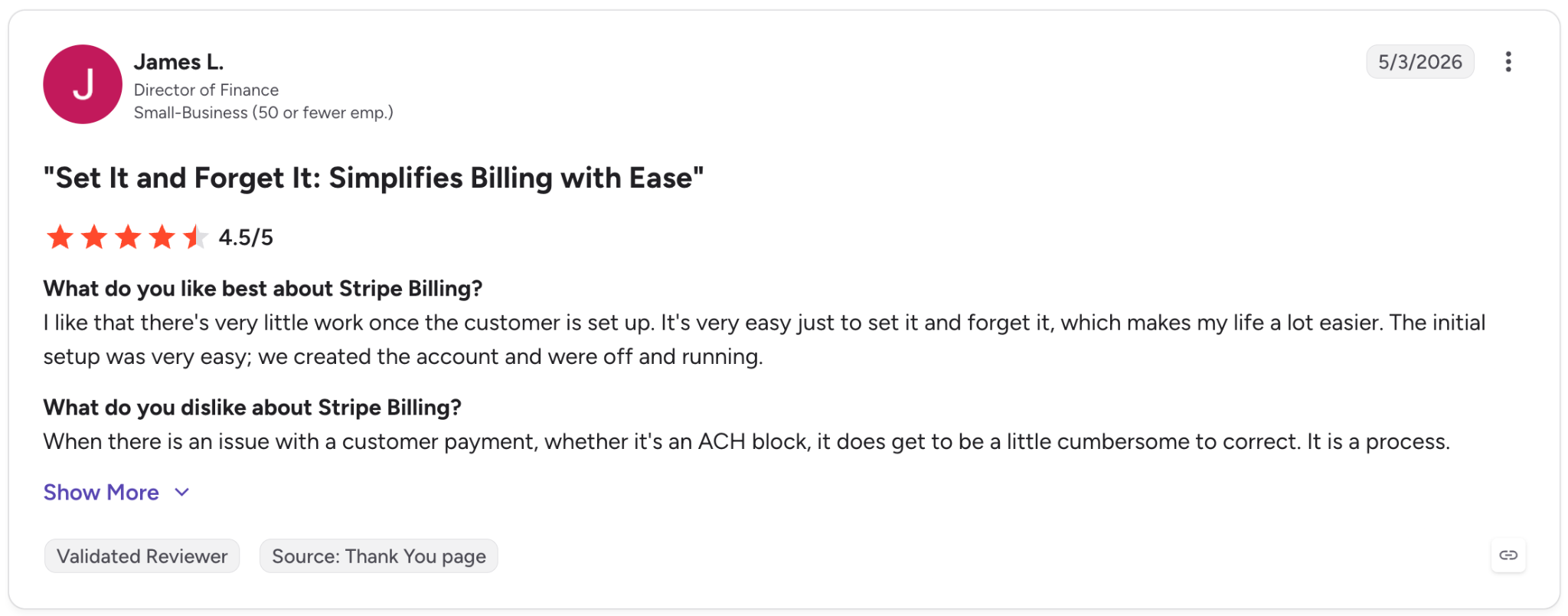
Pro: “I like that there's very little work once the customer is set up. It's very easy just to set it and forget it, which makes my life a lot easier. The initial setup was very easy; we created the account and were off and running.” [James L., G2 Review, May 3, 2026]

Con: “The dashboard can feel overwhelming at first, especially with all the advanced features and terminology. There’s definitely a learning curve when setting up subscriptions and understanding how Stripe structures products, prices, and billing cycles. Transaction fees can add up as volume grows, and certain automation features require a bit of technical understanding to fully optimize.” [Austin F., Capterra Review, February 11, 2026]
Stripe Billing starts at $620/month on a one-year contract, paid monthly. Its pay-as-you-go option charges 0.7% of billing volume with no recurring fee.
Stripe Billing is the right starting point if you're already processing payments through Stripe and your usage model is simple enough for one or two billable metrics.
Once pricing gets more dimensions than that, you'll likely need to pair it with a dedicated metering or entitlements layer rather than pushing all the logic into billing meters.
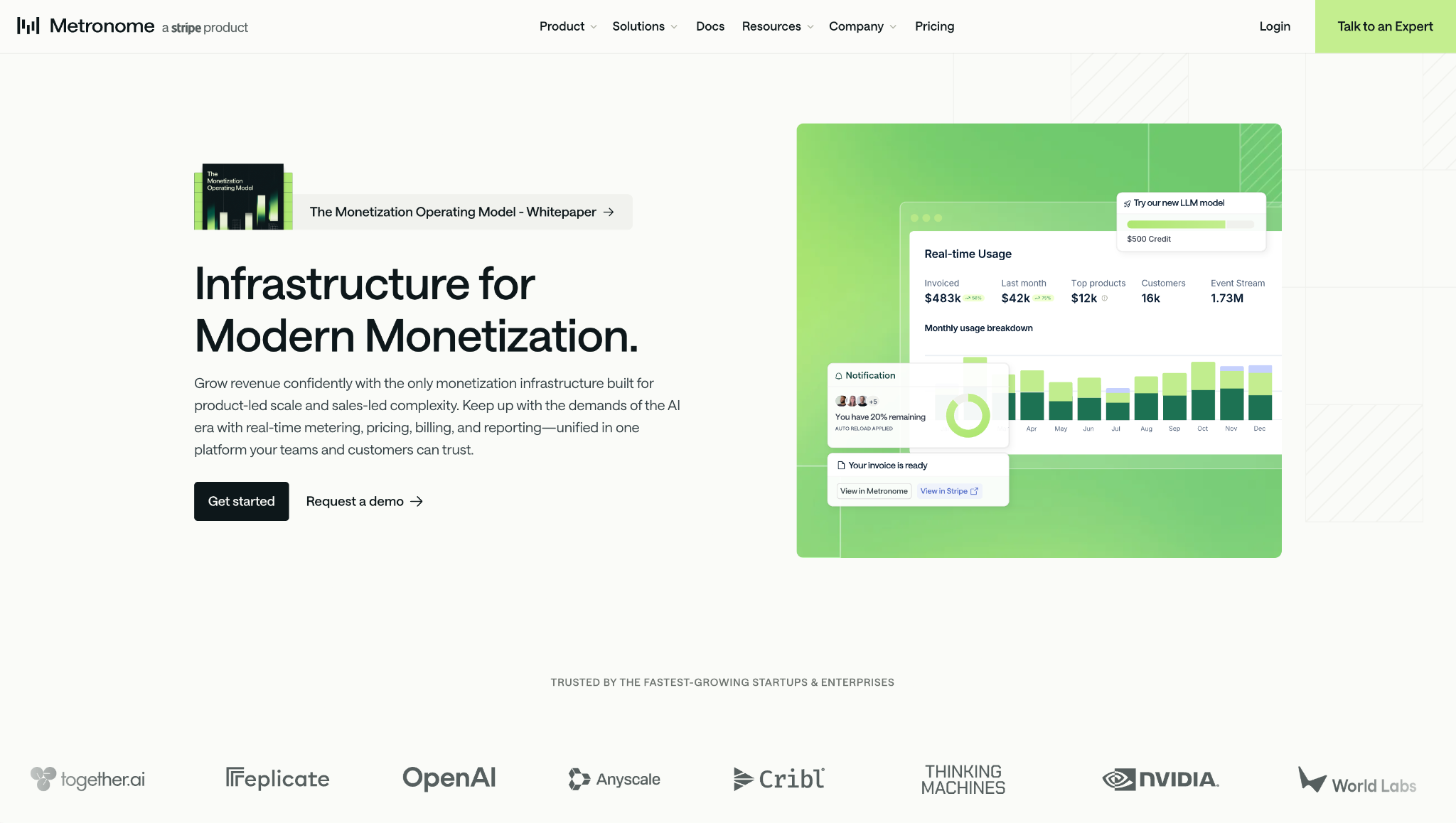
What it does: Metronome meters high-volume usage events and converts them into billable line items, with SQL-based tools for defining custom billable metrics.
Best for: AI companies already running payments through Stripe that need metering built to handle genuinely high-volume event traffic, agent actions, and token consumption.
Metronome's customer list includes OpenAI, Anthropic, and Nvidia, which reflects the kind of usage volume it's built to handle.
Stripe completed its acquisition of Metronome in January 2026, and Metronome's roadmap is now part of Stripe's broader billing strategy.
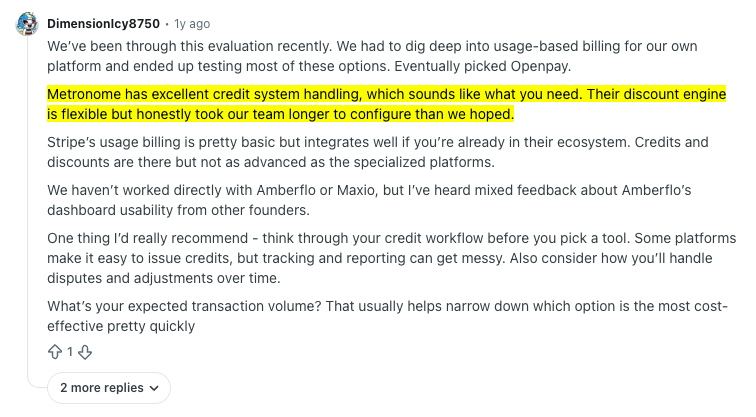
Pro: “Metronome has excellent credit system handling”
Con: “Their discount engine is flexible but honestly took our team longer to configure than we hoped.” [u/DimensionIcy8750, Reddit User Review, July 3, 2025]
Metronome does not publish standard plan pricing. It offers a Starter plan with usage-based pricing and a Custom plan for larger businesses, with pricing available by contacting sales.
Metronome is the strongest option if your pricing model needs SQL-level flexibility and you expect it to change often enough that backdating and iterating metrics without pipeline rework becomes a real requirement.
If your usage model is simple and unlikely to change, the SQL and engineering dependency here is more than most teams need.
For a deeper look, see our full Metronome review.
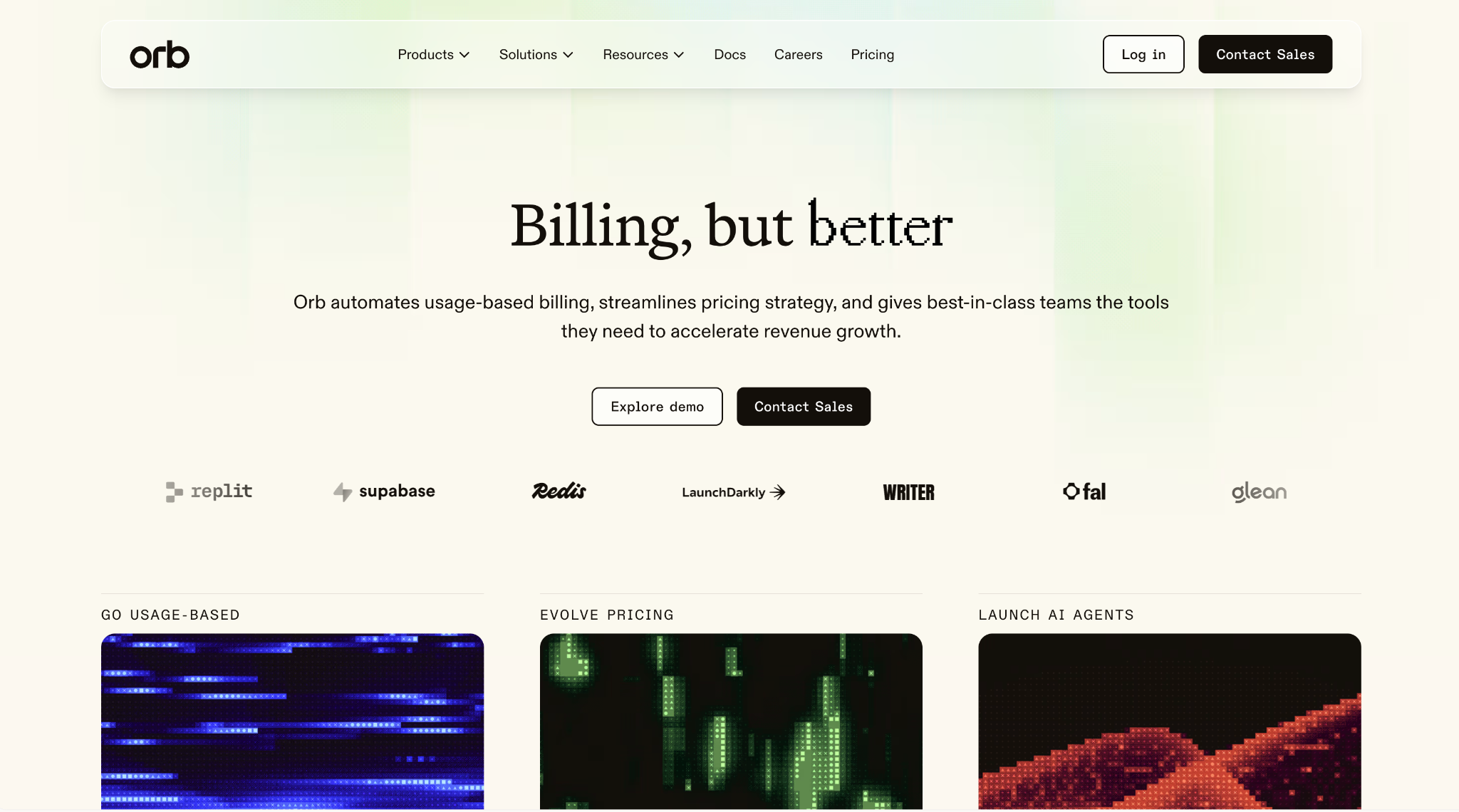
What it does: Orb stores usage events at full, individual granularity instead of pre-aggregating them, so invoices can be corrected, backdated, and audited after the fact, and proposed pricing changes can be tested against real historical usage before they go live.
Best for: Enterprises that want to test proposed pricing changes against real usage data before launching them, and that are comfortable evaluating a product now owned by a payments company.
Adyen closed its acquisition of Orb on July 1, 2026, in a deal valued at $335 million, and Orb now operates under Adyen's ownership, run initially under what Adyen has described as an incubator model to preserve product continuity.
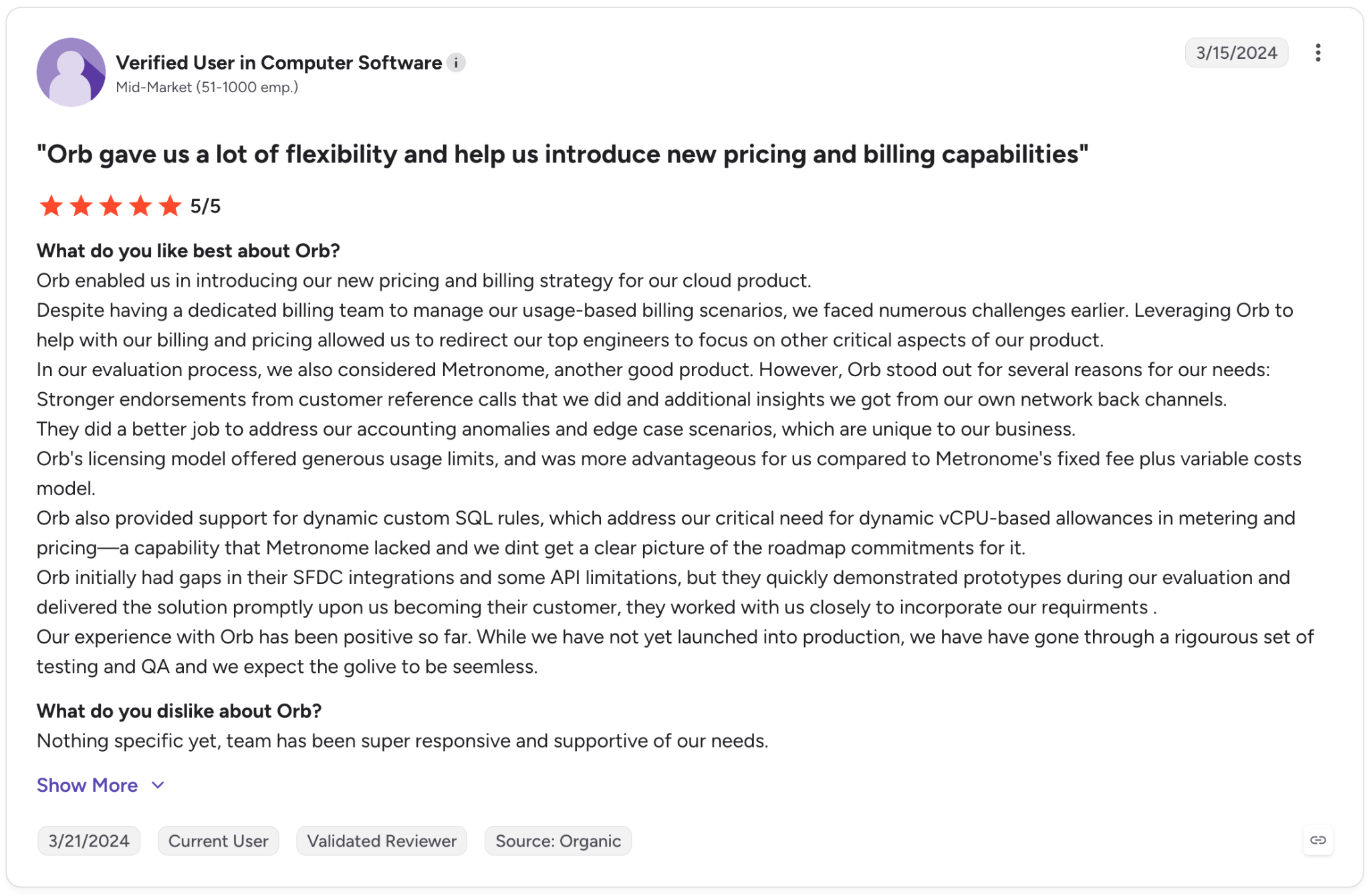
Pro: “Orb also provided support for dynamic custom SQL rules, which address our critical need for dynamic vCPU-based allowances in metering and pricing, a capability that Metronome lacked and we didn't get a clear picture of the roadmap commitments for it.” [Verified User in Computer Software, G2 Review, March 15, 2024]
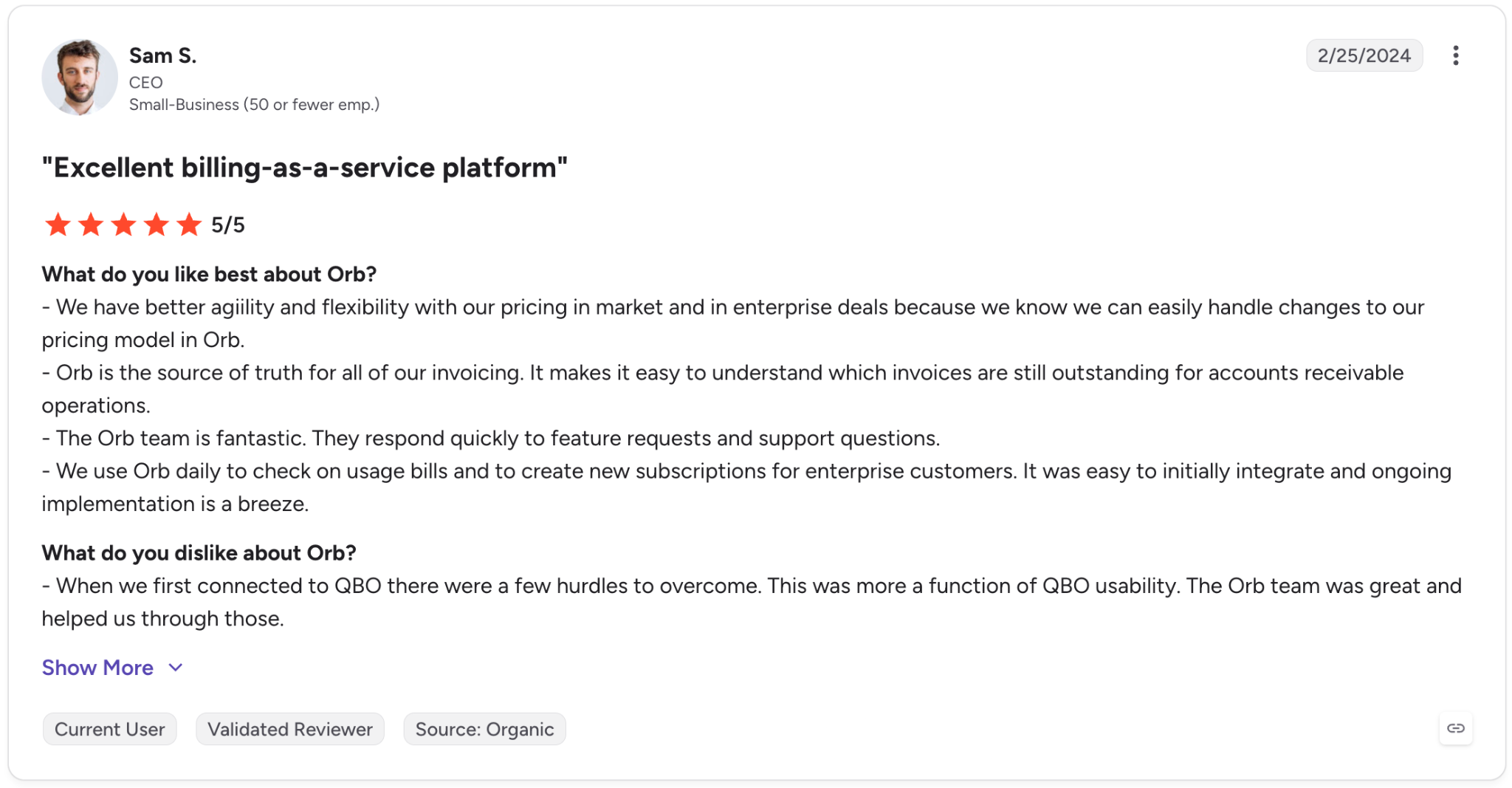
Con: “When we first connected to QBO there were a few hurdles to overcome. This was more a function of QBO usability. The Orb team was great and helped us through those.” [Sam S., G2 Review, February 25, 2024]
Pricing for Orb’s Core, Advanced, and Enterprise plans is not publicly available. Contact Orb sales directly for tailored pricing.
Orb is a strong fit for enterprises that want pricing simulation and custom metric flexibility, especially if working with Adyen for payments isn't a blocker.
If processor neutrality matters to you specifically, the Adyen acquisition is worth weighing before committing.
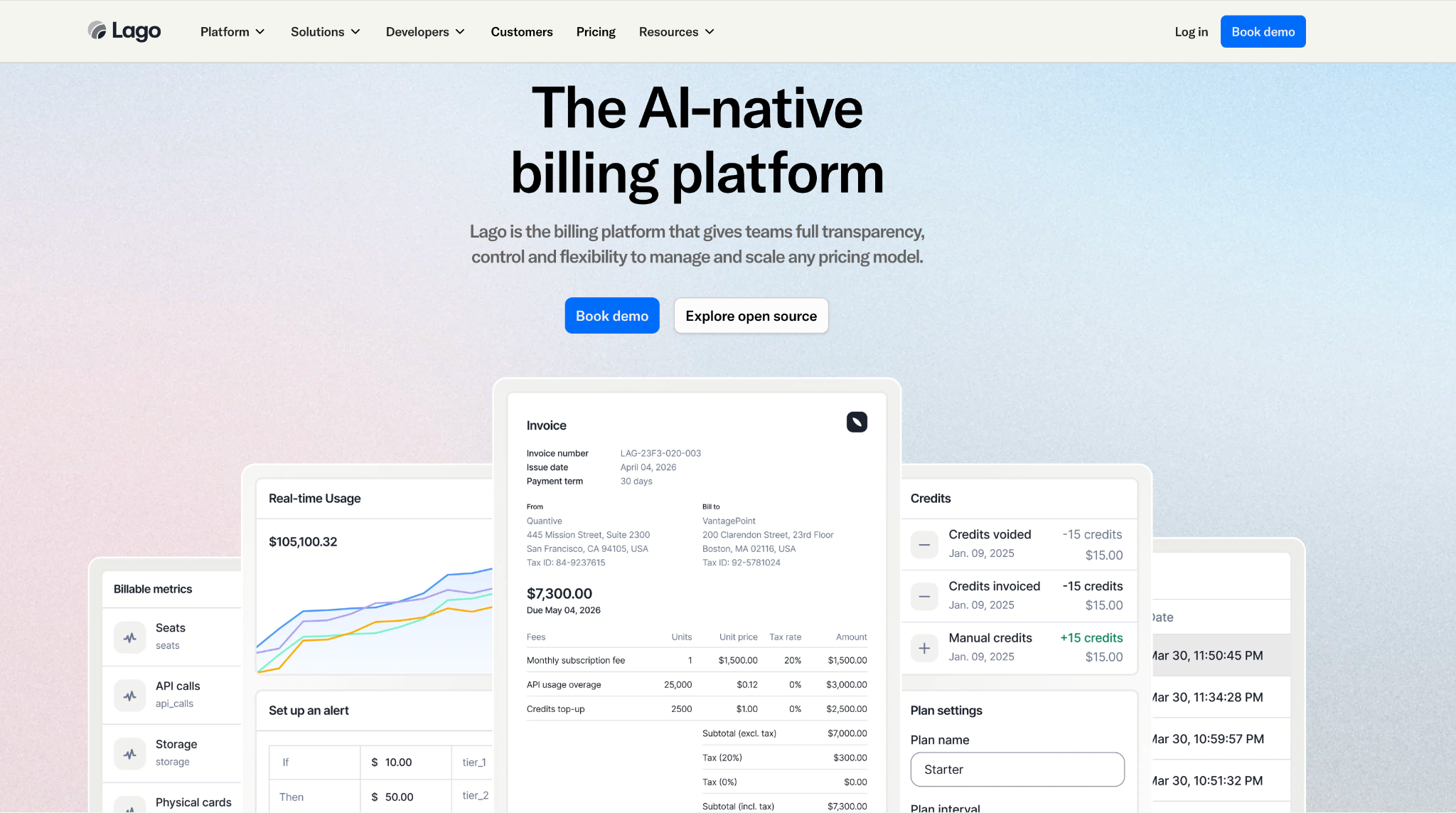
What it does: Lago ingests usage events, calculates charges against billable metrics and pricing plans, and generates invoices, supporting self-serve, sales-led, subscription, credit, and usage-based models across multiple products, entities, and currencies, either self-hosted or through a managed cloud option.
Best for: Engineering teams that want full control over their billing infrastructure and don't want a payment processor's acquisition to determine their billing roadmap later.
Lago is backed by Y Combinator and used by AI companies including Mistral, Groq, and Together.ai. The self-hosted version runs under an AGPLv3 license with no per-transaction fees, and its metering engine handles a high volume of events per second.
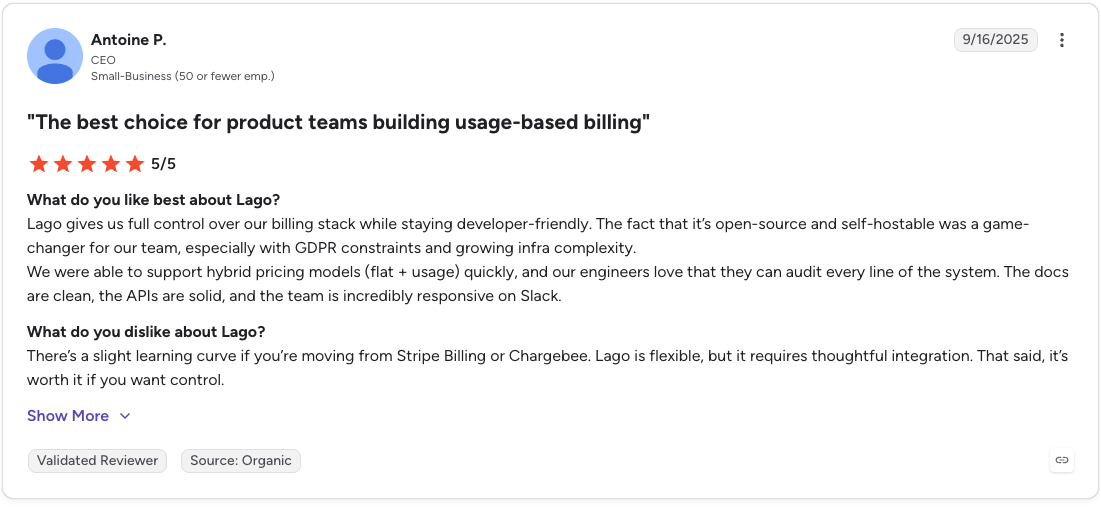
Pro: “Lago gives us full control over our billing stack while staying developer-friendly. The fact that it’s open-source and self-hostable was a game-changer for our team, especially with GDPR constraints and growing infra complexity.”
Con: “There’s a slight learning curve if you’re moving from Stripe Billing or Chargebee. Lago is flexible, but it requires thoughtful integration. That said, it’s worth it if you want control.” [Antoine P., G2 Review, September 16, 2025]
Pricing for Lago Premium is not publicly available. Contact Lago directly to request a tailored quote.
Lago is the strongest choice for engineering teams that want to own their billing infrastructure outright, without a payment processor's acquisition later deciding the roadmap for them.
It holds up as a serious option for high-volume, custom usage models, provided you're comfortable with the operational responsibility that comes with self-hosting.
What it does: Chargebee handles usage ingestion, metering, pricing, billing, and revenue recognition together, alongside its original subscription and recurring billing engine, with quoting and contracting tied directly into the same system.
Best for: AI companies that need usage-based billing to work alongside subscriptions and negotiated enterprise contracts, without building separate metering infrastructure from scratch.
Chargebee also handles quoting, renewals, and revenue recognition in one system, which makes it a common choice for companies running both self-serve plans and negotiated enterprise deals side by side, a pattern that shows up often once an AI product adds a seat-based tier on top of its usage pricing.
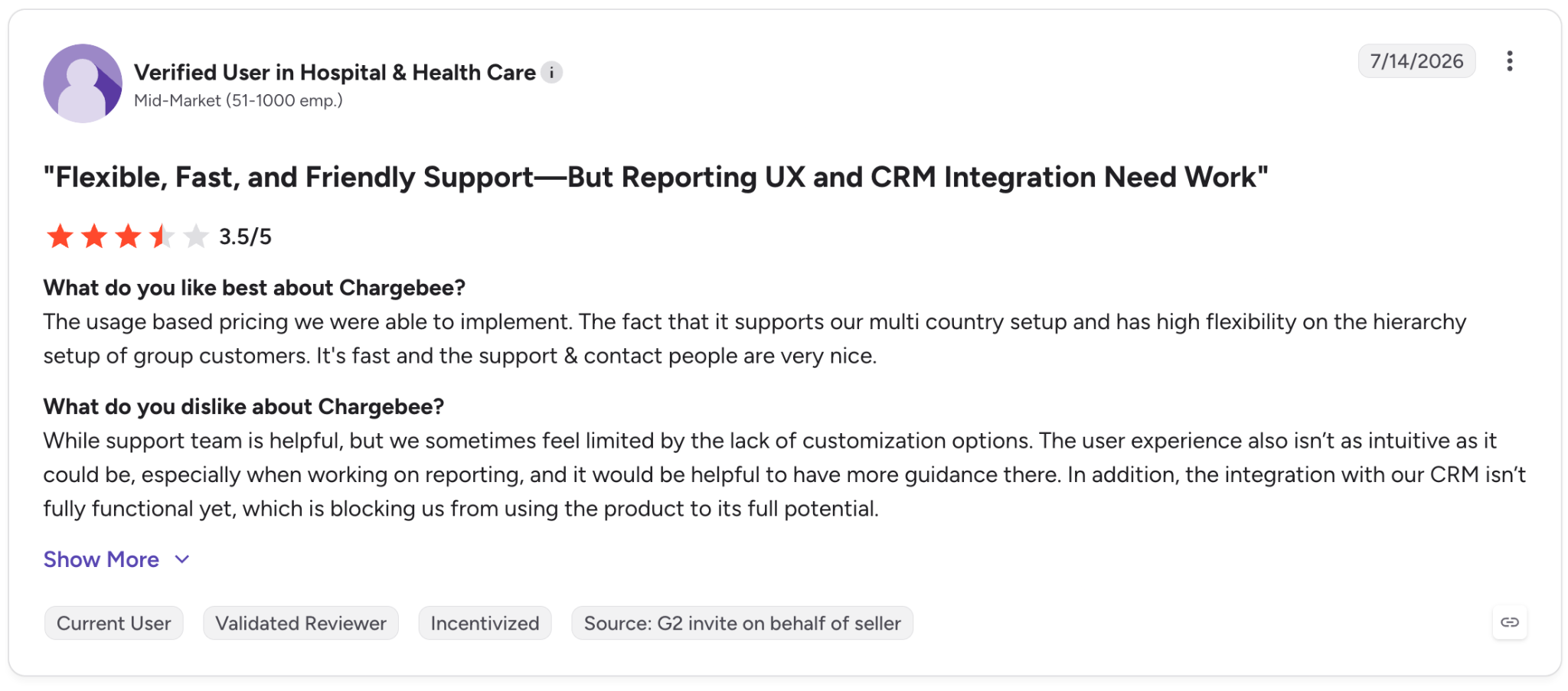
Pro: “The usage-based pricing we were able to implement. The fact that it supports our multi-country setup and has high flexibility on the hierarchy setup of group customers. It's fast, and the support & contact people are very nice.” [Verified User in Hospital & Health Care, G2 Review, July 14, 2026]
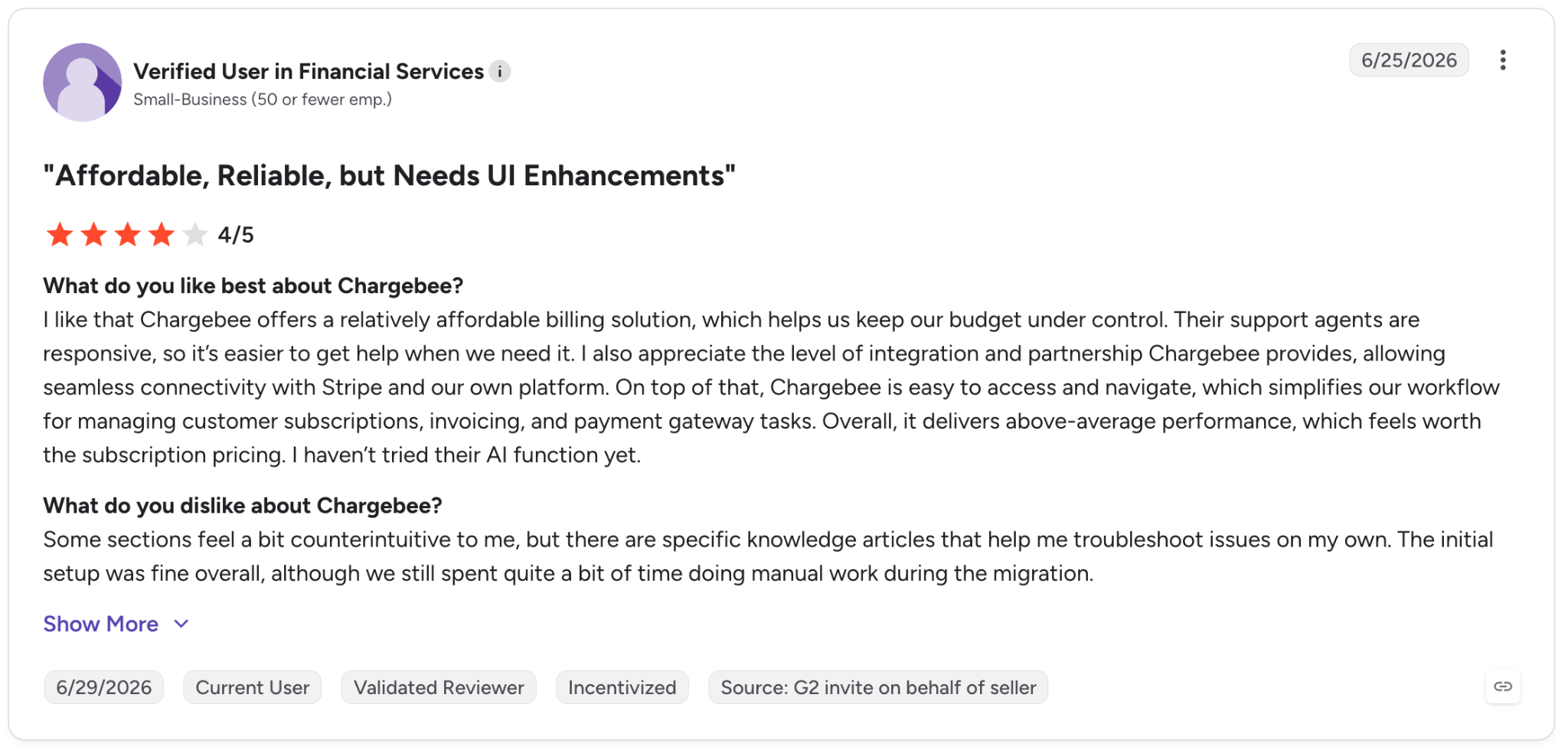
Con: “Some sections feel a bit counterintuitive to me, but there are specific knowledge articles that help me troubleshoot issues on my own. The initial setup was fine overall, although we still spent quite a bit of time doing manual work during the migration.” [Verified User in Financial Services, G2 Review, June 25, 2026]
Chargebee’s Flow plan starts at 0.80% of monthly billing value with no platform fee and includes 100M usage events per month. The Commit Monthly option costs $99 plus 0.65% of billing value, while Enterprise Plus uses custom pricing.
Chargebee is a strong fit if you need usage billing, prepaid credits, and entitlements working alongside subscriptions and enterprise contracts in one system.
If your business is usage-only with no subscription component, confirm the metering engine's throughput matches your actual event volume before committing.
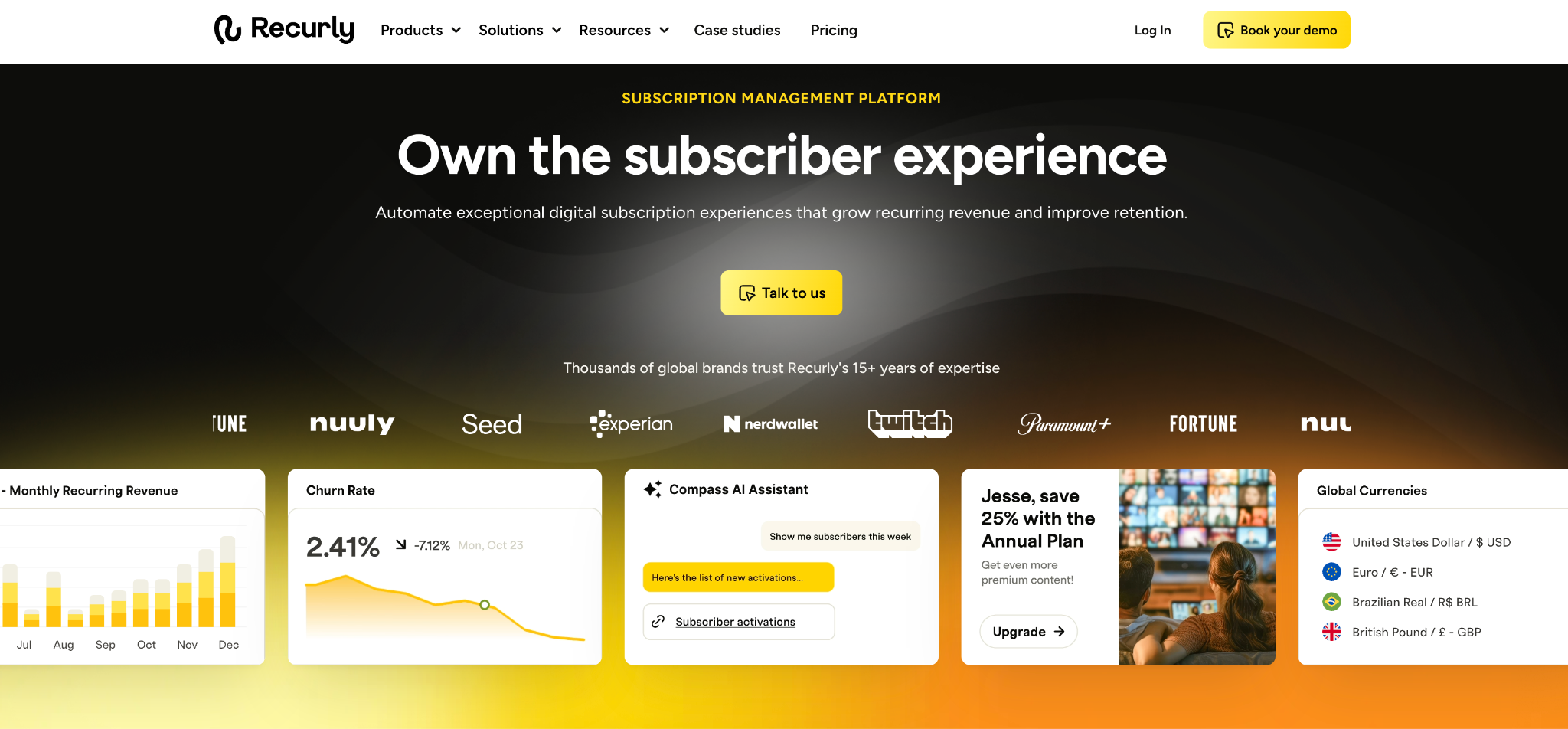
What it does: Recurly manages subscription billing, invoicing, dunning, and revenue recovery, with usage-based add-ons and consumption pricing layered on top of its original recurring-billing core.
Best for: AI companies that started on a flat subscription model and are introducing usage or credit-based pricing for the first time, without wanting to rebuild their entire billing stack to do it.
Recurly's roots are in subscription commerce, and its dunning and payment-recovery tooling, built for reducing involuntary churn on recurring charges, carries over directly into usage-based plans once a company adds consumption pricing on top of an existing subscription base.
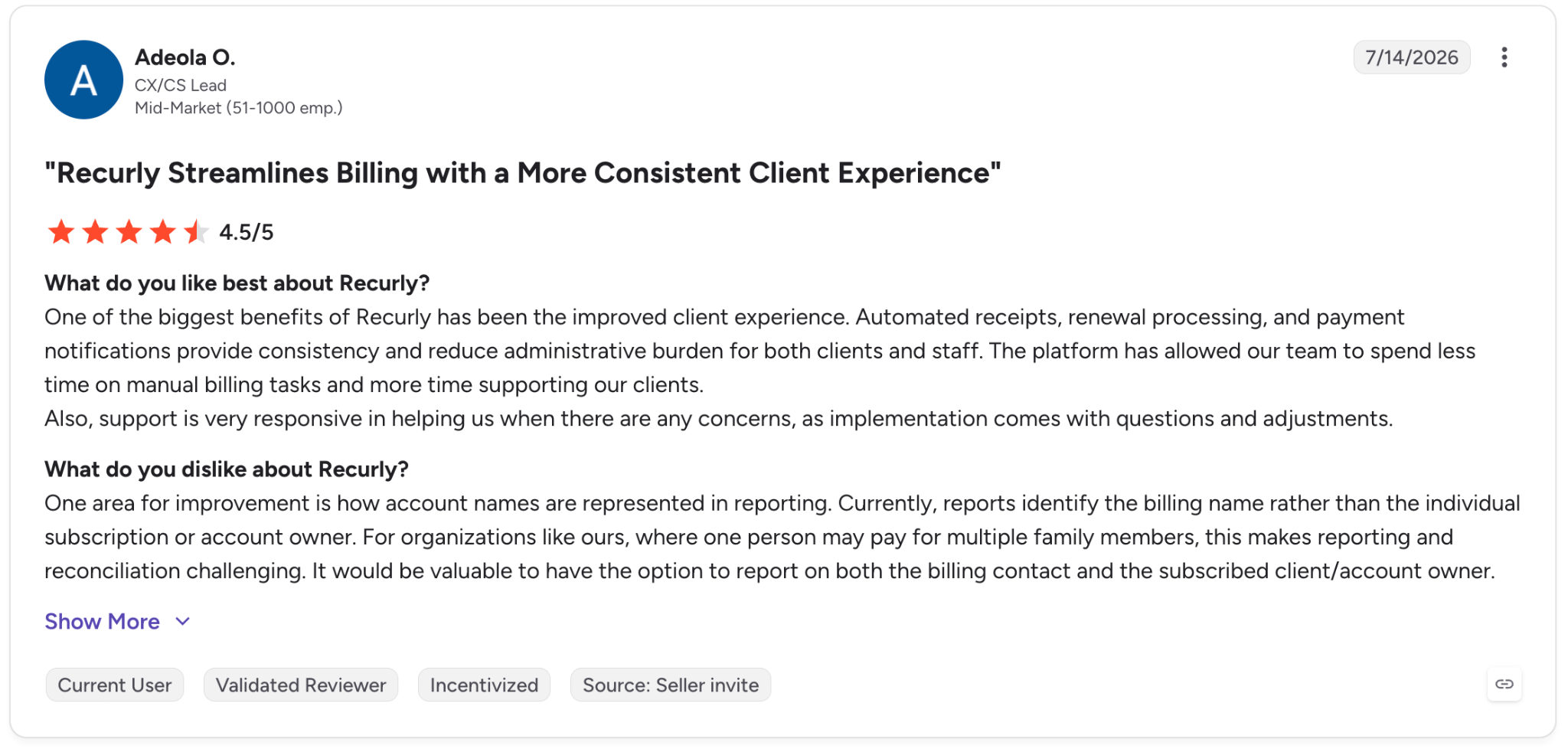
Pro: "One of the biggest benefits of Recurly has been the improved client experience. Automated receipts, renewal processing, and payment notifications provide consistency and reduce administrative burden for both clients and staff. The platform has allowed our team to spend less time on manual billing tasks and more time supporting our clients.” [Adeola O., G2 Review, July 14, 2026]
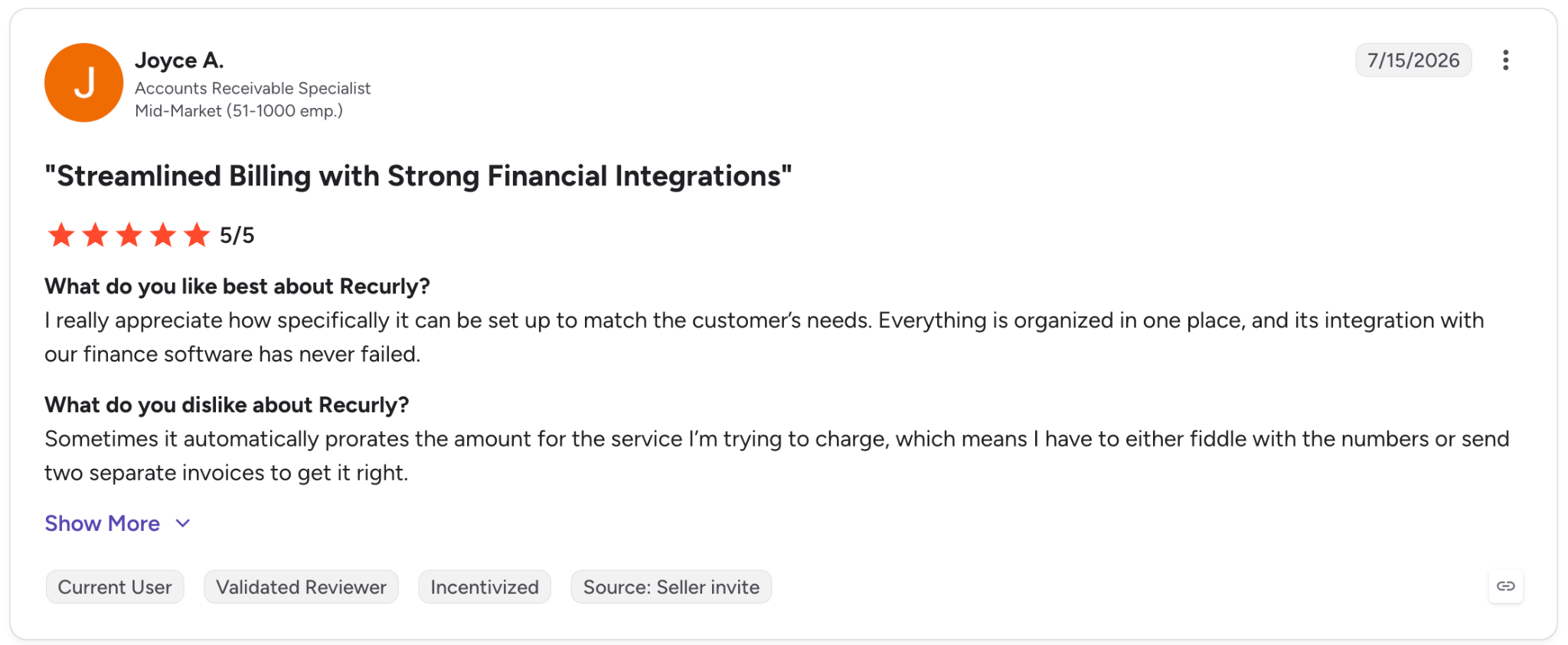
Con: “Sometimes it automatically prorates the amount for the service I’m trying to charge, which means I have to either fiddle with the numbers or send two separate invoices to get it right.” [Joyce A., G2 Review, July 15, 2026]
Recurly Starter starts at $249 per month + 0.9% of billing volume, with no fee on the first $40K billed monthly. Its All-Access plans charge less than 1% of billing volume on an annual contract.
Recurly is a solid choice for AI companies already on a subscription model that are adding usage or credit pricing for the first time and want to avoid a full billing migration.
For usage-only products with high event volume from day one, a usage-first platform is likely the better starting point.
The right choice depends more on your existing stack, deployment preferences, and who owns pricing changes than on any single best answer.
Choose Stripe Billing if you:
Choose Metronome if you:
Choose Orb if you:
Choose Lago if you:
Choose Chargebee if you:
Choose Recurly if you:
Skip this category entirely if your bottleneck is deciding what a request should be allowed to do before it happens, or if your usage model is genuinely simple with one metric, one tier, and low volume.
For most AI companies starting out, Stripe Billing is the fastest path to a working setup, and Metronome or Lago are the strongest upgrades as volume and pricing become more complicated.
Billing software alone can't govern AI usage because it answers "what should this customer be charged," instead of telling you whether a specific request should be allowed before that cost is incurred, and those are different questions.
Stigg is the usage runtime for AI products. Entitlements, credits, usage limits, and spend governance are enforced synchronously in the request path.
You don't have to adopt all of it at once. The credits engine, entitlements, and metering can each be adopted independently, and many companies start with a single SDK integration before layering in more:
Picking a billing platform from this list solves half the problem. What comes next is what happens the moment a request comes in, before it ever reaches an invoice. See the Stigg docs for details on entitlements and usage-based governance.
The best billing software for AI companies depends on where you're starting from.
Stripe Billing suits companies already on Stripe with a simple usage model, Metronome and Lago suit companies with high-volume, complex usage patterns, and Chargebee or Recurly suit companies blending subscriptions with usage for the first time.
The difference between billing software and entitlement enforcement is timing. Billing software counts usage and generates an invoice after the fact. Entitlement enforcement decides, synchronously, whether a specific request is allowed to happen at all, before it's ever counted.
Yes, AI companies can run more than one billing tool at once, particularly during a migration between providers or when subscriptions and usage-based charges are handled by different systems.
A layer that sits above billing, rather than replacing it, can support multiple providers simultaneously without requiring a rip-and-replace migration.
It varies by vendor and volume. Some platforms publish real starting prices. Stripe Billing starts at $620/month on a one-year contract, or 0.7% of billing volume pay-as-you-go, and Recurly Starter begins at $249/month plus 0.9% of billing volume, with no fee on the first $40K billed monthly.
Others, including Orb, Metronome, Lago's Premium plan, and Chargebee's Enterprise tier, use custom pricing available only through a sales conversation.
%20(1).png)
%20(1).png)