%20(1).png)
Guides
Best Metered Billing Software: 9 Tools Ranked (2026)
I tested 9 metered billing software platforms for metering accuracy, pricing, and real-time enforcement, with honest pros, cons, and prices for 2026.

Billing architecture is the set of layers that turn usage into a correct bill. Here's how billing systems are designed in 2026, and where they break.

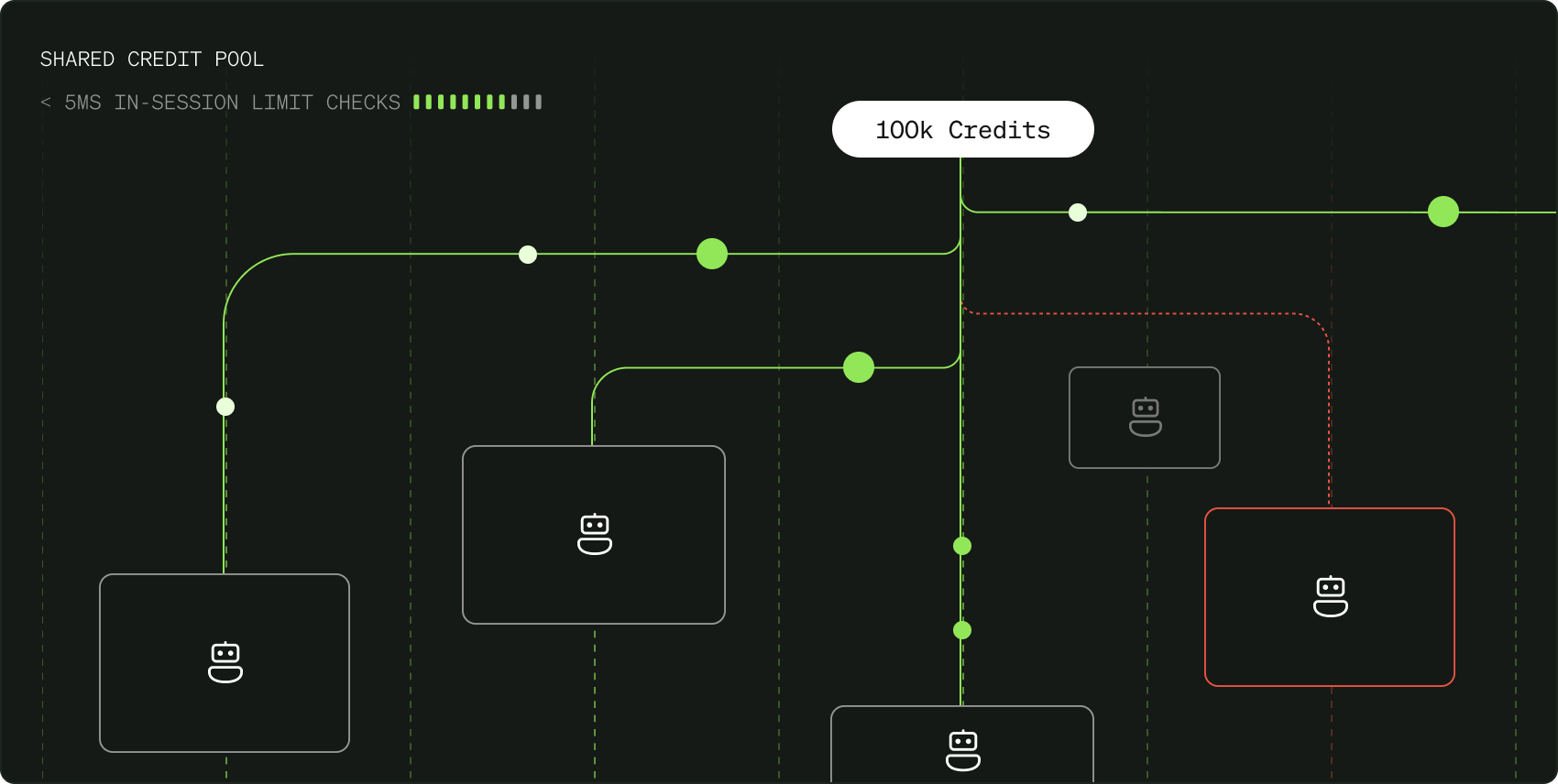
Friday afternoon, a customer starts batch work and traffic jumps. The API keeps responding. In the background, metering drops events, retries post duplicate charges, and cached plan limits stay active. On Monday, finance, support, and engineering have different numbers.
Billing architecture determines whether you issue a correction or a clean invoice. This article maps the systems behind that outcome and the entitlement checks that belong in the request path.
Billing architecture is the set of components that takes a unit of product usage and turns it into a collectible charge. It includes metering, rating, invoicing, payments, subscription state, and a financial ledger.
Invoicing is only one part of the system. It formats rated charges into a document, but the architecture starts earlier, with the event that records use, and continues after payment with reconciliation and revenue recognition.
A billing system is a data pipeline with financial consequences. A usage event enters the system, each stage transforms it, and a charge reaches the customer.
A mistake at the start reaches every layer after it. A missed event becomes a lower usage total, then an incorrect price, then a disputed invoice, and engineers need each handoff to preserve the right customer, time, product, and amount.
Billing systems use the same jobs even when their service boundaries differ. Each layer owns a specific state transition and protects against a specific class of error.
Card payments add another boundary. The PCI Data Security Standard governs systems that handle card data, which is why many products route payment collection through a provider and keep card details outside their own services.
One API call touches several layers before it appears on an invoice. Trace this path through your own system and check the data, owner, and failure behavior at every step.
Metering and entitlement enforcement often run thousands of times per second, while invoicing runs on a billing schedule. These workloads need different data paths and response-time targets.
An invoice can’t stop an agent from spending another $500 on model calls. The allow-or-block decision belongs in the request path, before compute begins.
Many products begin with one service that holds plans, pricing, invoices, and payment logic. That approach is manageable while pricing has few moving parts and usage is low.
A new tier, add-on, or usage limit exposes the problem when it requires edits across billing code, product logic, and customer state. Each change needs regression testing against older contracts and active subscriptions.
An unbundled design separates metering, rating, invoicing, and enforcement into components with clear responsibilities.
Monetization infrastructure describes this split as a control layer around the billing system, where packaging can change without an application release.
More components create more state to coordinate, and they also keep a high-volume request path independent from monthly invoicing and reporting. Draw the boundary around pricing velocity, event sources, and the concurrent usage you need to control.
Traditional seat billing can count access once a month. AI products need to account for tokens, inference runs, tool calls, and agent actions while the customer is using the product.
The meter becomes part of application delivery. When it loses events during a burst, you lose the data required to price use and investigate what happened.
Stigg models AI credits as a ledger of grants and debits. Each block carries its own expiry, cost basis, category (paid vs promotional), and priority in the burn order.
Depletion behavior is configurable: a hard limit denies the request, a soft limit allows usage to go negative and tracks the overage for finance.
Marginal cost also changes the risk, as each model call consumes paid compute. A runaway agent can run through a customer budget and your margin in minutes if the product checks usage only after the work completes.
Pricing may change with upstream model costs. When pricing rules live in code, every commercial update waits for a release cycle. Keeping packaging and rate rules in a product catalog gives you room to update the offer while preserving the terms of existing customers.
Billing records what has already happened, and entitlement enforcement answers whether the next operation may run.
Quotas, credits, trials, and add-ons make the separation concrete. A request needs an immediate answer based on the customer’s active plan, remaining balance, inherited allowances, and any promotional grant.
Effective entitlements combine those terms into one decision. The resolved value may include the base plan, add-ons, parent-plan limits, trials, and promotions.
An entitlement management system needs to evaluate those sources consistently whenever the product checks access.
Billing providers such as Stripe and Zuora handle invoices, collections, and subscription records well. They do not sit inside every application request to determine whether a customer has credits for the next model call.
That request-time layer needs current state, safe concurrent updates, and a short response path. It also needs to keep working during high-volume bursts and plan changes that happen mid-session.
On a cache hit, Stigg entitlement checks resolve from the Sidecar's local in-memory cache in single-digit milliseconds (p99 <10ms). On a cache miss, the Sidecar fetches current state from Stigg's Edge API in around 100ms, with a configurable 10-second timeout.
On timeout, it returns configured defaults rather than hanging. If you’re running serverless or large container fleets you can swap the default in-memory cache for Redis so cached entitlements survive restarts and stay shared across instances.
Your first decisions should describe the workload and the commercial promise you need the system to enforce.
The invoice generator is rarely the difficult part. The long-term work is reliable event capture, idempotency, a ledger, proration, recovery from payment failures, and policy enforcement as pricing evolves.
Billing infrastructure is hard to build because each concern has to stay correct together. A model change at a mature product can take months to roll out. A team of three to five engineers maintaining monetization infrastructure is a permanent, seven-figure line item that produces no differentiated product value.
Build the parts that define how your product works. Use infrastructure for the repeatable billing problems like retries, concurrent requests, audit questions, and frequent catalog changes that have to survive production.
Webflow's engineering team estimated a comparable in-house build at five full-time engineers for six months, "probably one year plus for 5 engineers" for the full feature set.
On Stigg, add-on rollouts went from months to about four hours, usage-based pricing from quarters to a few weeks, and roughly 500 engineering hours a year moved back to product work.
The requirements of a billing system are a useful checklist for the decision.
Most billing failures follow a small set of patterns. Treat them as design cases before your first enterprise contract makes them expensive.
The Friday-afternoon scenario from the top of this article is three of these failure modes stacked. Durable ingestion catches the dropped events, idempotency keys stop the retried webhooks from double-charging, and event-driven invalidation makes the stale cache harmless.
Each row below is the architectural response to one of them.
Idempotency protects customers and your revenue. Networks retry, and webhooks replay.
Stripe’s idempotency keys return the result of the original request when the same key reaches the API again. This keeps a second payment attempt from becoming a second charge.
Cache invalidation protects entitlement decisions. Cached reads help keep the request path fast. A customer who downgrades still needs the new limit to take effect immediately, which calls for event-driven invalidation tied to plan and balance changes.
High-concurrency workloads add a separate issue, where two agents can read the same balance before either debit writes. Atomic debit operations prevent both requests from spending the same credits.
Billing systems collect and reconcile, but AI products also need a synchronous decision about the next request, which belongs in a dedicated usage layer.
Stigg is the usage runtime for AI products. It enforces entitlements, credits, usage limits, and spend governance synchronously in the request path while your existing billing provider continues to invoice and collect.
Stigg gives engineering teams a way to handle complex commercial terms at high volume without putting pricing logic in application code.
Every expensive request needs an answer before it starts. Stigg’s documentation shows how entitlement checks work in the request path.
Billing architecture is the system that turns product usage into a collectible charge. It includes metering, rating, invoicing, payments, subscription lifecycle, a ledger, and reporting. Each layer passes data to the next, which makes early event errors expensive to fix later.
The core components are metering, rating, mediation, invoicing, payment processing, subscription management, a ledger, and reporting.
Your product may own some layers and use providers for others. The key design work is keeping customer, plan, price, and usage state consistent across those layers.
AI billing architecture differs from SaaS billing because it tracks consumption in the form of tokens, inference runs, credits, and agent actions during use.
Build when billing logic is central to how your product works. Infrastructure can handle recurring concerns such as reliable metering, rating, ledgers, credits, and request-time limits.
The in-house workload grows quickly once pricing changes, retries, concurrent use, and finance reconciliation enter the picture.
No, billing calculates and collects charges for past usage, while entitlement enforcement determines whether the next request can run based on the customer’s active commercial terms and current balance.
That decision needs the current plan and balance state while the request is still in flight.
%20(1).png)
%20(1).png)