%20(1).png)
Guides
AI Usage Control: Tokens, Credits & Real-Time Enforcement
Learn how AI usage control handles token limits, credits, entitlements, concurrency, and request-time enforcement before AI workloads run.

Stigg vs Flexprice: Features, Pricing & Differences

%20(1).png)
Credits leak, entitlement checks pile up at 500ms in the request path, and finance keeps asking why the invoice doesn't match what customers actually consumed.
Stigg vs. Flexprice keeps coming up because both platforms claim to fix parts of that, but they solve very different sides of it. Once you trace a request through each system, the split gets clearer.
Flexprice covers more of the usage-to-invoice path, including metering, pricing, credits, invoicing, tax, payment integrations, and reporting.
Stigg, on the other hand, concentrates more heavily on the live product path, where credits, entitlements, limits, and spend rules need to resolve while customers and agents access resources.
After going through both product sites, docs, pricing pages, open-source repositories, and public reviews, that architectural split is the most useful way to choose.
Stigg is a usage runtime for AI products. Its core job is keeping entitlements, credits, usage limits, metering, and governance close enough to the application to affect what can happen during a request.
Flexprice, meanwhile, is billing infrastructure for usage-based, credit-based, subscription, and hybrid pricing.
It covers usage ingestion, metering, credits and wallets, pricing configuration, invoicing, reporting, and integrations with payment and finance systems. It also supports feature gating and usage limits.
Choose Stigg if: Credits, entitlements, shared allowances, and request-time usage decisions are becoming the harder engineering problem.
Choose Flexprice if: You want more of the path from raw usage event through rating, credits, invoice generation, and payment integration under one system.
They overlap enough that this isn't a simple feature-count contest.
Stigg's strongest technical story is runtime commercial state.
A backend can ask whether a customer has access to a model, how much allowance remains, which credit balance applies, or whether another workload can proceed. Stigg resolves those rules from plans, add-ons, trials, promotional grants, customer overrides, and current usage.
Key features include:
The Sidecar is worth paying attention to here. Cached reads resolve immediately from local state. A cache miss goes to Stigg's Edge API at around 100ms, with a configurable network timeout and fallback behavior if upstream services become unavailable.
Stigg also makes the product modular. Credits, metering, and entitlements can be adopted without moving every surrounding commercial system into Stigg. Its billing integration docs explicitly keep payments, taxes, and payment methods with the existing provider.
Best fit: AI products where commercial rules need to become live product decisions, especially with shared credits, multiple agents, account hierarchies, or custom enterprise limits.
Flexprice covers a wider stretch of the billing lifecycle. Usage enters the system, gets metered and priced, can affect wallets and entitlements, and can eventually become an invoice.
Flexprice is available as both a hosted product and open-source software, which gives you more flexibility over deployment and infrastructure ownership.
Key features include:
Flexprice's credit implementation has more depth than a basic billing wallet. Its docs cover atomic debits, insufficient-balance validation, expiry-aware balances, transaction history, idempotency, and priority-based credit consumption.
Its homepage currently advertises 100K+ events per second and P99 latency below 20ms for its infrastructure. Those numbers aren't directly comparable with Stigg's Sidecar entitlement latency because they describe different paths through each system.
Best fit: Engineering teams that want metering, pricing, credits, invoicing, and financial workflows handled in one billing architecture, especially if open-source or self-hosting matters.
Disclaimer: Prices are subject to change without notice. Always visit the official company websites for the most up-to-date pricing information.
The overlap is real, especially now that Flexprice supports entitlements and real-time credit controls. The differences show up once you look at how each capability is implemented and what surrounds it.
Both products can ingest product events and turn them into commercial usage.
Stigg ties metering closely to entitlements, credits, limits, customers, and other managed entities.
Its published cloud rate limits range from 1,000 events/second on Build to 50,000 events/second on Scale, while BYOC lists 1M+ events/sec with throughput ultimately constrained by the customer's infrastructure.
Flexprice handles real-time usage ingestion and supports APIs, microservices, webhooks, and data sources. Its homepage currently cites 40K+ events/sec, while Scale adds custom SQL metrics for more involved billable definitions.
What separates them is what the meter feeds. Flexprice pushes naturally toward pricing and invoicing, while Stigg puts more emphasis on current entitlement, credit, and governance state.
Winner: Tie. Both have serious metering infrastructure. The better option depends on whether that data primarily feeds billing or runtime controls.
This is one of the closest parts of the comparison.
Stigg models a customer balance as credit pools made up of individual grants. Each grant can carry an effective date, expiry, paid or promotional category, cost basis, priority, and status. Every state change is written to an append-only ledger.
That structure is useful when the number shown in the UI is only part of the story. Two accounts can both show 10,000 credits while one holds purchased credits valid for a year and the other holds a promotional grant expiring tomorrow.
Flexprice also supports prepaid and promotional credits, recurring grants, expiry, priority-based consumption, top-ups, alerts, and transaction history. Manual API debits require an idempotency key and execute atomically, rolling the transaction back if any part fails.
Flexprice has also documented real-time credit gating, including expiry-first consumption and explicit treatment of stale cached balances.
Winner: Tie. Stigg's model is particularly strong around ledger-backed commercial state and consumption rules. Flexprice has a capable wallet system tied closely to its billing engine.
An entitlement is the commercial allowance that defines what a customer can access and under which limits, based on what they bought.
Both products now support them.
Flexprice lets you attach features to plans through entitlements and configure access permissions and usage limits. Its current metering product also advertises real-time plan limits and feature gating.
Stigg goes considerably deeper into entitlement resolution. Effective access can come from the active plan, inherited plan, add-ons, trials, promotional overrides, and additional products. Stigg computes those sources into a current entitlement state that the application can query.
Its entitlement types also cover Boolean gates, configurable values, metered limits, and credits.
Winner: Stigg. Flexprice has solid entitlement functionality, but Stigg builds much more of its product architecture around resolving and enforcing commercial access state.
This is where the architectural difference is sharpest.
Flexprice can check wallet balances, enforce usage limits, gate features, reject insufficient-balance debits, and support real-time credit gating. Calling it purely post-usage billing would now be inaccurate.
Stigg takes that idea further with infrastructure explicitly built to sit in the application request path.
Its Sidecar can run beside the application over gRPC. Entitlements and current usage are cached locally or in Redis. Cache hits resolve immediately, while a cache miss fetches from the Edge API at roughly 100ms.
If upstream connectivity fails, cached values remain available, with configurable fallback values as a final guardrail.
That failure behavior matters when an entitlement check sits between an incoming request and an expensive workload. The application needs a known answer even when one dependency is having a bad afternoon.
Winner: Stigg. Flexprice has real-time controls, while Stigg has more specialized infrastructure around synchronous entitlement resolution, caching, fallbacks, and request-path availability.
This one goes the other way.
Flexprice was built around the billing lifecycle. Depending on tier, it covers subscriptions, usage pricing, credits, invoices, customer usage views, tax, multi-currency billing, payment integrations, dunning, and invoice editing.
Stigg now includes invoicing, either through Stigg itself or through Stripe and Airwallex. Its broader architecture still expects payment collection, taxes, payment methods, and related financial workflows to live in the billing stack.
That makes Stigg useful when you're happy with the billing provider you already have. However, Flexprice makes more sense when billing itself is part of what you want to replace or consolidate.
Winner: Flexprice.
Both products give engineering several deployment paths, but they take different approaches.
Flexprice is open source. You can inspect the AGPLv3 repository, run it locally with Docker Compose, or build a production deployment on AWS. Its hosted Mission Critical tier also advertises cloud, VPC, on-premises, and air-gapped deployment.
That flexibility comes with an obvious trade-off. Self-hosting means owning PostgreSQL, Kafka, ClickHouse, Temporal, Redis, deployment, upgrades, and observability yourself. Flexprice's own AWS guide makes the infrastructure footprint pretty clear.
Stigg is managed infrastructure with Cloud, BYOC, BYODB, and air-gapped options. Its Sidecar can live in the same Kubernetes pod as your application or run as an internal shared service. Redis can be added for persistent distributed caching.
Winner: Tie. Flexprice wins if source access and self-hosting are priorities. Stigg is more attractive when you want private deployment without taking ownership of the full underlying billing stack.
Flexprice publishes a fairly broad set of connectors around the financial path.
Its current integrations page lists Stripe, Razorpay, Chargebee, HubSpot, Zoho Books, QuickBooks, Nomod, Paddle, and Moyasar.
Stigg's integration model is aimed more at keeping the usage runtime connected to the existing commercial stack. Its pricing page lists Stripe, Zuora, Chargebee, Salesforce, NetSuite, HubSpot, webhooks, and warehouse exports including Snowflake, BigQuery, Databricks, and S3, depending on plan.
Winner: Flexprice for billing and payment breadth. Stigg has the stronger set when the requirement is connecting entitlement and usage state into an existing billing and data architecture.
Both products let you start free, though the free tiers are structured differently.
Stigg:
The full credits, entitlements, and governance engines are available on the free Build plan.
Flexprice:
Flexprice also advertises a 20% discount for annual billing.
The pricing units are different enough that a direct monthly-price comparison only tells part of the story. Stigg bills around managed entities and usage events, while Flexprice tiers incorporate event volume, billing revenue, and feature access.
Winner: Stigg on published entry price. Its free tier also includes substantially more monthly usage events. Flexprice may still be better economics if it lets you remove another billing system from the stack.
Public review volume is still low for both products, which makes the individual comments more useful than the headline ratings.
Stigg currently has 4.7/5 from 10+ Product Hunt reviews and 4.5/5 from two G2 reviews. The Product Hunt reviews mostly predate Stigg's current usage-runtime positioning, which is worth keeping in mind.
What users like:
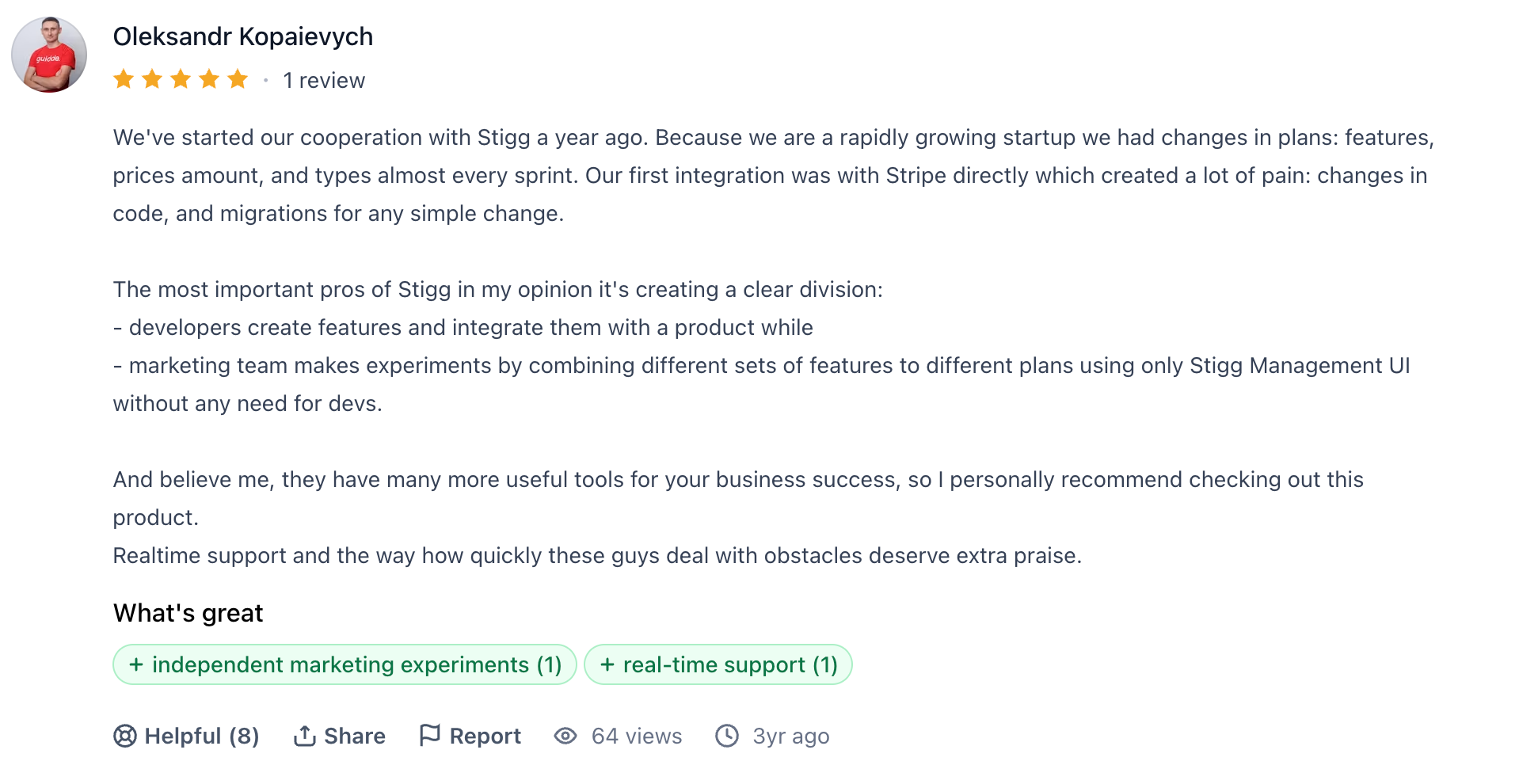
One user described how developers could concentrate on features while the commercial side adjusted packaging through Stigg's management UI without routing every change through engineering.
What users disliked:
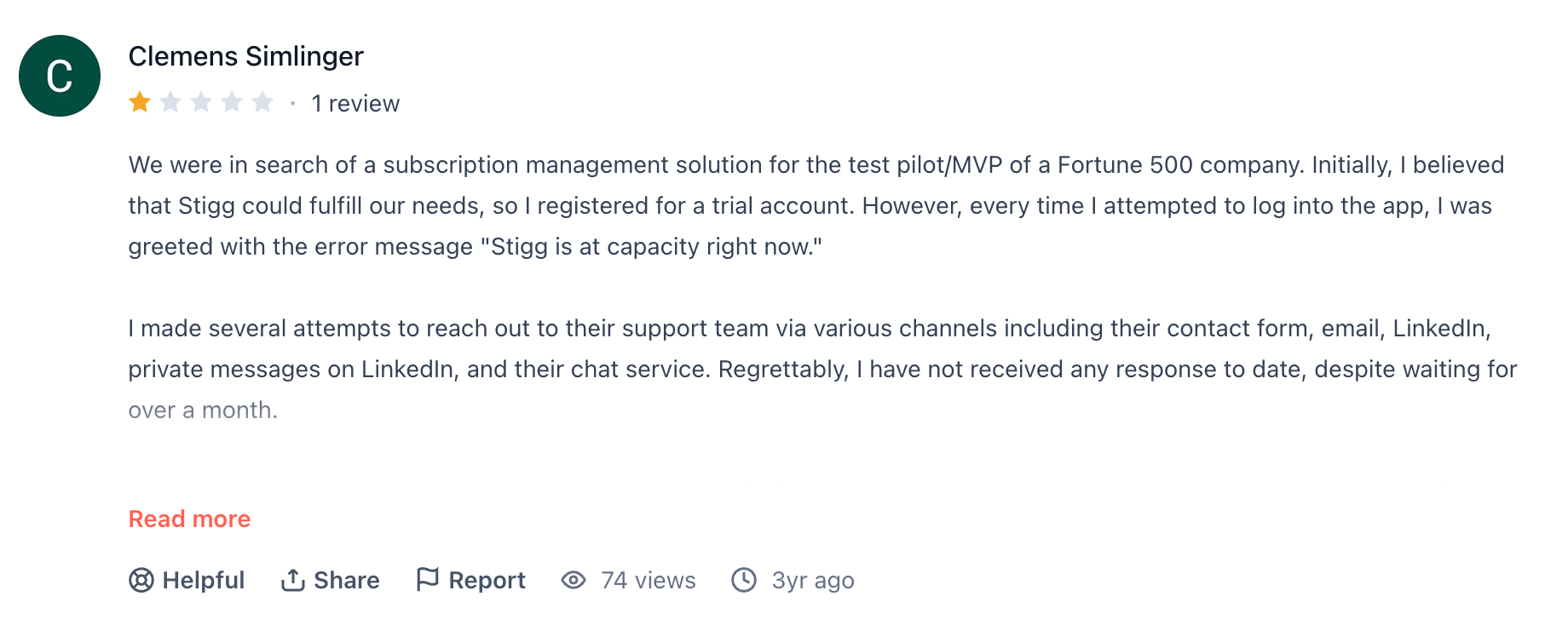
The negative signal is thinner. One older Product Hunt reviewer reported persistent login-capacity errors and poor support response. A G2 reviewer also found more complicated usage and feature pricing difficult to model at the time.
Those reviews are old enough that they shouldn't be treated as a reliable assessment of Stigg 2.0.
Flexprice has 5.0/5 from two Product Hunt reviews, and its G2 seller profile currently shows 4.8/5 from two reviews. That's far too small a sample for strong conclusions.
What users like:
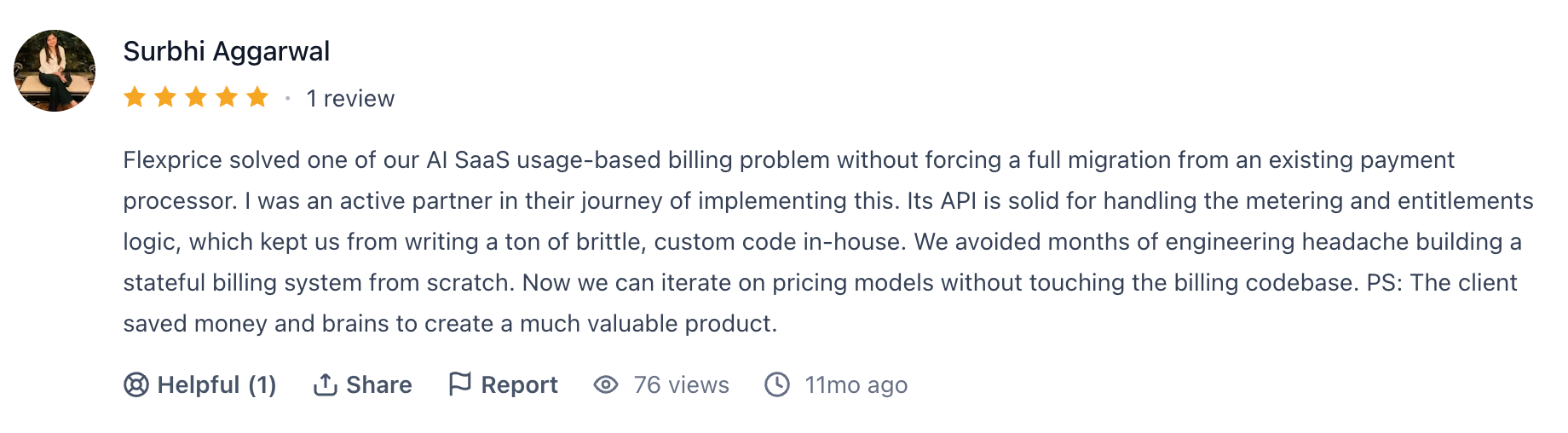
One Product Hunt reviewer specifically highlighted using Flexprice for metering and entitlement logic without migrating away from an existing payment processor.
What users disliked:
There isn't enough independent review volume yet to identify a recurring weakness with confidence.
For me, that lack of evidence is more useful to say plainly than inventing a “cons” narrative from two reviews.
The decision gets easier once you identify which state your application is struggling to own.
Stigg's sweet spot is where billing accuracy is already handled but commercial state is spreading through application services.
Flexprice is especially compelling when you're still designing the billing stack and would prefer one system to own more of that lifecycle.
Potentially, yes, but this would be an architecture decision rather than a documented native integration between the two.
Flexprice could own metering, rating, invoicing, and payment-facing workflows while Stigg owns request-time entitlement and credit decisions. Stigg explicitly supports DIY billing integrations alongside its named providers, which gives engineering room to connect another billing system when needed.
The first question would be ownership of usage state.
Running two independent credit ledgers or letting both systems become authoritative for the same allowance would create reconciliation work very quickly. A cleaner design would give one system authority over live credit and entitlement state, then synchronize the financial result downstream.
For many products, picking one platform for overlapping features will be simpler. Using both becomes more reasonable when billing and runtime governance have genuinely different requirements.
There isn't a universal winner in Stigg vs. Flexprice because the products put their engineering depth in different places.
Flexprice is stronger on billing breadth, with metering, credits, pricing, invoices, payment integrations, financial workflows, and an open-source deployment path in one platform.
Stigg is stronger on runtime usage infrastructure. Its advantage shows up when credits, limits, entitlements, tenancy, and spend governance need to resolve while a request is running, with dedicated caching, fallback behavior, and BYOC around that path.
Before choosing, map one real request through your stack. Mark where entitlements are resolved, where credits are debited, what happens on a cache miss, and which system owns the final financial record.
If the runtime side is where the complexity sits, see how Stigg handles that request path and compare it against the architecture you already have.
The main difference between Stigg and Flexprice is where each product puts most of its depth. Stigg centers on entitlements, credits, usage governance, and request-time enforcement, while Flexprice covers a broader billing flow across metering, pricing, credits, invoices, and payment integrations.
No. Stigg positions itself as a usage runtime, although it now includes invoicing capabilities. Its architecture is designed to work alongside existing billing and payment providers while Stigg manages credits, entitlements, usage limits, and enforcement.
Yes. Flexprice's core is open source under AGPLv3, and its main GitHub repository has several thousand stars, and the company also offers hosted plans and documents self-hosted deployments using Docker and AWS.
Yes. Flexprice supports plan-based entitlements, feature gating, and configurable usage limits. It also supports balance validation and real-time credit gating, although Stigg offers more specialized request-path infrastructure around entitlement caching and fallback behavior.
Stigg has the lower published paid starting price at $399/month for Pro, while Flexprice Build starts at $400/month (when billed annually).
Both offer free plans, but their limits and billing dimensions differ, which means the cheaper option at production volume depends on your entities, events, billing revenue, and required features.
%20(1).png)
.png)