Stigg vs Credyt AI: Credits & Usage Enforcement
Stigg vs Credyt AI explained for engineers comparing credits, entitlements, usage enforcement, wallets, deployment, and billing infrastructure.


.png)
Table of contents
A video-generation product can receive several expensive render requests against the same customer balance at once. If usage control reads stale state, more work can pass authorization than the customer can fund.
For Stigg vs Credyt, both products attack that hot-path problem. Stigg goes deeper on entitlements, credit governance, and local enforcement. Credyt puts the customer wallet at the center and extends further into real-time billing and cost observability.
Stigg vs Credyt AI: What’s the difference?
Stigg is a usage runtime for AI products. Entitlements, credits, usage limits, metering, and spend governance are enforced synchronously in the request path, alongside your existing billing stack.
Credyt is wallet-native billing infrastructure that authorizes usage against current balances, settles usage in real time, and tracks the underlying cost of AI workloads.
Choose Stigg if: your request can depend on plan rules, feature access, shared credits, usage limits, tenant hierarchy, or several sources of entitlement state.
Choose Credyt if: the wallet is your main control primitive and you want authorization, top-ups, real-time billing, and event-level cost tracking in one hosted system.
This is becoming a common architecture problem. Stripe found that 56% of AI company leaders use hybrid pricing and another 38% use pure usage-based pricing, both of which put more pressure on accurate usage state.
Meet Stigg: Features & highlights
Stigg is built around the decisions your product needs to make while usage is happening.
Stigg is the usage runtime for AI products. Entitlements, credits, usage limits, and spend governance are enforced synchronously in the request path.
Its five most relevant capabilities here are:
- Entitlements for Boolean access, configuration values, metered allowances, and credit-backed features
- AI credits with grant-level expiry, cost basis, categories, consumption priority, and auditable state
- Usage metering across customers, products, users, agents, and custom usage units
- Request-time enforcement for access, balances, and usage limits before more consumption runs
- Stigg Sidecar for synchronous checks backed by in-memory or Redis caching, Edge fallback, and configurable timeout
The Sidecar is the feature to pay attention to in this comparison. On a cache hit, entitlement state is returned immediately. A miss fetches from Stigg's Edge API at around 100ms, and the upstream timeout can be configured. Cached reads continue during Stigg API connectivity problems.
Stigg's current pricing page also lists 1M+ events/sec on BYOC, with BYOC, BYODB, and air-gapped deployment available on that tier.
Meet Credyt AI: Features & highlights
Credyt starts from a different primitive. Every customer gets a wallet, and each wallet can hold fiat or custom assets such as credits, tokens, GPU hours, or minutes.
Its five standout capabilities are:
- Real-time authorization against the customer's live wallet before an AI workload runs
- Multi-asset wallets covering fiat, credits, tokens, minutes, GPU hours, and custom units
- Credit grants with effective dates, expiry, purpose, cost basis, and configurable consumption order
- Profitability analytics connecting usage revenue with vendor costs by event, product, or customer
- Hosted billing portal for balances, usage history, top-ups, payment methods, and auto-recharge
Credyt authorizes the balance before the workload runs, then prices and debits the wallet in a single atomic operation after the response. Credyt's site illustrates the sequence as a single-digit-millisecond flow, though they don't publish a specific P95 or P99 figure.
Credyt runs cloud-only, with no self-hosted or BYOC deployment option published. Data residency options and region selection are not documented publicly.
Stigg vs Credyt AI: Quick comparison
The headline overlap is credits and real-time controls.
At a glance, both products cover credits and real-time usage control. The bigger difference is what each system is built around. Stigg starts with entitlement and governance state, while Credyt starts with the customer wallet.
Stigg vs Credyt AI: Feature-by-feature comparison
The table shows where the products overlap. The more useful differences appear once you follow credits, entitlement state, and authorization through a live request.
1. Credits and wallet architecture
Both products treat credits as stateful infrastructure with history and policy attached.
Stigg issues credits in blocks. Each grant can carry an expiry date, cost basis, paid or promotional category, and consumption priority.
Every movement lands in an append-only ledger, covering grants, consumption, expiry, refunds, and adjustments. That gives engineering a record of how the current balance was reached.
Burn order can follow commercial rules. Promotional credits can go first, while grants nearing expiry can take priority over longer-lived balances.
Depletion also feeds back into product behavior. Hard limits can stop consumption, while soft limits can allow controlled overage or trigger an upgrade path.
Credyt also works with discrete grants. Each can have effective and expiry dates, purpose, accounting treatment, cost information, and consumption priority.
Its wallet abstraction means a single customer can hold multiple assets at once, including USD and custom units, with a separate balance for each.
That makes Credyt a good fit when purchasing credits, holding funds, and consuming usage all belong in the same billing flow.
Winner: Stigg for credit governance. Credyt has the stronger wallet model, but Stigg goes further when credits need to interact with entitlements, limits, tenancy, and request-time product behavior.
2. Entitlements and feature control
This is where the comparison starts to separate. An entitlement is a commercial right to access or consume something based on what the customer bought.
RBAC answers questions such as “Is this user an admin?” An entitlement answers questions such as “Can this account use GPT-5?” or “How many concurrent jobs can this workspace run?”
Billing is separate again. It records the commercial transaction, while entitlement state tells the application what that purchase permits right now.
Stigg can resolve that state from several sources:
- Active plan
- Parent plan
- Add-ons
- Active trials
- Promotional overrides
- Additional product subscriptions
When several rules apply, Stigg resolves them into the effective entitlement before the application acts.
That result can include access status, limits, and current usage, giving the product enough context to block the request, allow controlled overage, or surface an upgrade.
Stigg supports Boolean, configuration, metered, and credit-backed entitlements. It also handles versioning, migrations, grandfathered plans, and entitlement lineage.
Credyt supports entitlements too, but its model stays closer to recurring wallet allocations.
A subscription can issue credits, refresh them on a schedule, expire or roll balances forward, and apply overage after the included allocation is consumed.
That fits a package such as $20/month with a recurring credit allowance and prepaid usage beyond it.
Stigg covers a wider set of runtime questions around what a customer can access, configure, and consume across the product.
Winner: Stigg. Credyt's entitlements model handles recurring wallet allocations well, but Stigg resolves entitlement state from more sources, like plans, add-ons, trials, promos, additional subscriptions, before the application decides.
3. Zero-latency usage enforcement
“Zero latency” is a marketing shorthand. In practice, both products optimize different hot paths, and neither makes every possible request literally latency-free.
Credyt publishes an authorization path under 50ms. Before the AI workload runs, the application checks the customer’s current balance and decides whether the request can proceed.
The sequence is clean:
Authorize → execute → price and debit
Credyt also documents atomic balance checks for concurrent requests and idempotent event processing, which protects retries from duplicate charges.
Stigg moves more of that decision close to the application through the Sidecar.
For a cache hit:
Request → Sidecar → cached state → decision
For a cache miss:
Request → Sidecar → Edge API → cache update → decision
On a cache hit, entitlement checks resolve immediately from local state. On a miss, the Sidecar reaches Stigg’s Edge API in around 100ms, with a configurable timeout.
The useful part is what happens when an upstream dependency has a bad day. Existing cached reads can continue if connectivity to Stigg drops. Redis can also preserve shared entitlement and usage state across Sidecar instances and container restarts.
That gives you local reads plus an explicit fallback path, which is valuable when the check sits directly in front of an expensive model or agent workload.
Winner: Stigg. Credyt’s hosted authorization path is fast, but Stigg gets the edge for request-path infrastructure because cached checks stay local and failure behavior is more configurable.
4. Billing and cost observability
This category plays much more to Credyt’s strengths. Its wallet can price usage, deduct balances, record transactions, and expose that information through a customer-facing billing experience.
The hosted portal covers:
- Current balances
- Usage history
- Manual top-ups
- Auto top-ups
- Payment methods
- Transaction history
Customers can also set auto-recharge thresholds for individual assets when using Credyt’s Stripe-powered payment flow.
The more interesting feature for AI products is event-level cost attribution.
Vendor costs can travel with usage and be tied back to a customer, event, or subject. Credyt then exposes that cost data across customers, products, and workloads.
Take a video-generation job. It might involve retrieval, several model calls, image generation, and a final render. Credyt can associate those underlying vendor costs with the same customer activity.
That gives engineers a clearer view of what a workload consumed and what the customer was charged for it.
Stigg focuses more heavily on control and governance. It supports invoicing and connects into the surrounding billing stack, while the runtime stays centered on entitlements, credits, limits, and usage state.
Winner: Credyt. Vendor-cost attribution per event, a hosted billing portal, and multi-asset wallets make Credyt the stronger fit when billing and cost observability sit in the same runtime as usage control.
5. Developer experience and deployment
Credyt has made AI-assisted integration a real part of the product. Its MCP server can manage products, pricing, customers, subscriptions, wallets, usage events, adjustments, vendors, and custom assets from supported coding environments.
Supported MCP clients include:
- Claude Code
- Cursor
- Codex
- Windsurf
- Gemini CLI
- GitHub Copilot
For direct application integration, Credyt documents TypeScript/Node.js, Python, and REST APIs.
Stigg exposes SDKs, API, MCP server, CLI, and the Sidecar, giving engineering more options for how runtime checks enter the application.
Deployment is where the difference becomes sharper.
Credyt is fully managed and cloud-hosted, while Stigg can run in the cloud or move the runtime into your own environment through BYOC. Its published BYOC tier supports more than 1M events/sec, with usage remaining on customer infrastructure.
The Sidecar can run beside the application in the same Kubernetes pod or network namespace. Redis can provide persistent shared cache state across instances.
That opens up more options for data residency, private networking, failure isolation, and high-volume traffic.
Winner: Stigg. Credyt has the more distinctive MCP workflow. Stigg, however, covers a broader set of runtime and deployment patterns, which becomes more useful once the usage layer is part of production infrastructure.
What real users are saying
Public review data is limited for both products, especially Credyt. Treat the comments as individual signals, not broad customer consensus.
Stigg
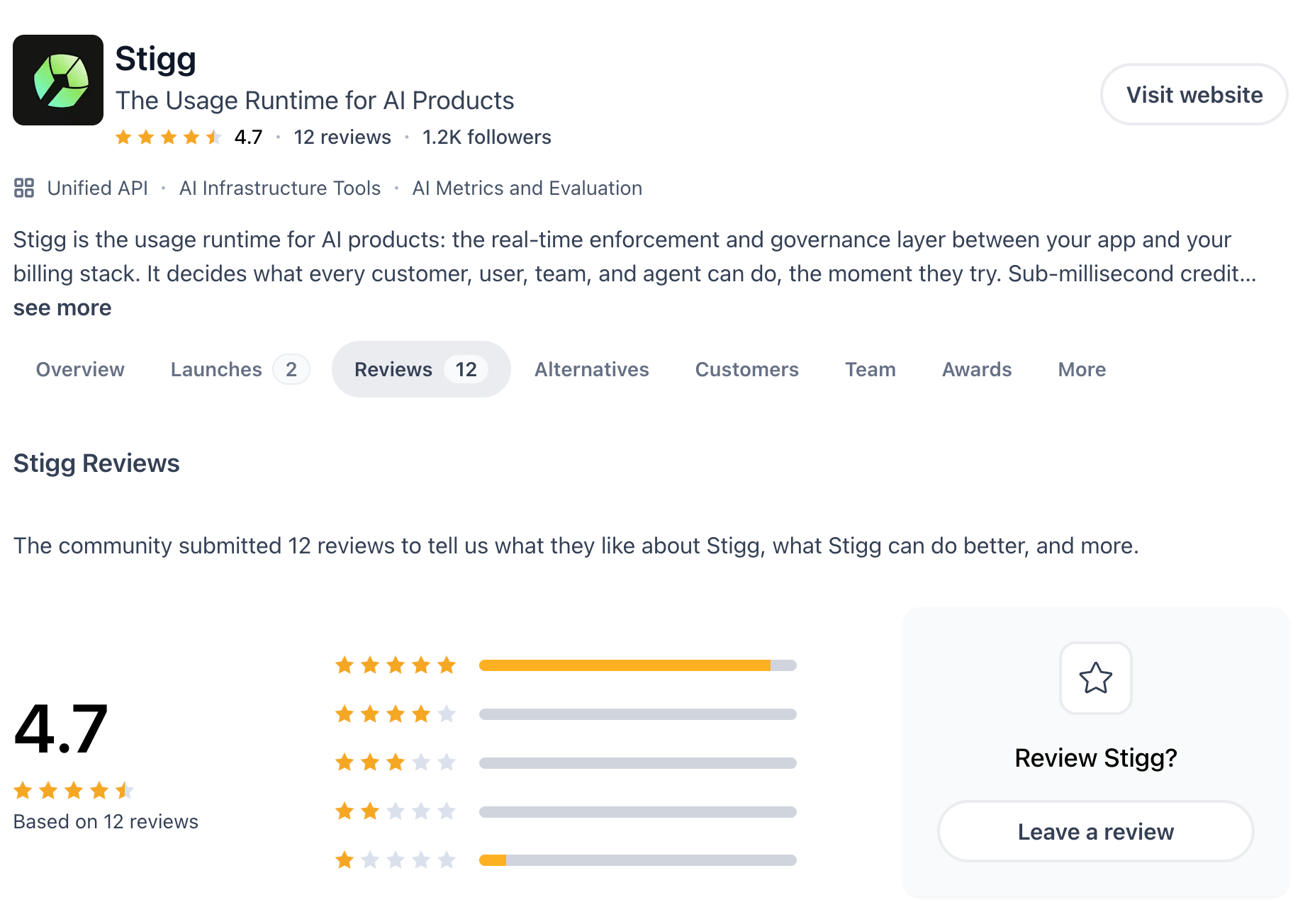
Stigg currently shows a 4.7/5 Product Hunt rating from around a dozen reviews. Much of that feedback predates the current Stigg 2.0 usage-runtime positioning.
Pros:
- Reviewers repeatedly mention flexible pricing and plan management.
- API and SDK quality comes up in several positive reviews.
- Users value reducing engineering work for routine packaging changes.
- Support receives positive mentions from several reviewers.
Cons:
- One older reviewer reported repeated capacity errors while trying to access a trial.
- The same reviewer said support did not respond despite several attempts.
The age of that complaint is relevant since it describes an earlier Stigg product and should not be treated as evidence of the current runtime's reliability.
Credyt
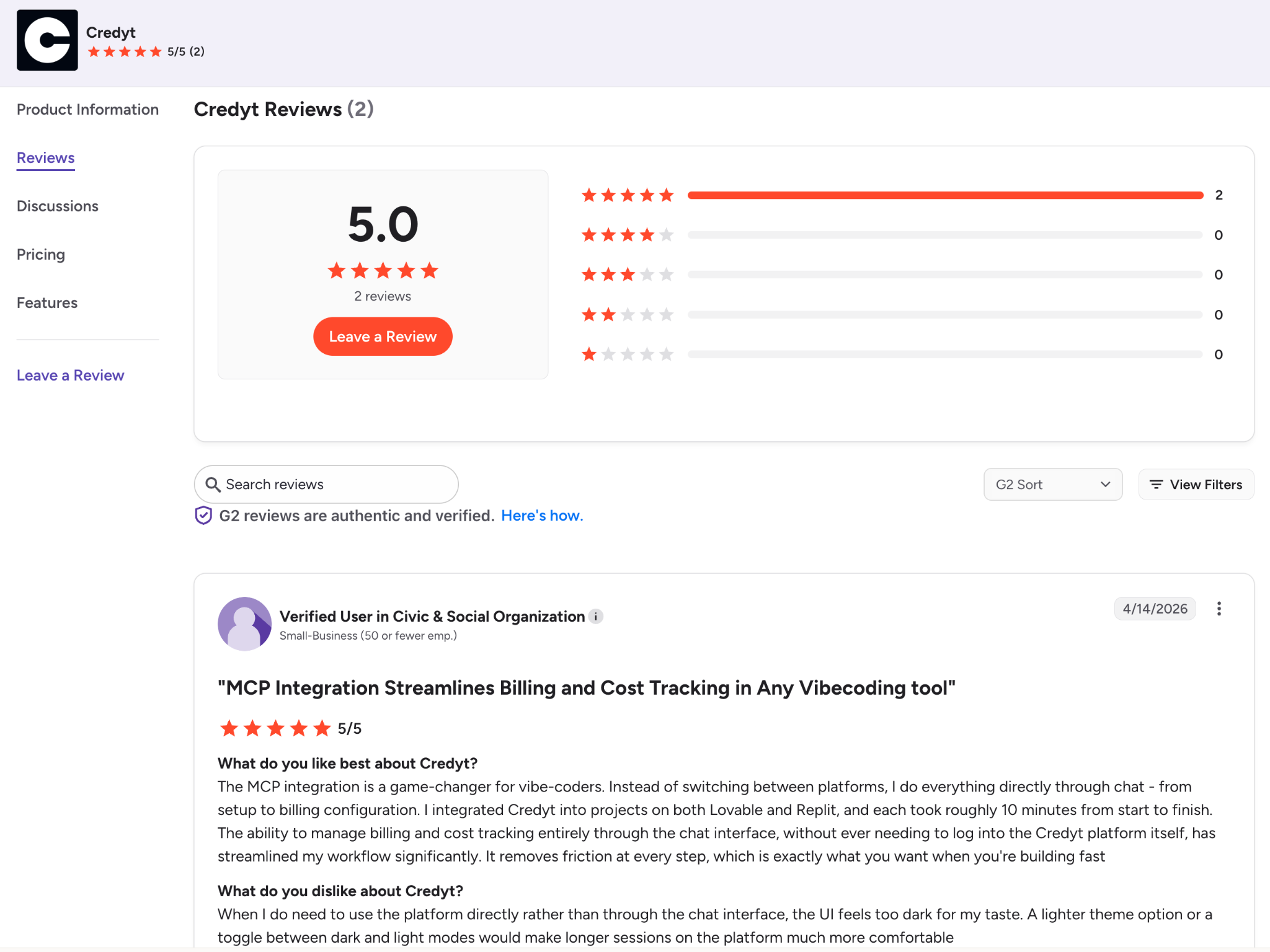
Credyt currently has a 5.0/5 rating on G2, though the review volume is still very small. G2 itself notes that there aren’t enough reviews yet to provide broader buying insights.
Pros:
- One reviewer, a vibe-coder, praised the MCP integration and said they integrated Credyt with Lovable and Replit in roughly 10 minutes each.
- A second reviewer, running an AI-assisted VFX pipeline, highlighted the drop-in customer portal, the honest $1/MAW pricing with no revenue percentage, and real-time authorization stopping expensive renders against empty wallets.
Cons:
- The reviewer found Credyt’s interface too dark for longer sessions and wanted a light-mode option.
- The second reviewer said the analytics dashboard is still maturing and per-client breakdowns by job type had to be pulled via API.
- More importantly, the review sample is still too small to identify recurring product weaknesses with confidence.
Credyt doesn’t have enough public reviews yet for a reliable consensus, though the available feedback is positive around integration speed, MCP support, and billing setup.
How to make your choice between Stigg and Credyt
A practical way to choose is to trace one expensive request through your stack.
If the authorization decision needs plan state, feature access, credits, limits, and tenant hierarchy, Stigg is the stronger fit. If the decision mostly depends on wallet balance and prepaid billing state, Credyt is cleaner.
Stigg is better for
Stigg fits products where commercial rules have become part of runtime infrastructure.
Its strengths include:
- Entitlements beyond balance checks
- Credits linked to plans and governance
- Shared allowances across several entity levels
- Local cached enforcement
- Known fallback behavior
- BYOC and BYODB
- Compatibility with an existing billing stack
You can also start small. Credits, metering, and entitlements can each be adopted on their own, and one SDK integration may be enough for the first use case.
That flexibility helps when only one part of your current infrastructure is causing pain.
Credyt AI is better for
Credyt is a better fit when a wallet already describes most of the commercial state you care about.
It covers:
- Wallet-based authorization
- Prepaid real-time billing
- Fiat and custom balances
- Customer billing UI
- Manual and automatic top-ups
- Vendor cost attribution
- Profitability reporting
- MCP-based configuration
Its production pricing also starts low. The first 10 active wallets are free, followed by $1 per active wallet per month, with 1 million monthly events included.
Verdict
In the Stigg vs Credyt AI comparison, Stigg wins for runtime control. The deciding factor is how much context the application can resolve before a request runs.
Stigg can combine credit state, feature access, usage limits, plan inheritance, overrides, tenancy, and current consumption in the same runtime decision.
The Sidecar strengthens that model. Cached checks stay inside your application environment, while cache misses have a defined Edge API path and upstream failures have explicit fallback behavior.
You can also adopt Stigg one component at a time (credits, entitlements, or metering) rather than the full runtime on day one.
Credyt takes the lead on wallet billing and cost observability. Its multi-asset wallets, top-ups, real-time settlement, hosted portal, and vendor-cost tracking make a lot of sense for prepaid AI products.
If authorization mainly comes down to whether the wallet can fund the next action, Credyt keeps the architecture focused.
Once the request needs to resolve who can use a feature, which allowance applies, what balance should burn, and which tenant owns the limit, Stigg gives the application much more context to work with.
What to look at next
The interesting question after this comparison is where you want usage state to live and which system should be authoritative for it. The Stigg documentation walks through the runtime architecture, including Sidecar deployment, entitlement resolution, credit state, fallbacks, and billing integration patterns.
FAQs
1. What is the main difference between Stigg and Credyt AI?
The main difference between Stigg and Credyt AI is the runtime state each product emphasizes.
Stigg combines entitlements, credits, limits, metering, and governance. Credyt centers the architecture on a customer wallet, with real-time authorization, billing, top-ups, and cost attribution.
2. Does Credyt AI support real-time usage enforcement?
Yes. Credyt can check a customer's live wallet balance before an AI action runs and block usage when the configured balance policy does not allow more consumption.
Credyt's site illustrates the sequence (authorize, deduct, and confirm) as a single-digit-millisecond flow, though the company doesn't publish a specific P95 or P99 latency figure.
3. Does Stigg really provide zero-latency enforcement?
Stigg's cached entitlement reads resolve immediately from local state. A cache miss reaches Stigg's Edge API, where typical latency is around 100ms.
The Sidecar also applies a configurable timeout and can continue using cached state during upstream connectivity problems.
4. Which has better AI credit management, Stigg or Credyt?
Stigg is stronger for credit governance tied to product access and usage rules. Credyt is stronger when credits function primarily as wallet balances for prepaid billing.
Both support grant-level expiry and consumption rules, but the surrounding state model differs.
5. Can Stigg and Credyt work with an existing billing stack?
Yes, Stigg and Credyt can both work with an existing billing stack, though they approach the surrounding stack differently.
Stigg is designed to sit between the product and billing infrastructure and integrates with providers such as Stripe, Zuora, and Chargebee on supported tiers. Credyt can use Stripe for payment flows and also supports hybrid arrangements around existing systems.