Industry Insights
Paying for Outcomes Is an Adjudication Problem
RFC v0.1: a vendor-neutral, research-backed proposal for pricing AI agents on outcomes, with a reference design and pre-registered predictions.

In April 2026, every major AI pricing plan broke at once. Here's why the real problem isn't pricing, it's that every AI company is unknowingly running a bank without a ledger, and what it takes to build one on purpose.


.jpg)
I gave this talk at the AI Engineer World's Fair last week. The room was fuller than I expected, which told me something before I said a word: this isn't a niche billing question anymore. A lot of the people there had felt some version of what I'm about to describe in the last few months, whether they run a five-person startup or a platform team at a company everyone's heard of. I want to walk through the argument here for anyone who wasn't in the room, because I don't think it's going away.
April 2026 was the month every AI pricing plan broke at once.
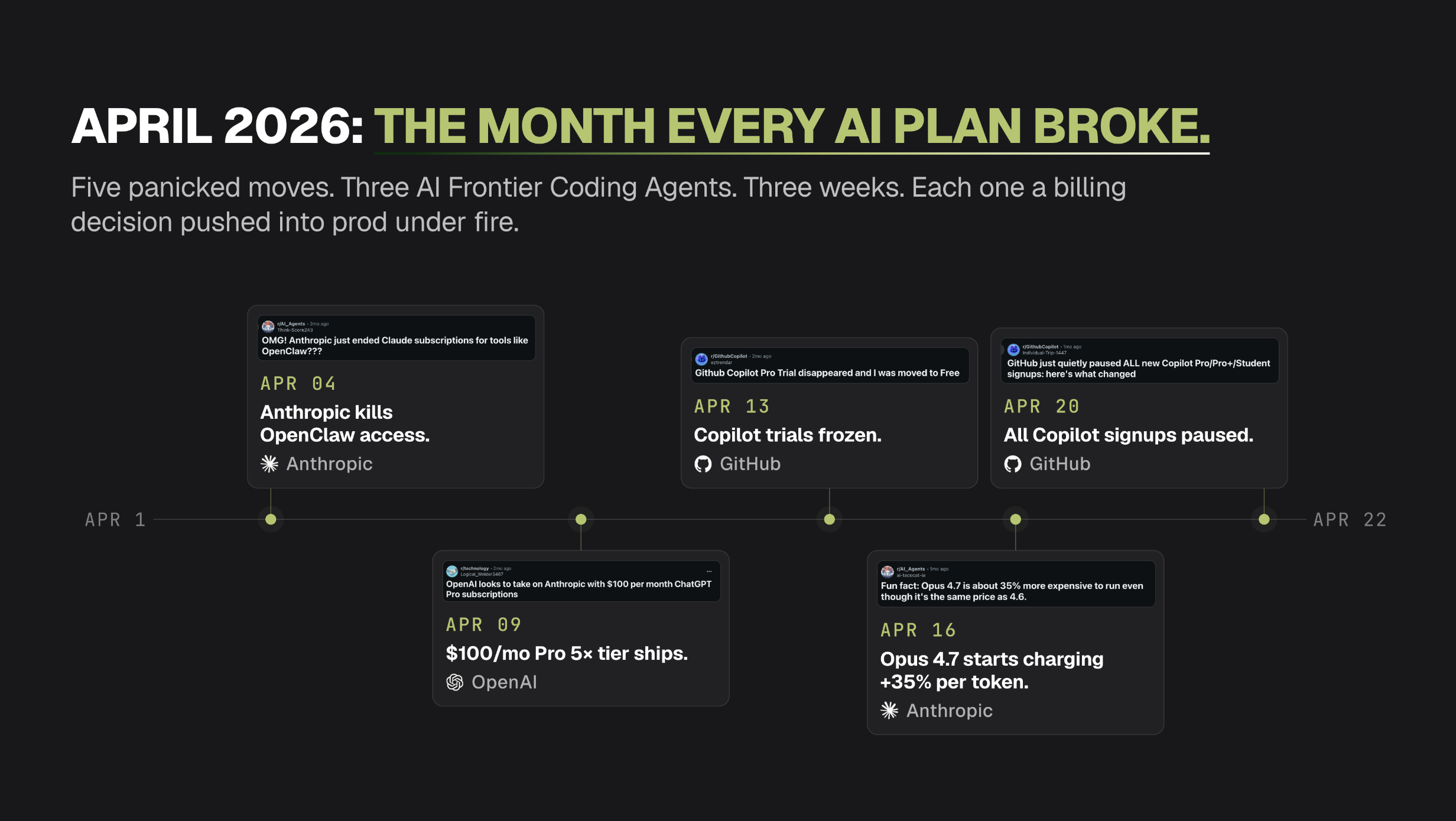
Four weeks. Three frontier labs. Five panicked, public moves, each one a billing decision, made under fire, pushed straight into production:
Apr 4: Anthropic cuts off OpenClaw's access.
Apr 9: OpenAI ships a $100/mo "Pro 5×" tier.
Apr 13: GitHub freezes Copilot trials.
Apr 16: Opus 4.7 starts charging 35% more per token.
Apr 20: GitHub pauses all Copilot signups.
None of these were product decisions. They were emergency financial patches. And if you squint, every one of them traces back to the same root cause: the company had no idea, in real time, what a request was actually going to cost them until the invoice showed up.
That's not a pricing problem. That's a bank without a ledger.
Here's the number that should worry every AI company, because it isn't unique to Anthropic, it's structural.
A Claude Max subscriber paid $200/month, flat. That's $6.67 a day. Routed through a third-party coding agent like OpenClaw, that same subscription could generate $1,000 to $5,000 a day in actual API cost.
That's a 150×–750× subsidy, per user, per day. Not because anyone did anything wrong, because the entitlement system couldn't tell the difference between a chat session and an 18-hour autonomous agent loop consuming tools in a while-loop. The plan was priced for a human. The traffic was a machine.
As Aakash Gupta put it: Anthropic was eating that difference on every user who routed through a third-party harness. Once inference is agentic, "unlimited" isn't a pricing tier. It's an unhedged liability.
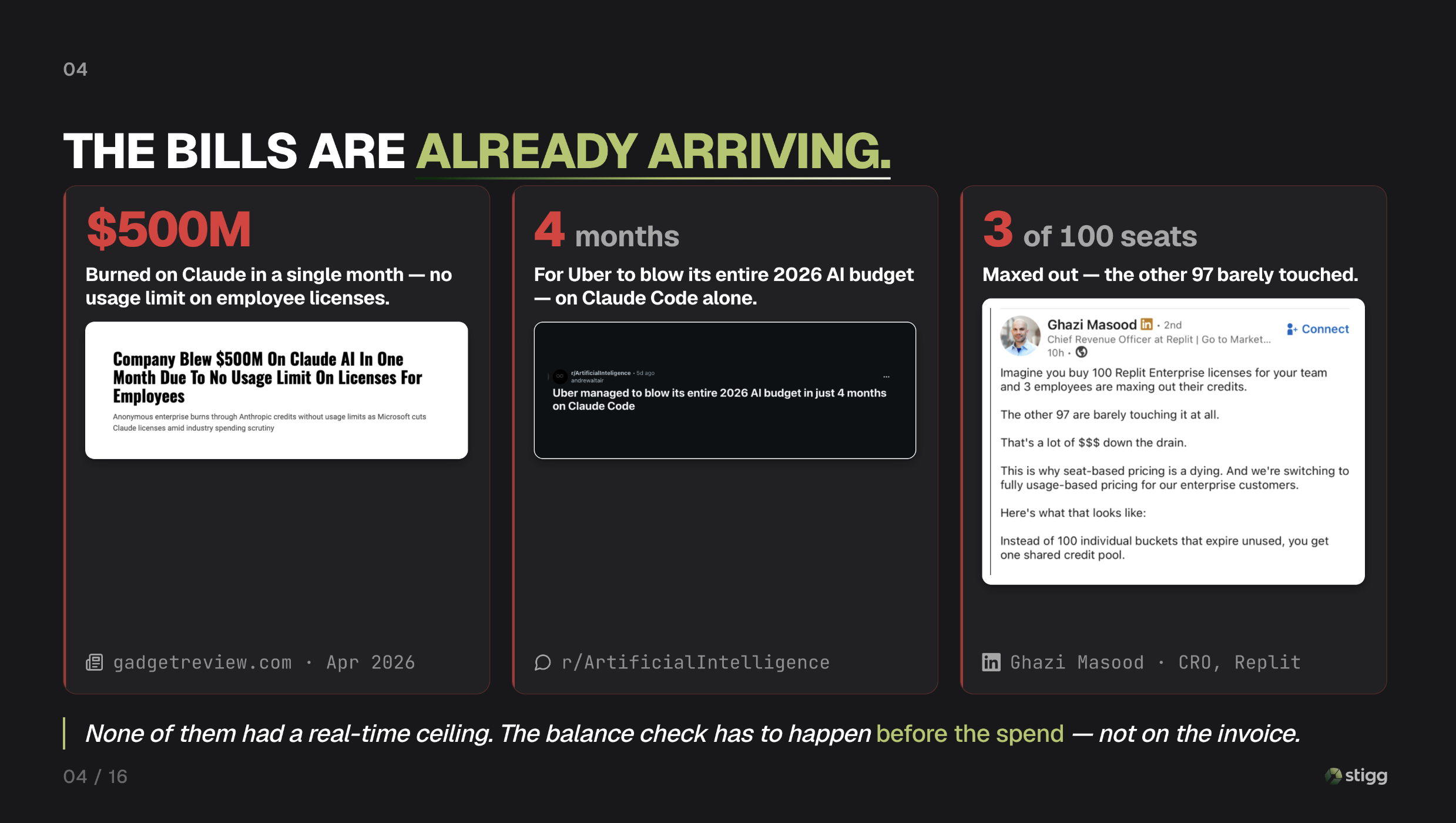
This isn't theoretical anymore:
Different companies, same failure mode: nobody had a real-time ceiling. The balance check happened on the invoice, weeks after the money was already gone. In a world of autonomous agents, checking your balance after the spend is like checking your parachute after you've landed.
Here's how most teams ship AI billing today:
request → inference → log usage → bill, later
That pipeline is async by design. It was built for SaaS seats, where usage is slow, human-paced, and forgiving. It assumes the worst case is a surprised customer at the end of the month. It was never built for a loop that can call a $5,000 tool a hundred times before anyone looks at a dashboard.
Financial engineering looks different:
request → ENFORCE (sync) → inference → settle (async)
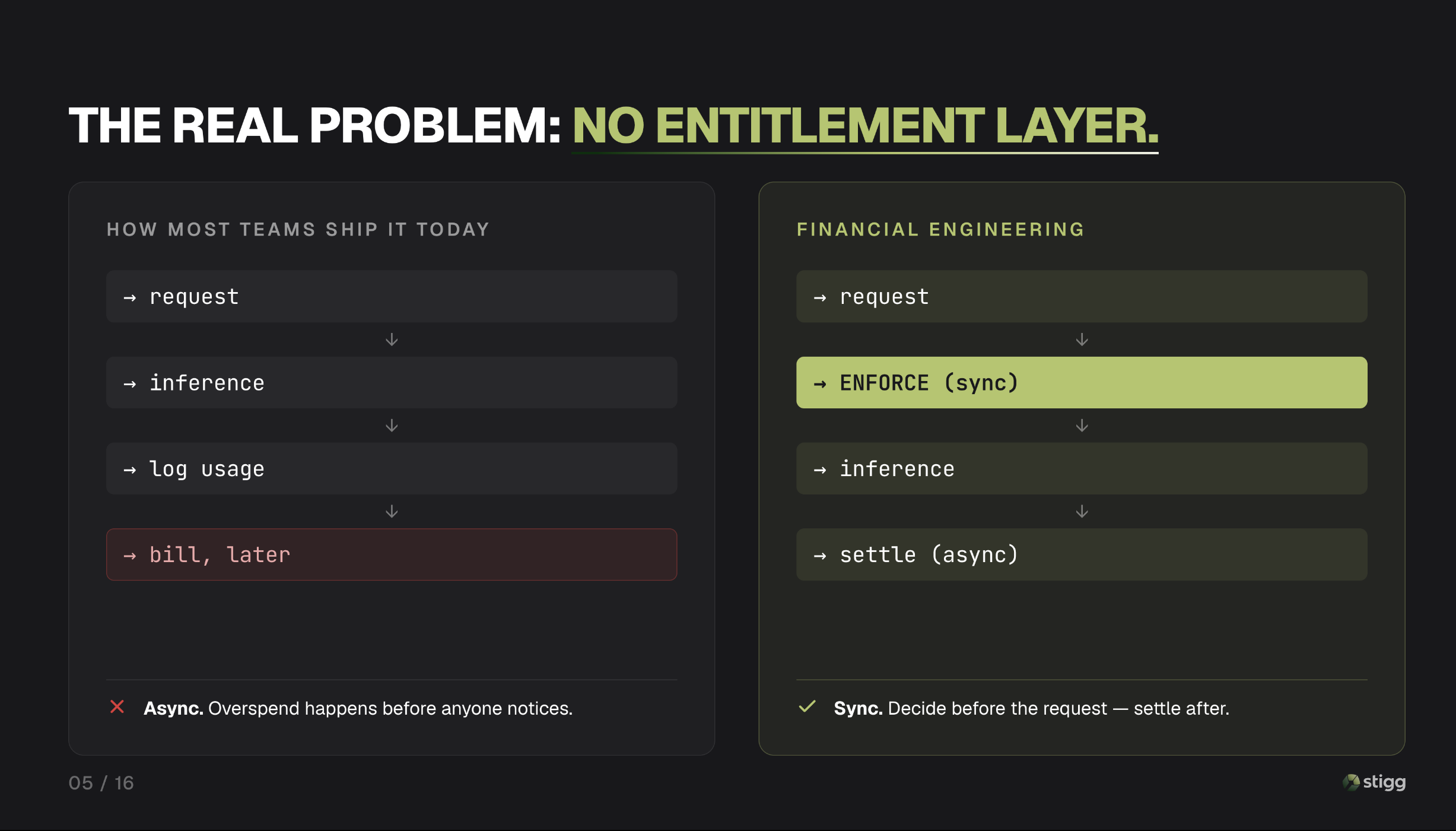
The difference is one word: enforce. You decide before the request whether it's allowed to happen, and only then let inference run. Settlement - the accounting, the reconciliation, the invoice - can stay async. It's the decision that has to be synchronous. Get that ordering backwards, and you don't have a pricing model. You have a subsidy program with extra steps.
OpenAI's own infrastructure writeup on this ("Beyond Rate Limits") reframes the question in a way I think every AI company should internalize:
Not: is this request allowed? But: how much is allowed, and from where?
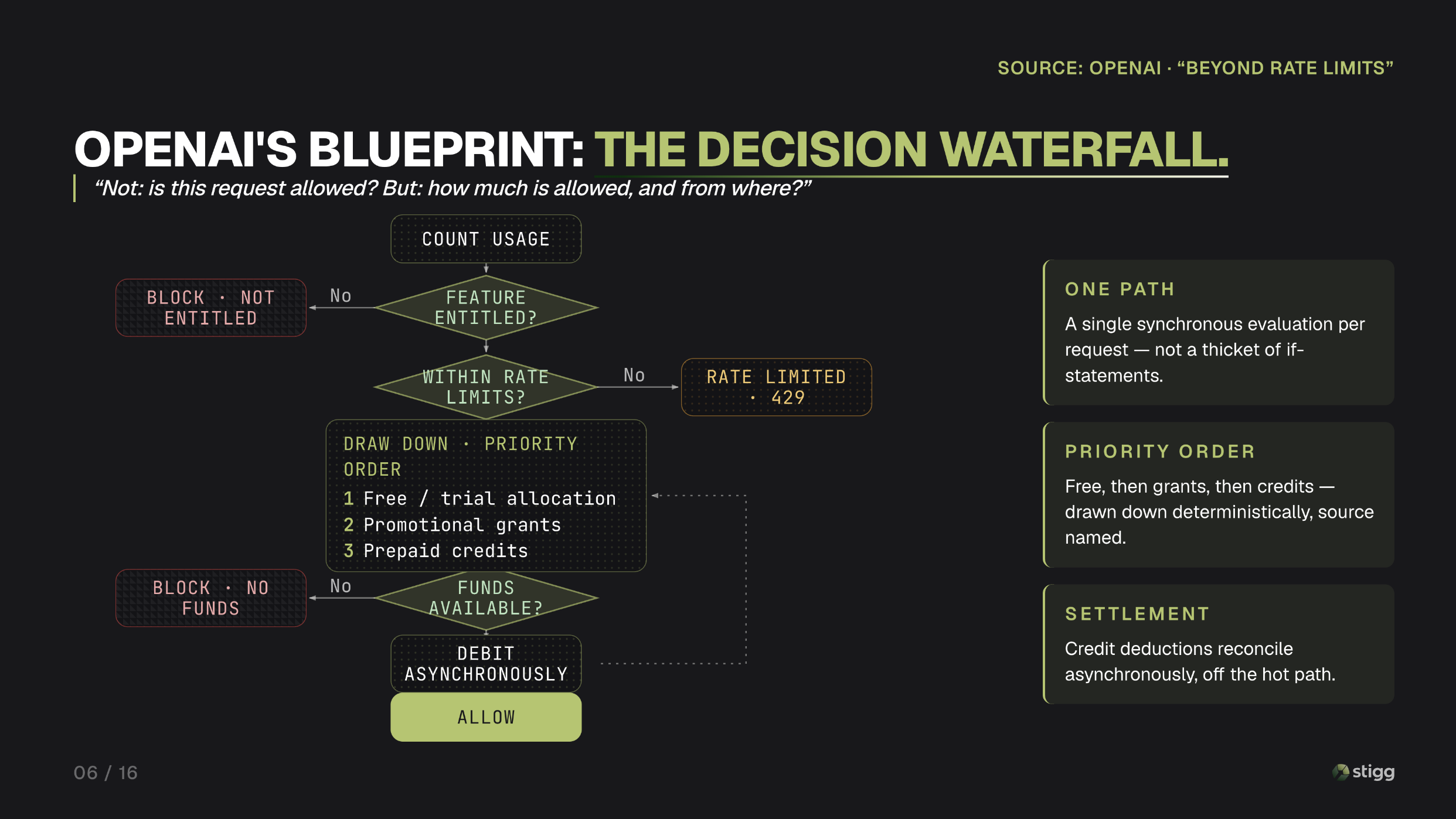
Concretely, that's a single synchronous evaluation per request, not a thicket of if-statements scattered across services:
Three things make this durable: it's one path (a single evaluation, not distributed logic drift), it has a deterministic priority order (so "which balance did this come from" is always answerable), and settlement is pushed off the hot path; credit deductions reconcile asynchronously, after the decision, not instead of it.
Here's the failure mode that keeps me up at night, and it has nothing to do with pricing tiers. It's a concurrency bug with a dollar sign on it.
Balance: $1.12. Three agents - A, B, C - each read the balance simultaneously. Each one sees $1.12. Each one independently concludes it can proceed. All three pass. You just 3×-overspent a dollar you didn't have, with no trace and no audit trail, because "check the balance" and "spend the balance" were two separate, unsynchronized operations.
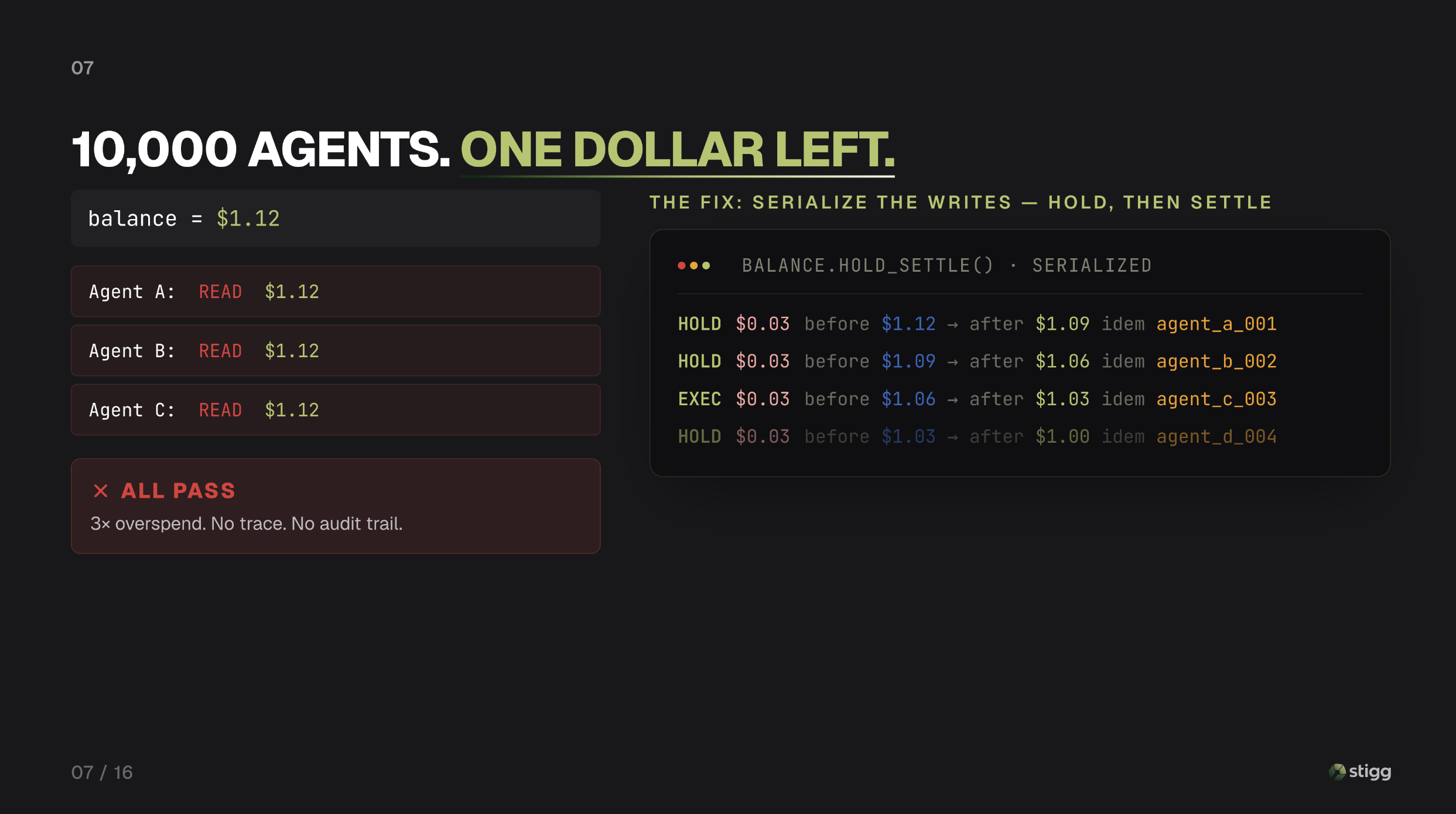
The fix is one most of us know from database systems and almost nobody applies to billing: serialize the writes. Hold, then settle. Each agent's request becomes an atomic, idempotent operation - balance.hold_settle() - with a before-balance, an after-balance, and an idempotency key tied to that specific agent's call. Agent A holds $0.03, balance drops to $1.09. Agent B holds against $1.09, not the stale $1.12. There is no read that isn't already accounting for every hold in flight ahead of it.
If your entitlement system can't answer "what's the ordered sequence of holds against this balance," it isn't a ledger. It's a shared variable with extra UI.
Once you take this seriously, "balance" stops being a scalar and starts looking like a portfolio: 500 monthly recurring credits expiring June 30, 200 promotional credits expiring September 30, 1,000 prepaid credits expiring in 2027. Same customer, same product, 1,700 credits across three blocks with three different expiry dates and three different costs of capital to you.
An API call costs 10 credits. Which block do you deduct from? FIFO? Soonest-to-expire? Lowest-cost-to-you first? Whatever the sales contract says? Each answer changes your revenue recognition, your margin, and your churn risk in a different way, and if you haven't chosen deliberately, your system has already chosen for you, probably the way that's worst for your gross margin.
Scale this up to an enterprise account and the gap gets existential. Acme Corp signs a $500K/year contract. Engineering gets a $200K allocation. The AI Platform team gets $50K of that. A single production agent, prod-agent-07, gets $500/week.
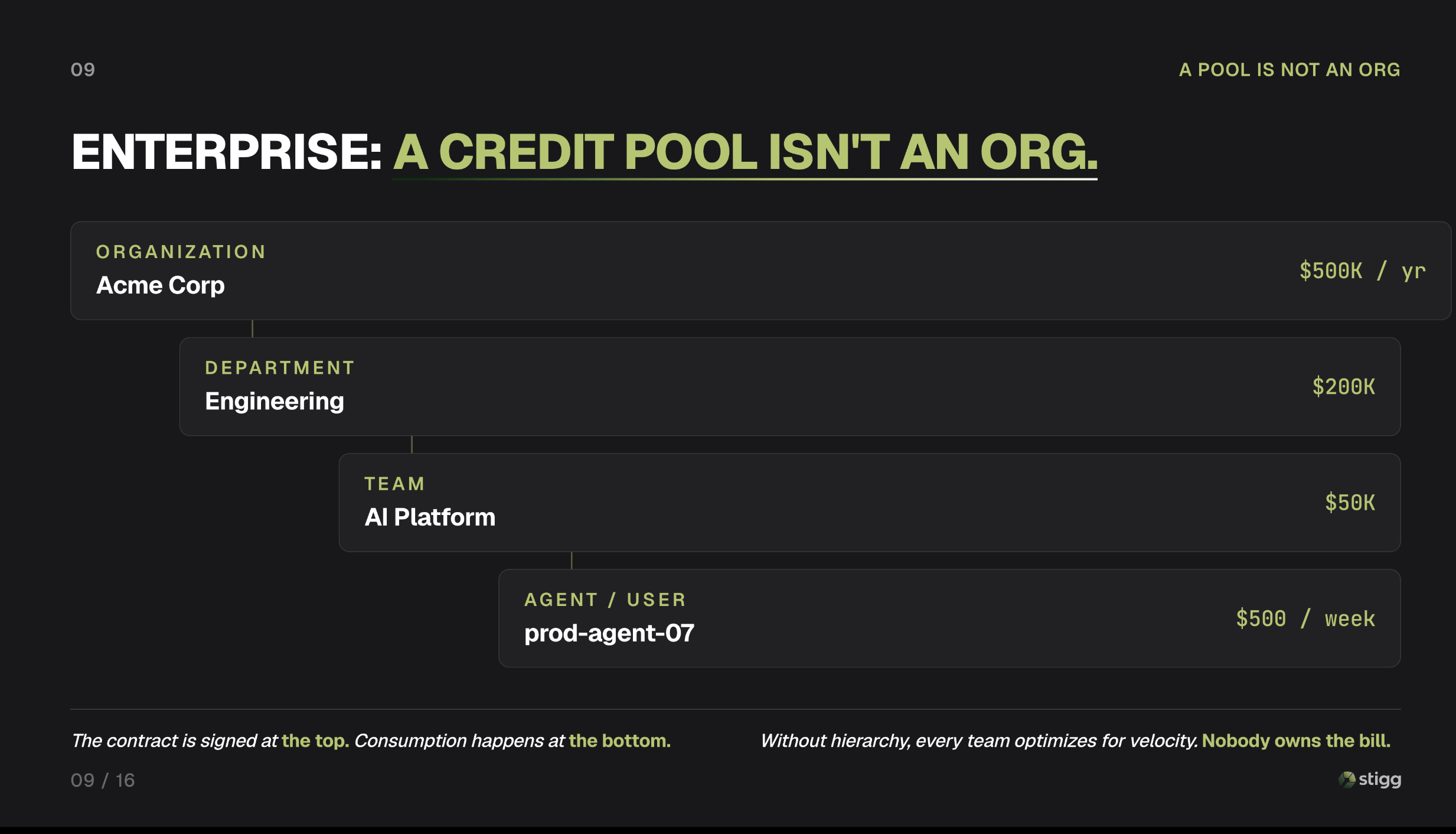
The contract is signed at the top. Consumption happens at the bottom. Without an enforced hierarchy connecting those two facts, every team optimizes locally for velocity, and nobody owns the bill. This is the same governance problem cloud infrastructure solved a decade ago with account hierarchies and budget alerts. AI usage is now facing it for the first time, at agent granularity, at machine speed.
Solving this for real means modeling every entity and every policy dimension as nodes in one graph, enforced at every request: Org (limits, budgets) → Team (quotas, roles) → User (seat caps, RBAC) → Agent (spend, runtime), cross-cut by policy nodes for feature entitlements, model cost basis, region/latency tier, and namespace isolation.
The bar for this isn't aspirational. It's operational: sub-10ms p99, over a million events per second, zero overspend, every node enforced on every request. That's not a batch job. That's infrastructure.
There's no single right architecture here, because there's no single right constraint. I'd group what's working into four patterns:
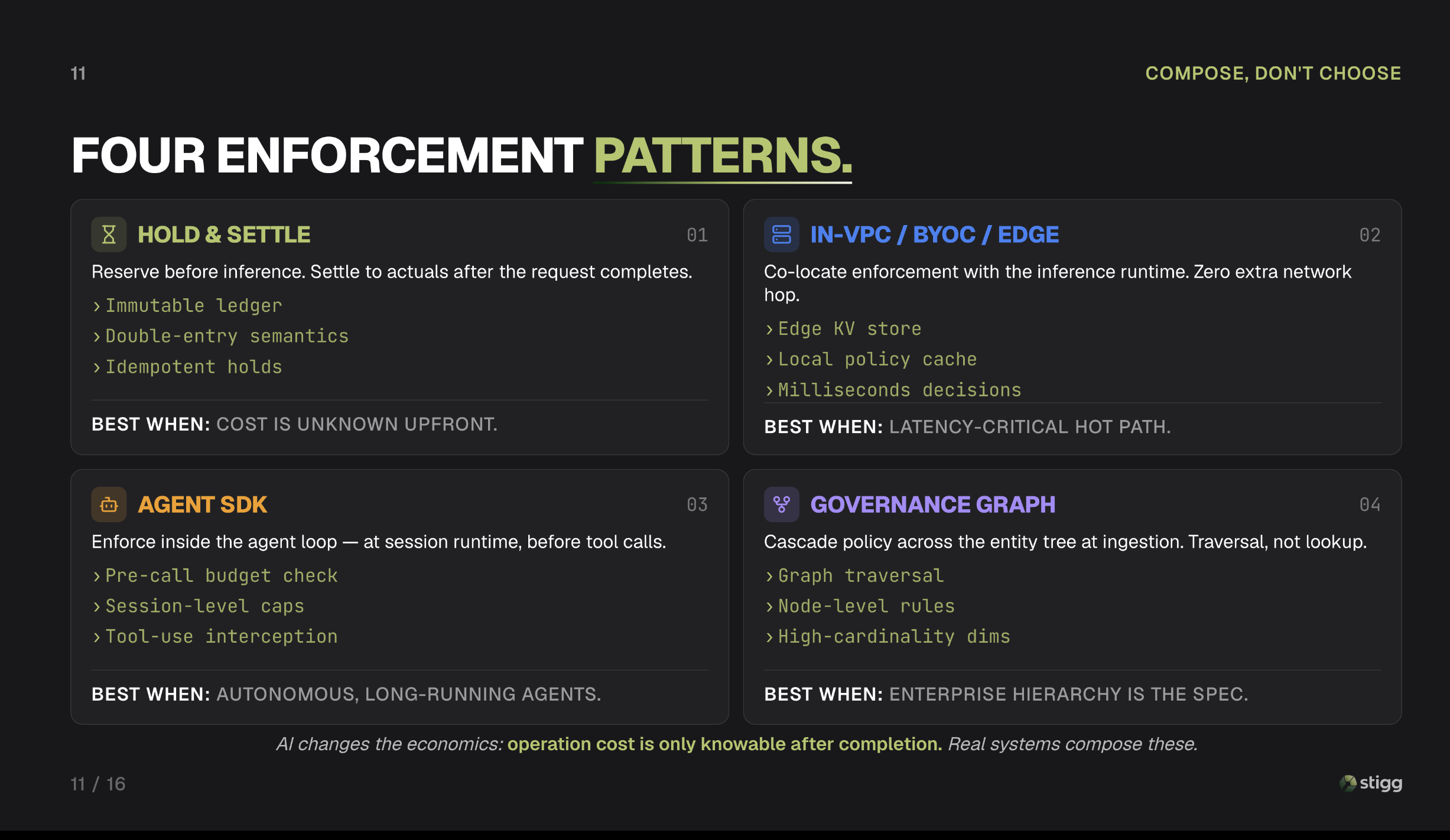
The underlying truth AI forces on all of them: operation cost is only knowable after completion. You can't perfectly price a tool call before it runs any more than a bank can perfectly price a loan before it's repaid. Real systems don't pick one pattern. They compose several, matched to where the risk actually lives.
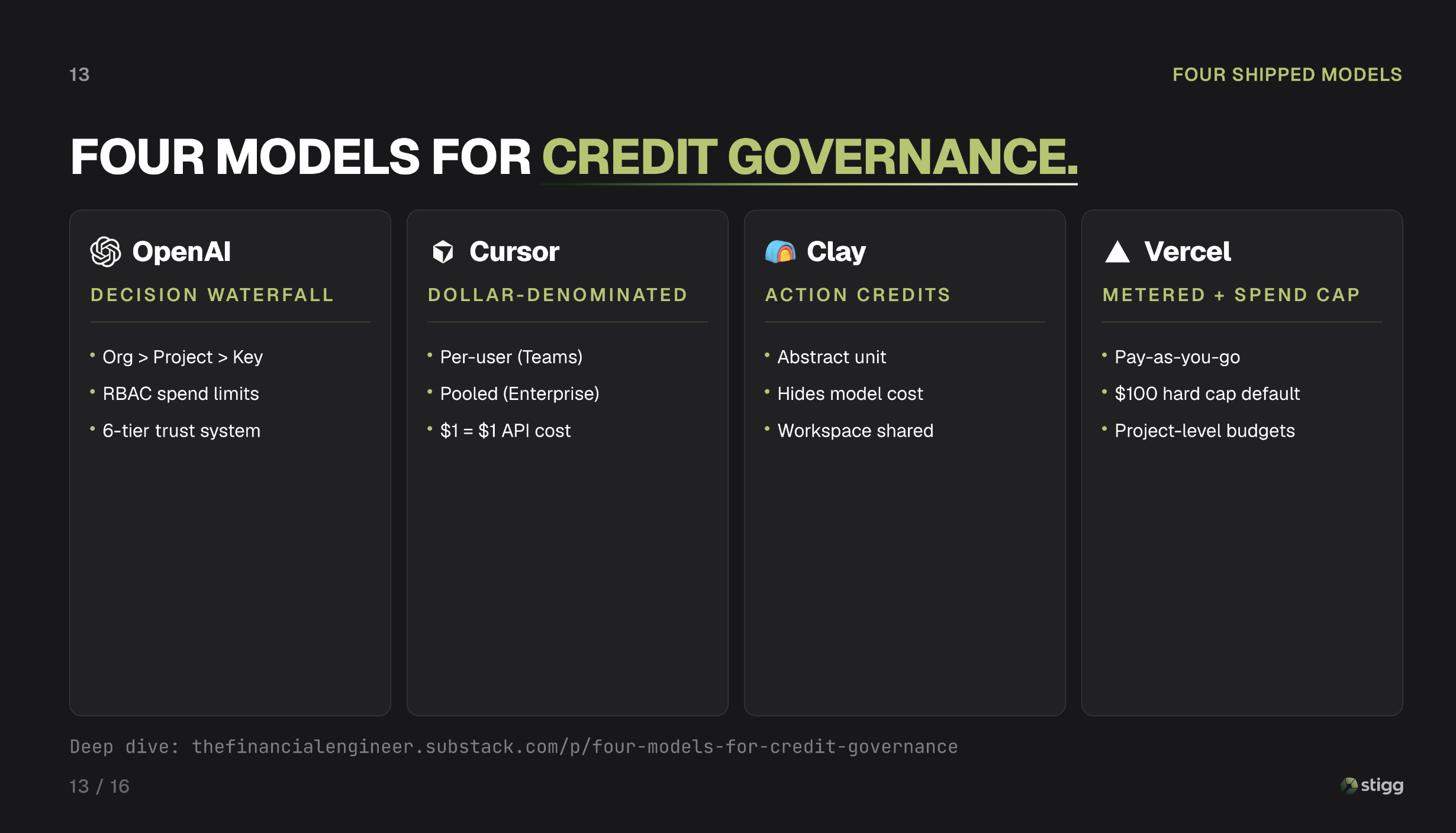
Look at what's already in production and a taxonomy falls out:
Four different philosophies, and every one of them is a legitimate answer to the same question: how transparent do you want your unit economics to be to the customer, versus how much optionality do you want to keep for yourself? There's no universally correct point on that spectrum. There's only the point that matches your margin structure and your customer's tolerance for surprise.
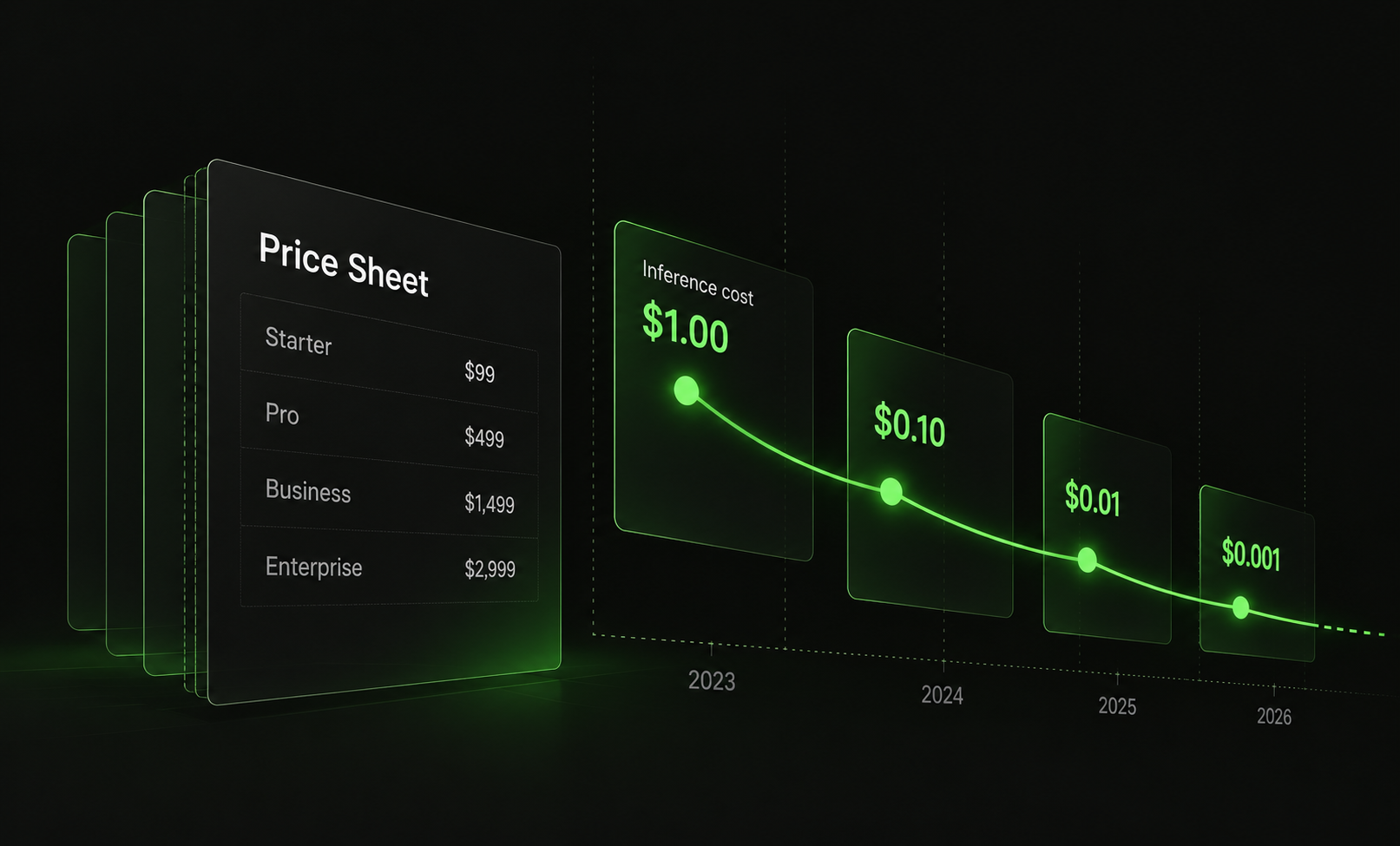
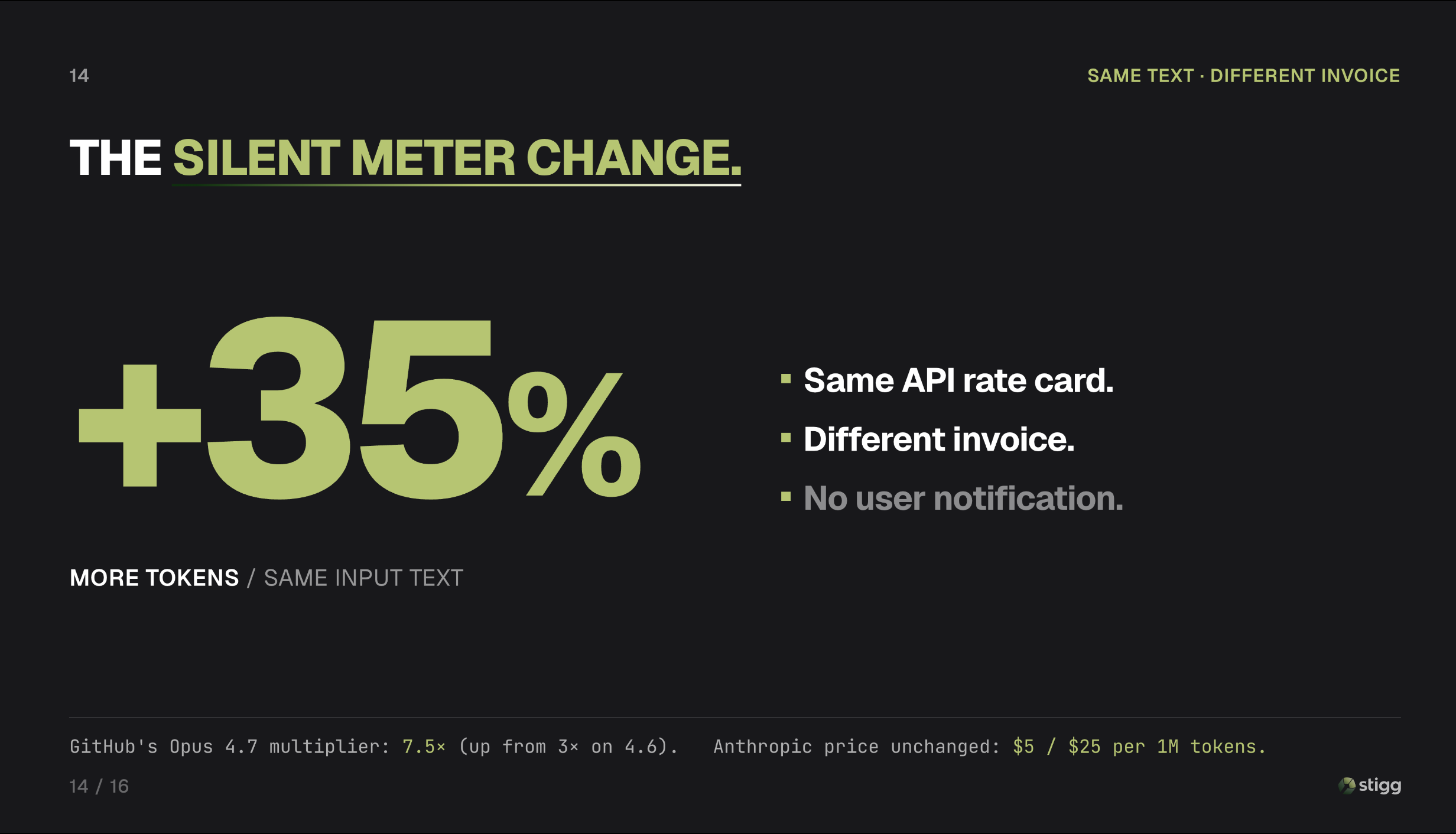
And then there's the failure mode that ties back to April: the silent meter change. GitHub's Opus 4.7 multiplier moved from 3× to 7.5×. 35% more tokens consumed for the same input text, on an unchanged $5/$25-per-million-token rate card, with no user notification. Same price sheet. Different invoice. If your customers can't audit why their bill moved, you haven't built a pricing model. You've built a rumor.
Every layer of this stack - entitlements, metering, enforcement, settlement - currently exists as a bespoke, internal, half-built system inside every AI company shipping agentic products. That's exactly the shape of the problem Stripe solved for payments fifteen years ago: not "should this exist," but "why is everyone rebuilding it badly, alone."
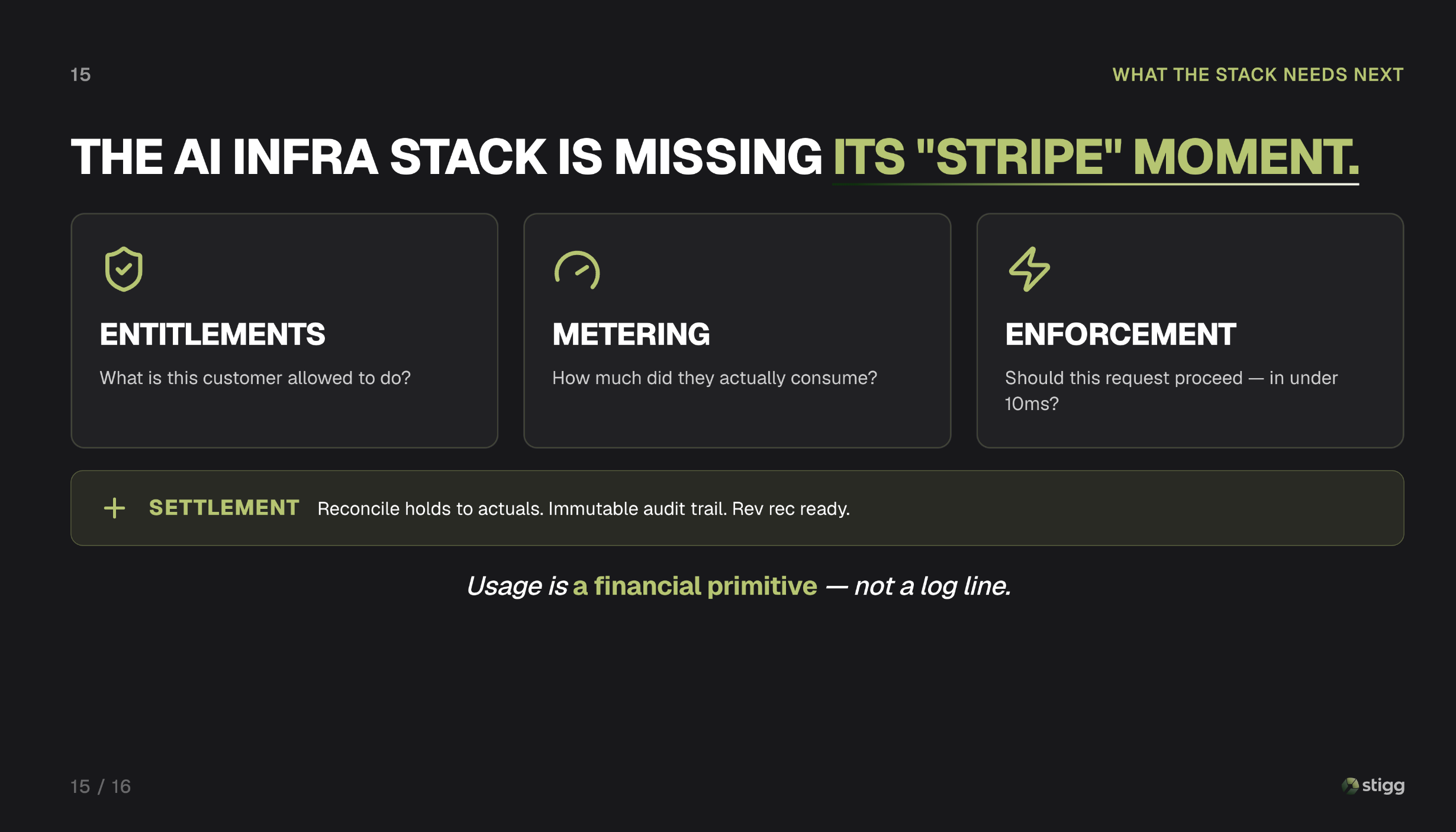
Four questions, one system:
The mental model shift underneath all of it is the one thing I'd want every AI builder to take from this: usage is a financial primitive. It is not a log line. A log line is something you inspect after the fact to understand what happened. A financial primitive is something you can hold, settle, reconcile, and audit. Something a finance team can close the books on and a customer can trust the invoice for.
Every AI company shipping agents is already running a bank: issuing credit, extending balances, absorbing risk on behalf of users who can spend faster than any human ever could. The only choice left is whether you build that bank on purpose, with a real ledger, real-time enforcement, and an auditable settlement layer, or whether you find out you're running one the way Anthropic did in April: publicly, expensively, and one panicked policy change at a time.
The infrastructure to do this on purpose already exists. We're building it at Stigg. If you want to see it - a live entitlement and credit engine, hold-and-settle in production, the governance graph enforced at request time - try it for free or talk to someone from our team.