.png)
Product Updates
The Contract Is the Source of Truth
Entitlements provisioned, usage metered, customers invoiced. Received.ai is now part of Stigg, and enterprise billing runs on one platform.

Deepening our capabilities with granular event dimensions, isolated credit pools, and advanced time-series filtering to give you complete control over your credit-based pricing.


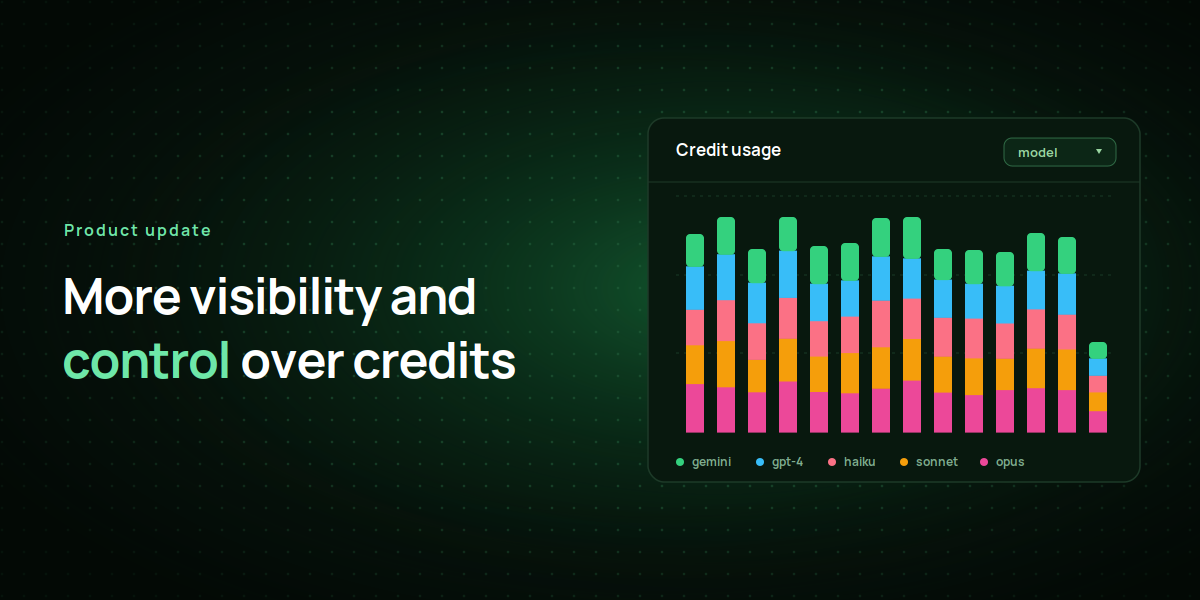
Credit-based pricing has become the infrastructure standard for modern software, especially in the AI and API economies, requiring the same precision, safety, and auditability as financial transactions. To give teams complete control over their pricing infrastructure, Stigg has overhauled its credit engine with three core updates. First, Credit Usage Breakdown by Event Dimensions opens the black box of consumption, allowing customers to see exactly where credits are going by filtering dimensions like User ID, LLM model, or feature. Second, Resource-Specific Credit Pools support complex product architectures by letting teams isolate credits and assign independent budgets to specific resources or projects. Finally, Credit Usage Date Filters introduce advanced time-series filtering to help teams analyze trends, spot anomalies, and troubleshoot usage spikes. Serving as a real-time Usage Runtime, Stigg delivers real-time credit balances, prevents overdrafts, and provides absolute financial control at any scale.
Credit-based pricing has quickly evolved into the infrastructure standard for modern software, especially in the AI and API economies. Because credits function as an internal currency within your application, they require the same level of precision, safety, and auditability as any financial transaction.
As teams launch and iterate on credit models, managing this financial resource requires increasingly granular visibility.
No matter your size or scale, tracking credit balances is just the foundation. To truly manage usage behavior, you don't just need to know how many credits are left in an account. You need the ability to easily break down that consumption, keep different environments or teams within their shared allocated budgets, and troubleshoot usage anomalies.
To give you complete control over your pricing infrastructure, we’ve overhauled the Stigg credit engine - deepening our existing capabilities with granular event dimensions, isolated credit pools, and advanced time-series filtering.
Up until now, credit consumption visibility was limited and often lacked the granularity needed to understand exactly what was driving usage. If a customer's credit balance suddenly dropped to zero, they had no clear way to figure out why. This leads to a very common, frustrating pain point: a single automated script, an AI agent, or an individual user runs a heavy job and burns through the entire company's credit pool, leaving the rest of the team without access.
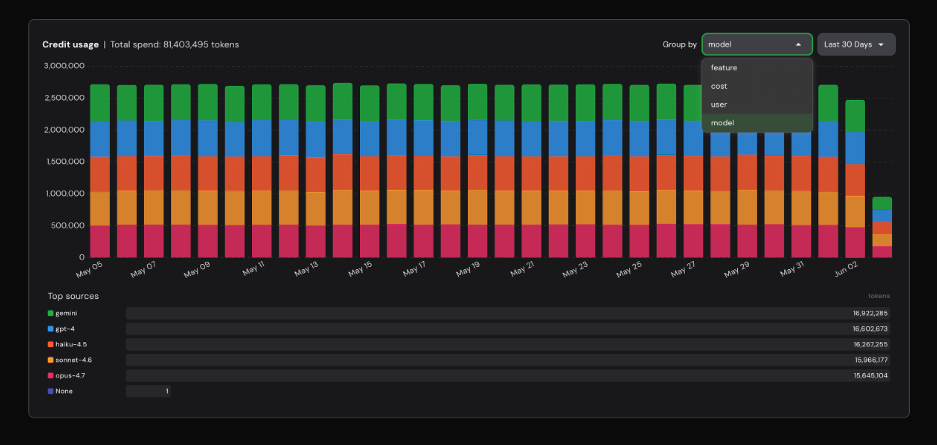
With our new update, you can finally open the black box and break down credit consumption by the specific dimensions of the events sent to Stigg.
Instead of guessing, your customers can filter and visualize exactly how credits are being used based on the reported usage events of the action itself. For example, they can track usage by:
Stigg provides visibility for any dimension that’s included in reported usage events. This means that customers have the flexibility to decide how to slide-and-dice their data. As long as they report this dimension to Stigg, they can break down usage according to it.
Identifying what spent the credits is only the first step. To align monetization with actual product usage, you need a system that supports complex, multi-instance product architectures where customers might pay for resources separately.
To make this seamless, we are introducing Resource-Specific Credit Pools.
Stigg now allows you to create and manage dedicated credit pools that mirror exactly how you sell your products. Instead of forcing all usage into a single, global bucket, you can isolate credits and assign them directly to specific resources - whether that represents an individual website, a workspace, a region, or a project.
With this update, you can provision resource-dedicated subscriptions (such as creating a separate subscription for each individual seat) and grant relevant credit budgets to each instance. Because these pools operate independently, you can manage and enforce each resource's credits separately, ensuring that usage on one instance or seat never overflows into another.
This brings complete flexibility to your monetization engine, allowing you to easily model complex team plans and multi-tenant structures exactly the way your product is built.
Understanding what triggered a credit drop is crucial, but you also need to see when and how usage trends develop over time. Historical context is what turns raw usage data into predictable planning, adding another layer of visibility and control to your credit infrastructure.
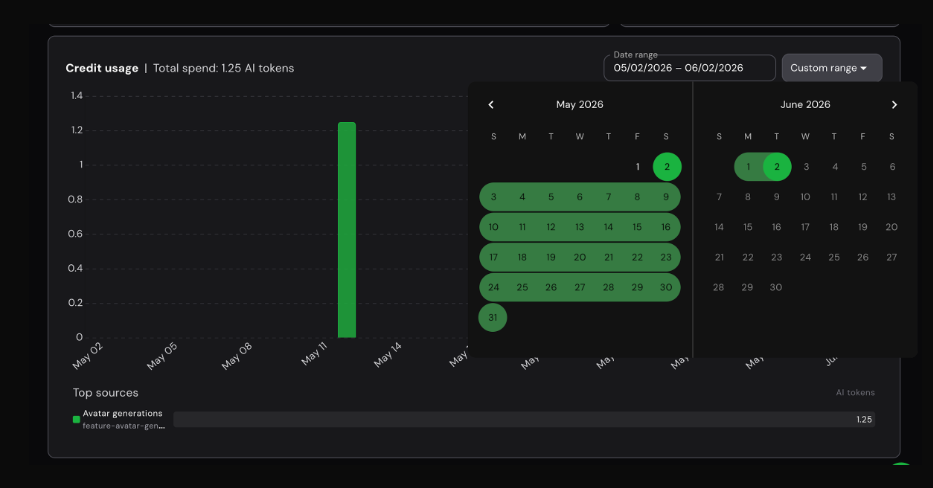
Previously, analyzing credit consumption through the UI or API was limited to fixed presets (e.g. last month, week, year). To give you and your customers additional flexibility, we are introducing Credit Usage Date Filters.
You can now apply flexible, precise date and time filters to investigate credit history. This allows your customers to select custom windows of time, compare usage between different quarters, or zoom in on a specific day to troubleshoot a consumption spike.
With these filters, teams can slice and cut specific time frames, spot anomalies, and debug consumption behavior in seconds.
These updates are not just cosmetic improvements to a billing dashboard. They represent a fundamental shift in how Stigg handles usage data.
As we look forward, our core mission is to serve as a real-time Usage Runtime. In a world where automated AI agents and complex enterprise systems can consume thousands of dollars in infrastructure costs within seconds, you need synchronous, real-time access decisions and absolute financial control.
By delivering real-time credit balances, preventing overdrafts before they happen, and providing control and visibility, Stigg gives you the infrastructure to support any monetization model, at any scale, safely.
The new Credit Usage, Filtering and Resource-Specific Pools are now fully available in your Stigg workspace and via our API.
Ready to bring more visibility and control to your credit-based pricing? Get started now

.png)